
“GEO tools” isn’t one category. It covers three distinct product types solving different jobs: AI visibility trackers that measure brand citations across ChatGPT, Perplexity and Google AI Overviews over time; content-optimisation platforms that help write and structure pages before publishing; and page-level checkers that audit a single page’s GEO readiness. This article covers all three, clearly separated.
Why “GEO Tools” Means Three Different Things
Search for “best GEO tools” and most roundups return a mixed list: a brand-visibility dashboard next to a content editor next to a page checker, with no explanation of how they differ. That’s not wrong, exactly, but it hides a real structural split in what these products actually do.
Three genuinely distinct categories exist in this market:
- AI visibility and citation trackers monitor whether, how often and in what context a brand gets mentioned or cited across AI platforms, on an ongoing basis, after content is already live.
- AI content-optimisation platforms help write, structure and score content before or while it’s being published, aimed at making it more likely to rank and be cited.
- Page-level GEO checkers audit one specific page’s readiness signals (structured data, crawlability, clarity, entity naming) at a single point in time, similar to a technical SEO audit but scoped to generative-engine readiness.
Most comparison articles cover two of these three and treat the coverage as complete. This one covers all three, because a reader who only sees one category can end up buying a visibility tracker when what they actually needed was a page checker, or the reverse.
For the underlying mechanics of what generative engine optimisation actually involves, see how generative engine optimisation works. This article is about which real tools do the work, not what GEO means as a discipline.
Which Type of Tool Do You Actually Need?
Match the job, not the marketing label.
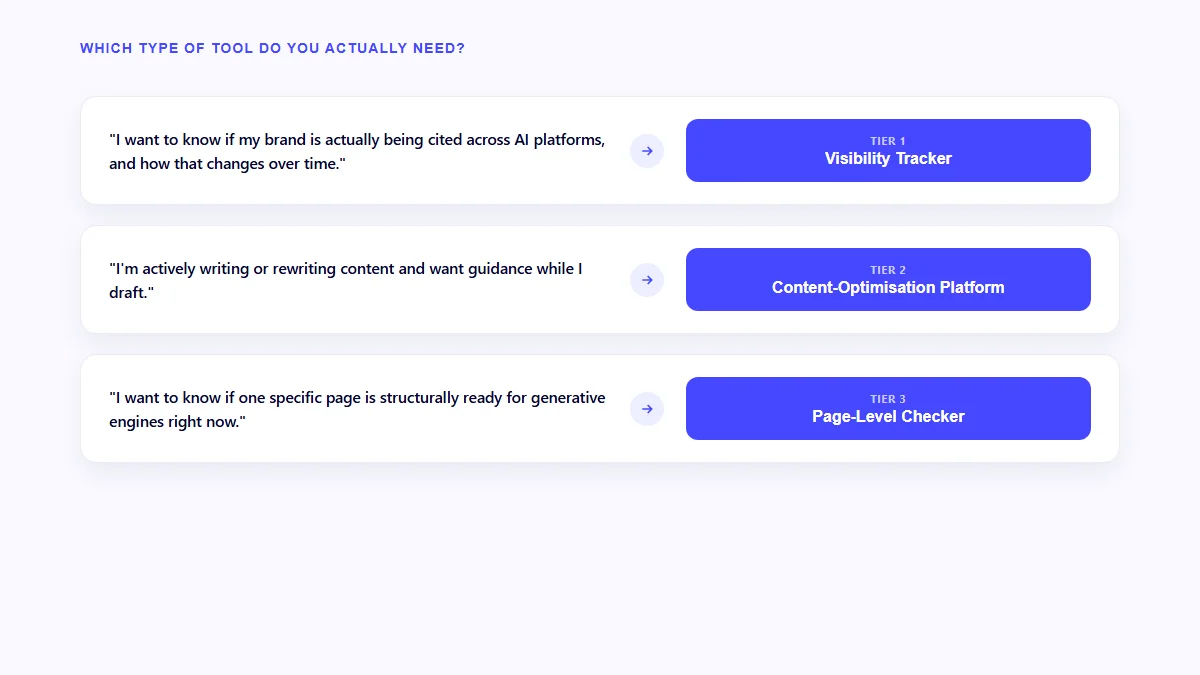
You want to know if one specific page is structurally ready for generative engines right now. That’s a page-level checker. Paste a URL or run an extension, get a score, fix what’s flagged. Covered in tier 3 below, with the full comparison in our dedicated GEO checkers article.
You’re actively writing or rewriting content and want guidance while you draft. That’s a content-optimisation platform. These score a draft against ranking pages and AI-visible competitors as you write, not after the fact. Covered in tier 2.
You want to know whether your brand is actually being mentioned or cited across AI platforms over time, and how that changes week to week. That’s a visibility tracker. Nothing in tiers 2 or 3 measures this; it’s the only category of the three that looks outside your own site. Covered in tier 1.
You want more than one of these. That’s common, not a sign you’re doing it wrong. A team publishing regularly might reasonably run a page checker before publishing, a content platform while drafting, and a tracker afterwards to see what actually happened. Budget, not correctness, usually decides how many tiers a team can justify running at once.
One distinction worth keeping in mind throughout: a strong result from a checker or an optimisation platform is a page-level or content-level readiness signal. It tells you the page is easier to parse, better structured, or better matched to a topic. It does not tell you whether any specific AI platform will actually choose to cite it, since that’s an external, platform-side decision no tool in any of these three tiers can control or guarantee. The checker-versus-tracker distinction goes deeper on exactly this line if it’s relevant to your decision.
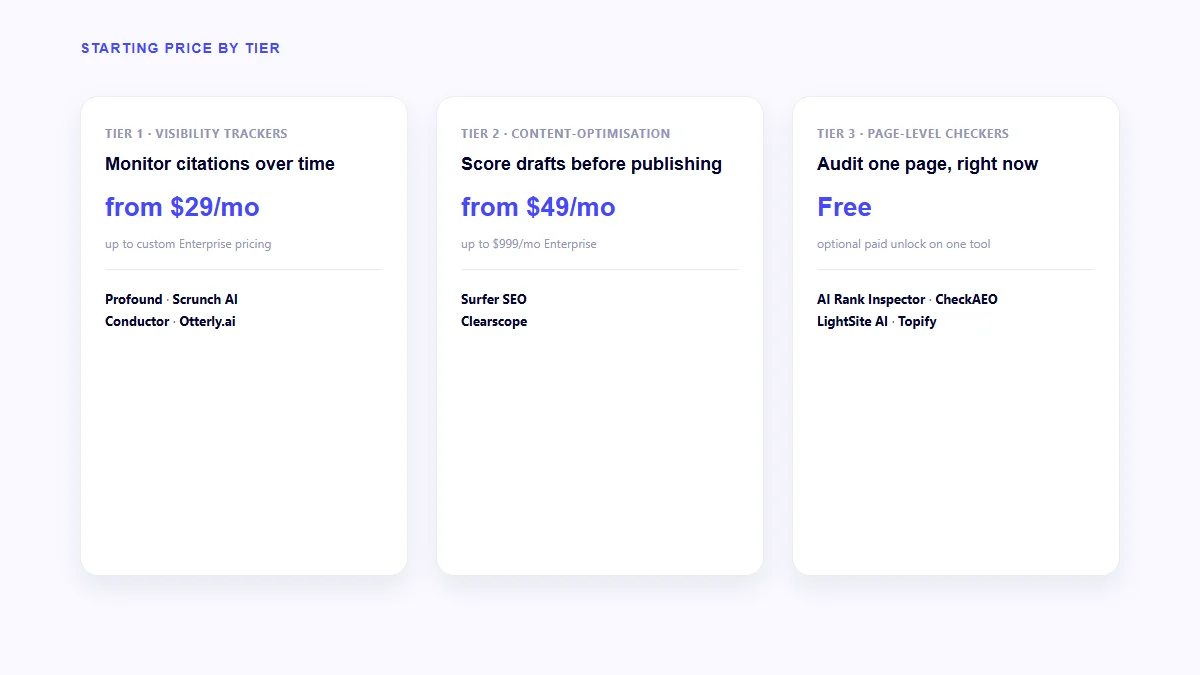
GEO Tools Compared: Tier, Price and Key Differentiator
| Tool | Tier | Starting price | Key differentiator |
|---|---|---|---|
| Profound | Visibility tracker | $99/month | Widest platform coverage at Enterprise (up to 9 answer engines) |
| Scrunch AI | Visibility tracker | $250/month (annual) | AXP builds a separate, structured, agent-facing version of a site |
| Conductor | Visibility tracker | Usage-based, sales-priced | Bundles content, monitoring and tracking into one enterprise suite |
| Otterly.ai | Visibility tracker | $29/month | Lowest entry price of the trackers reviewed here |
| Surfer SEO | Content-optimisation platform | $49/month | Content-editor-first, with visibility tracking as an add-on |
| Clearscope | Content-optimisation platform | $129/month | “Query fan-out awareness” shows the searches AI runs to build an answer |
| AI Rank Inspector | Page-level checker | Free | Checks GEO alongside SEO and AEO in one combined pass |
| CheckAEO | Page-level checker | Free (+$10 one-time unlock) | Separately tests whether an AI model can actually answer questions from the page |
| LightSite AI | Page-level checker | Free | Four-category breakdown (25 points each) with no signup required |
| Topify | Page-level checker | Free | P0/P1/P2 fix-priority tagging (see limitation noted in tier 3) |
Prices shown are each vendor’s own published starting price, verified directly on each vendor’s site as of 2026-08-20, and can change; check the vendor’s current pricing page before budgeting against these figures.
Tier 1: AI Visibility and Citation Trackers
These tools don’t check a page’s structure. They monitor, over time, whether a brand actually shows up when real prompts are run against ChatGPT, Perplexity, Google AI Overviews, Gemini and similar platforms, then report citation frequency, sentiment and competitive position. This is an external AI visibility measurement, not a page-level readiness signal, a distinction worth holding onto through this whole section, since a tracker reading tells you what happened, not why, and can’t be fixed the way a failed structured-data check can.
None of the four tools below were hands-on tested for this article. They’re paid B2B SaaS products with tiered or fully custom pricing, and several require a sales conversation before real account access. Everything below is described from each vendor’s own public marketing and pricing pages, fetched directly on 2026-08-20, the same listing-based research standard this site has previously used for gated tools like AI Rank Lab and AEO Lite.
For classic keyword-position tracking rather than AI-citation tracking, see our SERP rank tracker comparison, which covers AccuRanker, SEMrush, Ahrefs, SE Ranking, Nightwatch, Wincher and AirOps, including which of those track AI Overview visibility alongside classic rankings.
Profound
Profound tracks brand citations, sentiment and competitive positioning across AI answer engines through daily structured prompts, alongside a credit-based content-generation feature (“Profound Agents”) and traffic attribution for AI-sourced visits.
Pricing starts at $99/month (Starter, ChatGPT tracking only, 50 prompts tracked), rising to $399/month (Growth, three answer engines, 100 prompts tracked) and custom Enterprise pricing (up to nine answer engines, SSO/SAML, SOC2). The Enterprise tier’s platform breadth is the widest of the four trackers reviewed here.
Best for: teams that want to scale tracking coverage across many AI platforms as they grow, without switching tools between the SMB and enterprise stages.
Scrunch AI
Scrunch AI monitors brand presence across ChatGPT, Claude, Gemini, Perplexity, Google AI Mode/Overviews and Meta, with citation tracking, page audits, persona management and a reporting dashboard.
Its most distinct feature is AXP (Agent Experience Platform), an Enterprise-only capability that builds and serves a separate, structured version of a site specifically for AI crawlers to read. Pricing starts at $250/month billed annually (Starter, 3 users, 350 custom prompts), rising to $417/month annually (Growth, 5 users, 700 custom prompts) and custom Enterprise pricing.
Best for: teams that specifically want an agent-facing site layer, not just a reporting dashboard, and are prepared to pay Enterprise pricing for it.
Conductor
Conductor positions itself as an all-in-one enterprise AEO platform bundling four modules: Creator (AI writing/content optimisation), Intelligence (search and AI visibility reporting), Monitoring (site-health checks) and AgentStack (AEO for LLMs and agents).
Conductor doesn’t publish a flat monthly price; its plans (Essentials, Growth, Enterprise) are described by usage limits instead, from 1,000 pages analysed and 500 tracked keywords at the entry tier up to 125,000+ pages and 60,000+ keywords at Enterprise, with pricing confirmed through sales rather than shown on the page. That makes it more of an enterprise-suite purchase than a self-serve subscription.
Best for: larger organisations that would otherwise be buying separate content, monitoring and tracking tools, and want one vendor relationship instead of three.
Otterly.ai
Otterly.ai tracks AI search visibility across ChatGPT, Google AI Overviews, Perplexity and Microsoft Copilot (with Claude, Google AI Mode and Gemini available as add-ons), alongside brand visibility indexing, competitor benchmarking and a GEO audit feature.
It’s the most accessible tracker of the four on price: Lite starts at $29/month (15 search prompts), Standard at $189/month (100 prompts, marked “Most Popular”), Premium at $489/month (400 prompts), and Enterprise from roughly $1,000/month.
Best for: a smaller team or solo operator who wants real cross-platform tracking without committing to enterprise-scale pricing from day one.
Tier 2: AI Content-Optimization Platforms
These tools work at the drafting stage, not after publication. They score a piece of content against what’s currently ranking or being cited for a topic, and guide structure, terms and coverage while it’s being written, rather than auditing a finished page or reporting on external citations.
Both tools below are described from their own public marketing and pricing pages, fetched 2026-08-20, for the same reason as tier 1: they’re paid subscription products, not something this task could meaningfully hands-on test without an active paid account and real content to optimise inside it.
Surfer SEO and Clearscope get a short treatment here because this article covers the whole GEO tool landscape. For the dedicated deep-dive, current pricing, what each optimisation score actually measures, per-tool limitations, and which of these platforms have genuinely adapted for AI search, see our comparison of on-page SEO content optimisation tools, which covers Surfer SEO and Clearscope alongside Frase, MarketMuse, NeuronWriter, PageOptimizer Pro, Scalenut and Rankability.
Surfer SEO
Surfer SEO is a content-optimisation platform built around scoring drafts against real-time SEO data, alongside an AI writing assistant (“Surfy”), content audits, topical mapping and SERP analysis. AI visibility tracking across ChatGPT, Perplexity, Google AI Overview and Gemini exists as a feature within the platform, and as a standalone $158/month add-on plan.
Pricing runs from $49/month (Discovery, 120 documents, 10 pages tracked) through $99/month (Standard), $182/month (Pro) and $299/month (Peace of Mind, unlimited documents), up to $999/month for Enterprise with API access and a dedicated success manager.
Best for: a content team whose main job is producing and optimising a high volume of pages, where visibility tracking is a secondary, bundled feature rather than the primary reason to buy.
Clearscope
Clearscope is a content-optimisation platform offering topic exploration, content grading against ranking and AI-cited pages, and prompt tracking for brand mentions across ChatGPT and Gemini. Its “query fan-out awareness” feature shows the underlying set of web searches an AI platform actually runs to construct an answer, which is meant to inform what a content brief should cover, not just how a finished draft scores.
Pricing starts at $129/month (Essentials: 50 tracked prompts, 50 pages, 20 monthly topic explorations, 20 monthly drafts), rising to $399/month (Business, with a dedicated account manager) and custom Enterprise pricing with SSO and crawler whitelisting.
Best for: a team that wants content briefs informed by what AI platforms are actually searching for before writing starts, not only a post-draft content score.
Both platforms sit at a materially higher starting price than any tracker in tier 1 except Scrunch AI and Profound’s higher tiers, reflecting that they’re priced as content production tools with tracking bundled in, not tracking-only products.
Tier 3: Page-Level GEO Checkers
Checkers do a narrower, more mechanical job than the other two tiers: audit one page, right now, against a fixed set of structural and clarity signals, and return a score. They don’t monitor anything over time and they don’t help write content; they check what’s already there. For what a GEO score itself measures and how these scores are typically built, see what a GEO score actually measures.
Delivery method varies across this tier, too: some checkers are web tools you paste a URL into (CheckAEO, LightSite AI, Topify), while AI Rank Inspector runs as a Chrome extension instead. Neither format is inherently more accurate; it’s a workflow preference, covered further in our Chrome extensions comparison for anyone specifically choosing between extension-based tools.
This site has already published a full, hands-on-tested comparison of page-level GEO checkers, including real test results, screenshots and a disclosed tool failure. Rather than duplicate that review here, this section gives a short summary of what checkers do differently and points to the full comparison for actual reviews and methodology.
| Checker | Price | What it checks | Full review |
|---|---|---|---|
| AI Rank Inspector | Free (Chrome extension) | 60 signals across SEO, content, AEO and GEO/trust, in one combined pass | Full GEO checkers comparison → |
| CheckAEO | Free (+$10 one-time unlock for the full fix list) | 0-100 score across 6 categories, including a test of whether an AI model can actually answer questions from the page | Full AEO checkers comparison → |
| LightSite AI | Free | 0-100 GEO readiness score across 4 categories (Discovery Files, Crawler Access, Structured Data, Page Clarity) | Full GEO checkers comparison → |
| Topify | Free | 0-100 score with P0/P1/P2 fix priorities, per its own page | Full GEO checkers comparison → |
Worth noting plainly, since AI Rank Inspector is this site’s own product: it’s included in that table with the same one-line, factual treatment as the other three, no more prominently. Its full review, including its actual limitations, sits in the linked comparison article alongside the rest.
A genuine result from that comparison is worth carrying over here rather than re-testing: real hands-on runs against this site’s own pages found LightSite AI producing a detailed, mostly accurate result with one identifiable quirk (a robots.txt check that constructed the wrong URL), while Topify errored on both real attempts made against it. That’s the kind of gap between marketing copy and actual behaviour a page checker’s short feature list won’t show; see the full comparison for the complete results, category breakdowns and screenshots.
For the AEO-specific equivalent of this checker tier, the AEO checkers comparison covers CheckAEO and five other AEO-focused checkers in the same depth.
What None of These Tools Can Promise
Across all three tiers, it’s worth stating plainly: no tool reviewed here, in any tier, can guarantee a Google ranking, guarantee inclusion in an AI Overview, or guarantee a ChatGPT, Gemini or Perplexity citation. Trackers report whether citations are currently happening, which is a measurement, not a lever. Content platforms and checkers improve readiness signals, which make citation more plausible, not certain. Every claim in this article is a description of what each tool measures or does, not a prediction of what it will achieve for any specific page or brand.
FAQs
Do I need a tool from all three tiers?
No. Most teams start with whichever tier matches their most immediate gap: a checker if you don’t know whether your pages are structurally ready, a content platform if you’re actively producing content at volume, or a tracker if you already believe your content is solid and want to know what’s actually happening externally. Running all three at once is reasonable for a larger team, not a requirement for a smaller one.
Why don’t visibility trackers appear in the page-level checkers comparison, or vice versa?
Because they measure different things at different points in time. A checker score is reproducible right now, on demand, against a fixed page. A tracker reading changes week to week based on what AI platforms are actually doing, independent of anything you just changed on the page. Combining them into one comparison table would imply they’re substitutes, which they aren’t; see the checker-versus-tracker breakdown for the full reasoning.
Are content-optimisation platforms and page-level checkers the same thing with different pricing?
No, even though both operate on a single page. A checker audits a page that already exists and reports what’s missing. A content-optimisation platform is used during drafting, before the page is finished, to guide what to write. Running a finished page that was drafted in Surfer or Clearscope through a checker afterwards is a reasonable extra step, not a redundant one, since the two tools are scoring different things.
Is a higher-priced tracker automatically more accurate than a cheaper one?
Nothing in the public pricing and feature pages reviewed for this article supports that assumption. Price differences here mostly track platform coverage, prompt volume and team seats, not a documented accuracy difference between vendors. Because none of these four trackers were hands-on tested for this article, no claim about comparative accuracy is made either way.
Does AI Rank Inspector compete directly with the trackers or content platforms in this article?
No. It’s a free, page-level checker, the same category as CheckAEO, LightSite AI and Topify, not a visibility tracker or a content-drafting tool. Someone who actually needs tier 1 or tier 2 functionality won’t find it there, and this article says so directly rather than blurring the categories to fit it in more places.
How to Choose the Right GEO Tool for Your Team
The GEO tool market isn’t one list to rank from best to worst; it’s three separate jobs that happen to share a label. A visibility tracker won’t tell you why a page is structurally weak, a content platform won’t tell you whether your brand is actually being cited anywhere, and a page checker won’t tell you what’s happening across AI platforms over time. Pick the tier that matches the job in front of you first, verify any pricing directly on the vendor’s own site before committing since these figures change, and treat every score or reading from any of these tools as a signal to investigate, not a guarantee of any outcome.