

A GEO score is a summary number from an audit that checks a webpage against Generative Engine Optimisation readiness signals: entity clarity, source attribution, authorship and structured data, typically. It measures how well-prepared a page is to be trusted as a source, not whether any specific generative system will actually cite it.
Scores like this are becoming a common way to summarise a GEO audit, but the number alone can mislead without knowing what’s behind it. This article covers what these scores typically measure, how they’re usually built, and what a score can and can’t tell you.
It’s worth flagging one source of confusion early, the same distinction covered in what an AEO score measures: “GEO score” sometimes gets used for brand-level metrics like recognition or citation frequency across multiple AI platforms, tracked over time rather than read from a single page. That’s a genuinely different measurement, built by querying platforms directly, not by auditing a page. This article is specifically about the page-level version.
What a GEO Score Typically Measures
A GEO score is built from checks against observable page-level elements: whether the core entity is named consistently, whether factual claims are attributed to a source, whether authorship and dates are visible, and whether structured data accurately describes the page. The underlying mechanics of why these signals matter are covered in how GEO works; the full GEO audit checklist covers what these checks usually look like in detail.
Everything a score like this measures is observable on the page itself. None of it measures what happens after: whether a specific generative system actually cites, quotes or draws on the page for a specific query. That’s a separate, external outcome no page-level audit can observe directly.
How GEO Scores Are Usually Built
Most GEO scores follow a similar general pattern to other page-level audit scores, though no platform or standards body publishes an official GEO scoring methodology. Each tool that produces one has made its own choices about what to check and how to weight it.
The typical approach: group checks into categories (entity clarity, sourcing, authorship, structured data), run each check against a page, and assign a result, often a three-way Passed, Review or Failed outcome rather than a strict binary, since some checks genuinely need a judgement call (whether a claim is “adequately” attributed, for instance). Category results then roll up into an overall score.
Because none of this is standardised, two tools can legitimately disagree about the same page, purely from differences in how each one was designed rather than either being wrong.
A concrete Review case makes this clearer. Take a page that attributes a claim to “industry research” without naming the specific study. This isn’t a bare, unsupported assertion (there’s at least a gesture at a source), but it isn’t a fully checkable attribution either (a reader can’t verify which research, or when it was published). A tool built to require a named, dated source would score this Failed. A tool built to credit any acknowledgement of external backing, even a vague one, would score it Review, partial credit rather than none. Neither reading is wrong; they reflect different judgement thresholds for the same borderline case.
What a High Score Tells You, and What It Doesn’t
A high GEO score tells you that a page’s observable trust and sourcing signals are in good shape: consistent entity naming, attributed claims, visible authorship, accurate structured data. That’s genuinely useful and something you can act on directly.
What it doesn’t tell you is whether any of that translates into external results. Google states directly that meeting stated requirements for AI features “doesn’t mean that Google will crawl, index, or serve” a page’s content, and the same logic applies to any score built on page-level readiness. A perfect GEO score is not a guarantee of citation by any specific generative system, because that depends on factors outside the score’s reach: competing sources, exact query phrasing, and how established a brand already is for that topic.
Example: How One Score Is Built
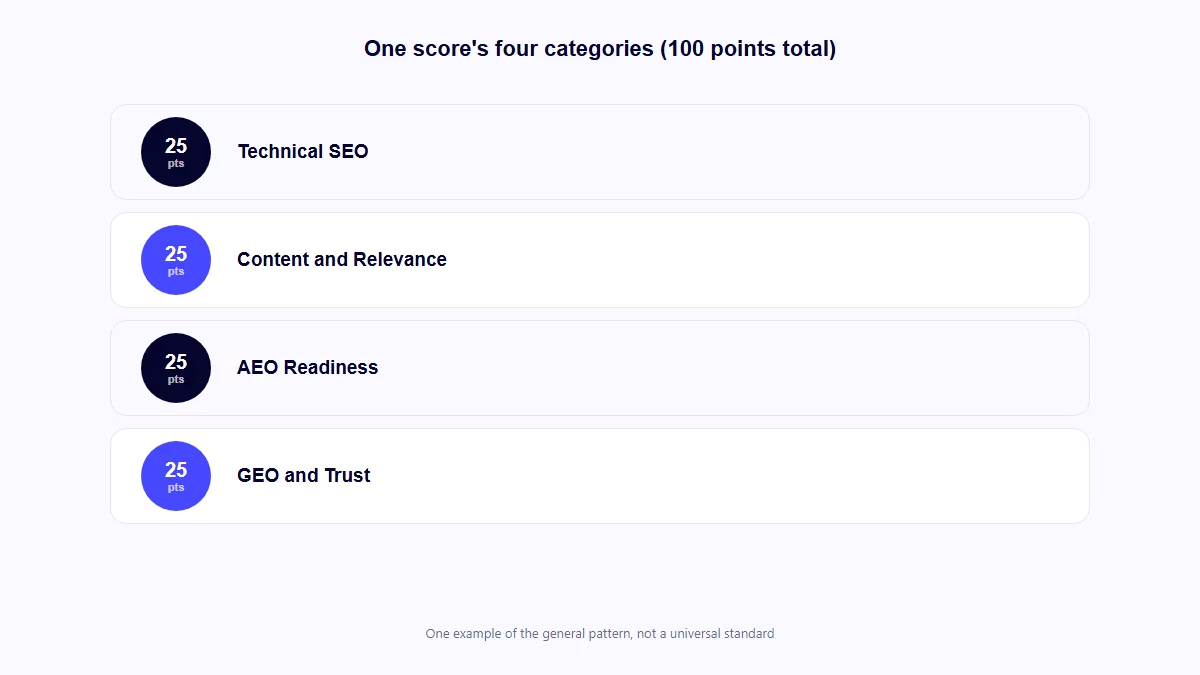
To make this concrete, here’s one real example. AI Rank Inspector’s audit divides its score across four categories, each worth 25 points for a 100-point total: Technical SEO, Content and Relevance, AEO Readiness, and GEO and Trust. Within GEO and Trust specifically, checks cover entity naming consistency, source attribution, authorship visibility, and structured data accuracy. Each check returns Passed, Review or Failed, with Review items acknowledged as sometimes needing a human judgement call.
This is one example of the general pattern, not a universal standard. A different tool could reasonably choose different categories or different weighting, and neither would be more officially correct, since no such official standard exists.
Why Two Tools Might Score the Same Page Differently
Given how much of this is left to each tool’s own design choices, disagreement between tools is expected. A few reasons this happens:
- Different check sets. One tool might check for author-bio schema; another might not look for it at all.
- Different weighting. A tool that weights entity consistency heavily will penalise inconsistent naming more than one that treats all checks equally.
- Different thresholds. What one tool calls “Review” (partial credit) another might call “Failed” (no credit), for the same borderline attribution case.
- Different scope. Some tools check GEO signals alone; others bundle GEO together with technical SEO and AEO into one combined score, which changes what the number represents.
A score is only really comparable to other scores from the same tool, tracked over time on the same page, rather than compared directly across tools.
Tracking a GEO Score Over Time
A single GEO score reading tells you where a page stands today. Tracked consistently with the same tool, it tells you something more useful: whether trust signals are holding up, improving, or drifting as content ages.
GEO scores have their own specific decay pattern worth watching for. A cited source can go stale or get taken down. A business can start appearing under a slightly different name on a new page without anyone noticing the inconsistency. Structured data can drift out of sync with the visible content after an unrelated edit. None of these require the original page to have changed at all.
Re-run a GEO check after any substantive content edit, and periodically even without one. A single low reading is worth checking for a tool-side change (updated checks or weighting) before assuming the page itself got worse.
A concrete decay scenario: a service page scores well at launch, with three cited industry statistics and a named author byline. Eighteen months later, one of the three cited reports has been superseded by a newer edition with different figures, the author has left the company without the byline being updated, and a newer competing page has added structured data this page never had. Nothing on the page itself was edited, yet a re-audit would now show a lower score across two categories: source attribution (a stale citation) and authorship (an outdated byline). This is the ordinary lifecycle of a page’s GEO signals, not a sign anything was done wrong originally.
Common Mistakes When Using a GEO Score
Treating the overall number as the goal. A page edited purely to push a score higher, rather than genuinely improving sourcing or clarity, has optimised for the measurement rather than what it represents.
Comparing scores from different tools directly. As covered above, two tools measuring the same page can legitimately disagree.
Ignoring the category breakdown. Two pages can share the same overall score while failing in completely different categories, one on entity naming, one on attribution, and need entirely different fixes.
Fixing the easiest category instead of the most important one. Entity naming is often the fastest category to fix, which can tempt a quick win there while a genuinely more consequential attribution gap sits untouched. Effort spent should track impact, not ease.
How to Use a Score Well
Treat a GEO score as a prioritisation tool, not a verdict. Use the category breakdown to see where to focus first. Re-check after making changes, since consistency with the same tool is what makes tracking meaningful over time.
If it would help, AI Rank Inspector’s GEO checker checks your own page’s category breakdown, or add AI Rank Inspector to Chrome to try it.
Final Practical Takeaway
A GEO score is a useful summary of observable, page-level trust and sourcing signals, and nothing more than that. It’s built from a tool’s own choices about what to check and how to weight it, not a universal standard, and it can’t predict what happens once a page leaves the audit. Used to prioritise fixes and tracked consistently over time, it’s a genuinely practical tool. Used as proof of future citation, it isn’t one.
FAQs
Does a GEO score change if I only fix one category?
Yes, proportionally, since each category typically contributes its own share of the total. Fixing entity naming alone won’t move a score as much as also addressing attribution and structured data, but it should produce a measurable, isolated improvement in that one category’s result.
How does a GEO score relate to a combined SEO, AEO and GEO score?
A GEO score usually covers one of several categories in a combined audit, as in the four-category example above. A combined score blends all disciplines into one number, which can mask a strong GEO result sitting alongside a weak AEO one, covered in more depth in AEO vs GEO vs SEO.
Can a low GEO score still mean the page is fine?
Possibly, if the checks that failed don’t apply well to that specific page type. Review what actually failed rather than treating the number alone as a verdict.
Is a GEO score the same as an AEO score?
No. An AEO score measures answer clarity and extractability. A GEO score measures trust and sourcing signals, a genuinely separate set of concerns.
Does page length affect a GEO score?
Not directly. A short page with a clearly named entity, one well-attributed claim and accurate structured data can score well; a long page padded with unattributed assertions won’t score better just for being longer.
Should I re-audit every page on a site at once, or a few at a time?
A few at a time, prioritised by which pages make the most consequential claims or carry the most traffic. Auditing an entire site in one pass produces a long list with no natural order to work through; auditing in smaller batches makes it easier to actually act on what each round finds before moving to the next.
Can a GEO score be manipulated without genuinely improving the page?
To some extent, in the same way any checklist-based score can be gamed by satisfying the letter of a check rather than its purpose, adding a citation that only loosely supports its claim, for instance. This is exactly why the score is meant to support a human review, not replace one.