
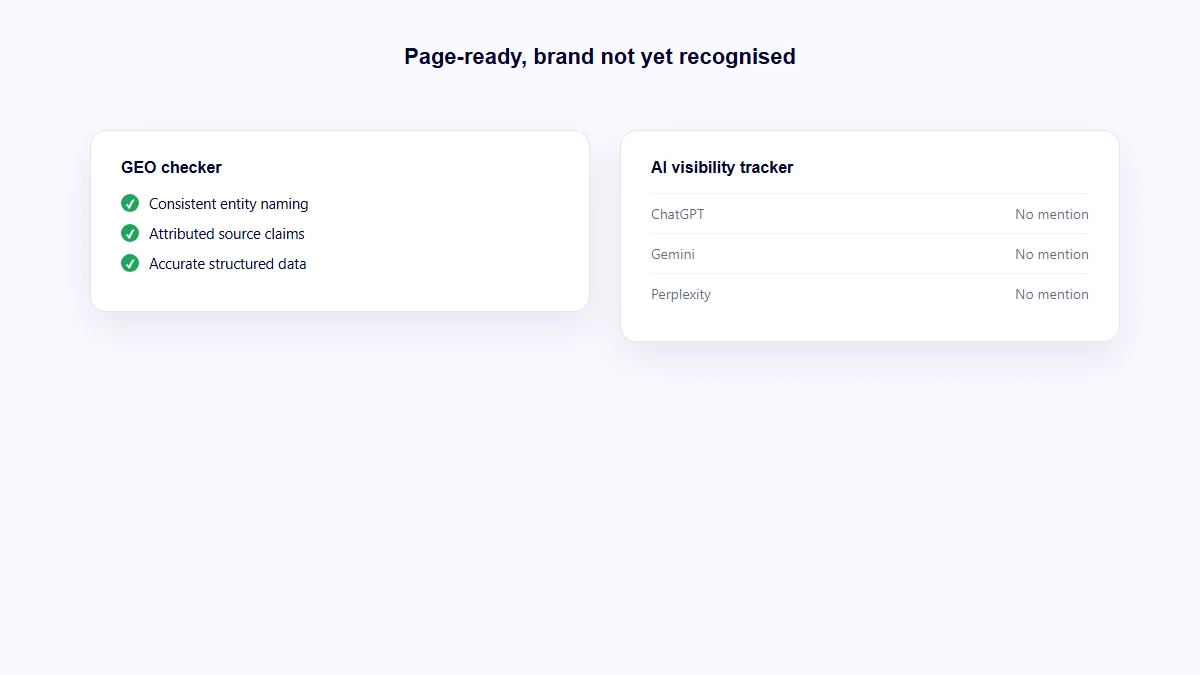
A Generative Engine Optimisation (GEO) checker audits a single page’s entity clarity, sourcing and structured data. An AI visibility tracker tests prompts against live AI platforms and records whether a brand gets mentioned or cited. One reads a page you control; the other observes a platform you don’t.
This is the GEO-specific version of a distinction covered generally in AEO checker versus AI visibility tracker, where “AEO” refers to Answer Engine Optimisation, the related discipline focused on answer clarity rather than trust signals.
What a GEO Checker Does
A GEO checker scans a webpage and evaluates entity naming consistency, source attribution, authorship visibility, structured data accuracy, and general trustworthiness signals, the mechanics of which are covered in how GEO works. It’s covered in full, as a checklist you can run manually, in the GEO audit checklist. The short version: it reads one page and reports what’s actually there.
What an AI Visibility Tracker Measures for GEO Specifically
An AI visibility tracker sends prompts to AI platforms and records whether a brand, product or domain gets mentioned in the responses. For GEO specifically, what’s usually being tracked is whether the brand entity itself is recognised and referenced, not just whether one particular page gets cited. This is a subtly different question from AEO-focused tracking, which more often looks at whether a specific page’s answer got surfaced for a specific query.
A brand can be mentioned by a generative system without any single page being the cited source, if the system has learned to associate the brand with a topic across many pages, mentions in other sources, or a knowledge graph entry. This is one reason GEO-focused visibility tracking often looks at brand-level recognition patterns over time, rather than only page-by-page citation events. It’s also consistent with what one benchmark study (Aggarwal et al., GEO-bench, KDD 2024) found about page-level signals like citing sources and consistent naming: they were associated with higher generative-engine visibility in that study’s test conditions, without any single technique guaranteeing selection for any specific query.
As with any AI platform query, responses can vary between runs of the same prompt, and can shift for reasons unrelated to any page change: a platform update, a competitor’s new content, or how a query happens to be phrased on a given day. A single tracked reading says less than a trend across several.
Comparison Table
| Comparison area | GEO checker | AI visibility tracker |
|---|---|---|
| What it evaluates | A specific webpage’s entity clarity, sourcing and structured data | Whether a brand or domain is mentioned across AI platform responses |
| Scope | Page-level | Brand-level or query-level |
| How it works | Reads and scans the page directly | Sends prompts to platforms and records what comes back |
| What you can act on | Entity naming, attribution, authorship, schema | Little directly; it reports an outcome |
| Typical output | A per-page score or checklist result | Mention/citation frequency across tested prompts, tracked over time |
| Best used for | Finding and fixing page-level trust gaps | Monitoring whether brand recognition is shifting over time |
Why a Page Can Pass a GEO Checker and Still Go Unmentioned
Consider a page that passes every GEO checklist item: consistent entity naming, well-attributed claims, visible authorship, accurate structured data. Test that brand’s name through a visibility tracker’s prompts, and the brand might still not appear, particularly for a newer or smaller brand competing against more established sources a generative system already associates with that topic.
This isn’t a contradiction. The checker confirmed the page itself is well-prepared as a potential source. The tracker reported that, for the specific prompts and platforms tested, the brand hasn’t yet built enough recognition to be surfaced. Page-level readiness is necessary groundwork; it isn’t the same thing as established brand recognition, which tends to build over a longer period and across more than one page. The reverse pattern is also possible, though less common: a well-known brand’s page with genuine GEO gaps can still get mentioned occasionally, if a generative system’s impression of the brand draws on recognition built elsewhere rather than that specific page’s own sourcing.
Do You Need Both?
Generally yes, in sequence rather than at the same time. Start with a GEO checker on your most important pages, since fixing entity naming, attribution and authorship gaps is something you can act on directly today, unlike brand recognition, which depends on more than what’s on any one page.
A visibility tracker earns its place once that groundwork is solid, and its real value shows up over a longer stretch of time than a single reading can capture, for the same reason a single AEO score reading matters less than one tracked over time. Running a tracker before addressing obvious page-level gaps mostly confirms what a checker would have told you faster: the foundation isn’t there yet. For real, named tools in both categories, plus a third category (content-optimisation platforms) neither a checker nor a tracker covers, see our comparison of GEO tools across all three types.
What Tracking Brand Recognition Actually Looks Like
In practice, GEO-focused visibility tracking usually means running the same small set of representative prompts against one or more platforms on a recurring basis, weekly or monthly rather than daily, and recording whether the brand appears, how it’s described when it does, and which competing sources appear instead. A single run tells you almost nothing reliable, given how much a single reading can vary. A pattern across several runs, checked consistently, is what actually indicates whether recognition is building, staying flat, or fading.
A small illustrative example: a five-prompt set for a regional accounting firm might include “who are trusted accountants in [city],” “best small business accounting firm near me,” and three close variants a real prospective client might type. Run weekly, a simple log might show the brand mentioned in 1 of 5 prompts in week one, 1 of 5 in week two, and 2 of 5 by week six, alongside notes on which competing firms appeared instead each time. This is a hypothetical illustration, not a real tracked result, but it shows the shape of what a genuinely useful log looks like: consistent prompts, a simple count, and a trend read across several weeks rather than any single run.
This is worth pairing with ordinary page-level maintenance rather than treating as a separate project: pages that were GEO-checked and fixed months ago can drift as cited sources age or new competing content appears, the same way any other page-level signal can decay without an edit ever happening.
Common Misconceptions
“If my brand isn’t mentioned, my pages must have GEO problems.” Possibly, but brand recognition also depends on factors beyond any single page: overall site authority, mentions elsewhere, and how established the brand already is relative to competitors for that topic.
“A GEO checker score predicts visibility tracker results.” It’s a contributing factor, not a predictor. Strong page-level signals improve the odds of being a usable source; they don’t guarantee a generative system has learned to associate the brand with the topic yet.
“Visibility tracking tells you which page to fix.” It reports whether the brand was mentioned, not which specific page (if any) was the cause. A GEO checker run on your most relevant pages is the tool for diagnosing what to fix.
Where AI Rank Inspector Fits
AI Rank Inspector’s GEO and Trust category audits observable page-level signals: entity clarity, sourcing, authorship, structured data, covering the full feature set. It doesn’t test prompts against AI platforms or track brand mentions over time, that’s a different category of tool, described generally above.
If it would help, check your own pages’ GEO signals with AI Rank Inspector’s GEO checker, or add AI Rank Inspector to Chrome to try it.
Final Practical Takeaway
A GEO checker and an AI visibility tracker measure different layers of the same underlying goal: being trusted as a source. Fixing what a checker finds is the concrete, page-level work available immediately. Watching what a tracker reports over time tells you whether that work, combined with everything else building the brand’s recognition, is showing up anywhere beyond the page itself.
FAQs
Is a GEO checker the same as an AEO checker?
No, though both are page-level audit tools. An AEO checker evaluates answer clarity and extractability. A GEO checker evaluates entity clarity, sourcing and trustworthiness, a different set of signals, covered fully in AEO checker versus AI visibility tracker.
Can a small or new brand ever compete on GEO visibility tracking?
Page-level GEO work is available to any site regardless of size. Brand-level recognition in a visibility tracker tends to build over time and isn’t something one well-optimised page changes overnight.
How long does it typically take for brand recognition to build after fixing page-level GEO issues?
There’s no documented timeline, and it varies by how established competing sources already are for the same topic. A newer or smaller brand competing against long-established sources for a topic should expect a slower shift than a well-known brand fixing a handful of overlooked pages.
Should I run a GEO checker on every page, or just my most important ones?
Prioritise pages making specific factual claims, or pages you’d want a generative system to treat as a trustworthy source for a given topic. A checkout page has little to check; an informational article or a claims-heavy service page has plenty.
If resources are limited, is it better to fix a few pages thoroughly or many pages lightly?
A few pages thoroughly, prioritised by which ones make the most consequential claims or get the most traffic. A generative system forming an impression of a brand’s trustworthiness is more likely to be influenced by a handful of genuinely well-prepared pages than by a larger number of pages each fixed only partially.