
An AEO checker audits a single webpage’s structure, schema and clarity for answer-engine readiness and returns a score. This article compares real, page-level AEO checkers only, tested and verified on 13 August 2026, and excludes brand-visibility trackers that also use “AEO” in their marketing.
This article is published by AI Rank Inspector, one of the tools compared below. Its own listing is reviewed using the same criteria and disclosure standard as every other tool on this list.
How Was This Comparison Researched?
This article compares which real tools do the checking; for a deeper look at what an AEO checker actually measures and how it arrives at a score, see our dedicated breakdown of the checking process. Every tool below was checked against its own real, live page or listing on 13 August 2026. Two were tested differently from the rest: CheckAEO was actually run, live, against a real URL from this site, and the genuine result is shown further down. AI Rank Inspector is described from its own first-party feature set. AEO Lite by Maciej Turek is described from its public page only, not run, because its free scan requires submitting a work email into a third party’s lead form, and no email was submitted without the account owner’s consent. The three Chrome extensions on this list (AEO Analyzer, GEO/AEO Readiness Check, and the SEO/AEO/GEO Checker by PPCBlogPro) already received a full review in our Chrome extensions comparison; their ratings and user counts were re-verified live for this article rather than reused unchecked, but they aren’t reviewed twice here.
One genuine finding from this research is worth stating plainly: several tools marketed with “AEO” in the name (a well-known brand-visibility grader, a major SEO platform’s AEO tool, and at least two dedicated “AEO checker” products) turned out to be brand-level AI visibility trackers, not page-level checkers, once actually inspected. They monitor how often a brand name is mentioned across AI platforms over time, rather than scoring a specific page’s structure right now. Both are useful, but they answer different questions, covered separately in AEO checker versus AI visibility tracker. This article sticks to the page-level checker category only.
How Do the Six AEO Checkers Compare?
| Checker | Type | Price | What it outputs | Hands-on tested here |
|---|---|---|---|---|
| AI Rank Inspector | Chrome extension | Free | 60 signals, 4 categories, Passed/Review/Failed | First-party |
| CheckAEO | SaaS web tool | Free + $10 one-time unlock | 0-100 score, letter grade, 6 categories | Yes |
| AEO Lite by Maciej Turek | SaaS web tool | Free (email required) | 100-point score, 5 tiers, 6 buckets | No (email-gated) |
| AEO Analyzer | Chrome extension | Free | AEO-only score | Reviewed separately |
| GEO/AEO Readiness Check | Chrome extension | Free | 0-100 score, radar chart | Reviewed separately |
| SEO/AEO/GEO Checker by PPCBlogPro | Chrome extension | Free | SEO+AEO+GEO scores | Reviewed separately |
Which AEO Checkers Made This Comparison?
AI Rank Inspector
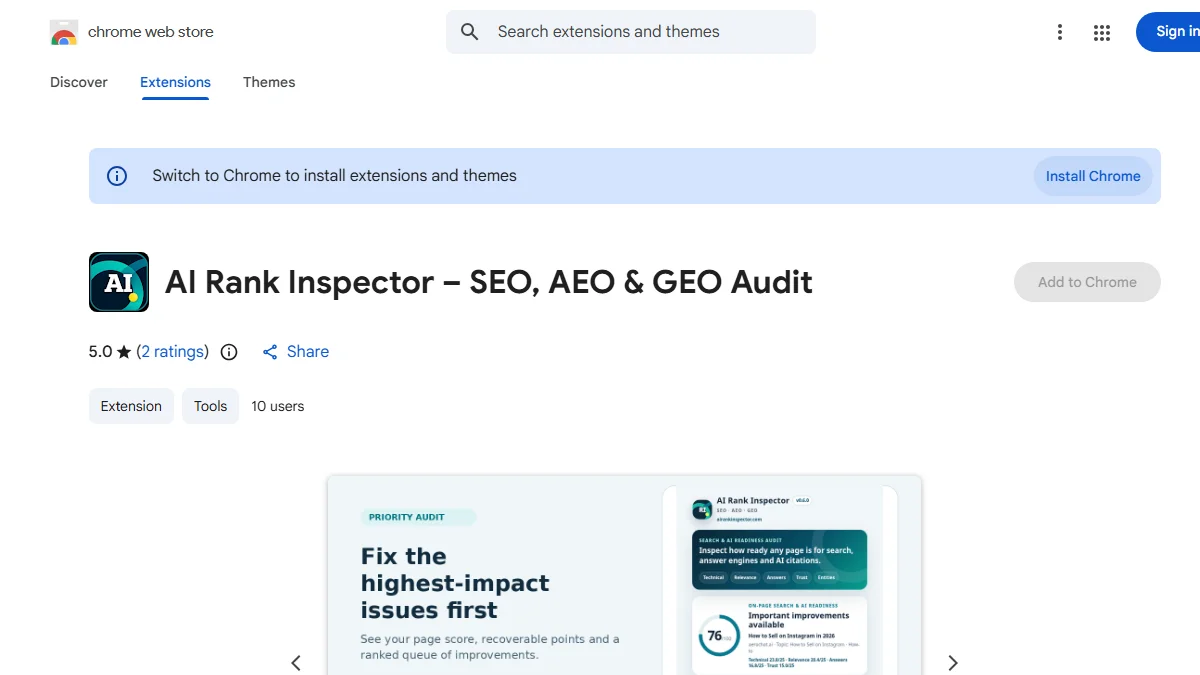
AI Rank Inspector checks 60 page-level signals across four categories: Technical SEO, Content and Relevance, AEO Readiness, and GEO and Trust, each marked Passed, Review or Failed. It runs as a Chrome extension rather than a website, so a page is checked directly where it’s being edited or reviewed, without pasting a URL into a separate tool.
Worth stating plainly, same as in our extensions comparison: this is a small, new product. As of 13 August 2026 it has 2 ratings (5.0 average) and 10 users, up from 1 rating and 7 users a week earlier. Its genuine differentiator is combining SEO, AEO and GEO into one four-category pass rather than an AEO-only score, and its listing carries an explicit disclaimer that scores don’t guarantee rankings, AI Overview inclusion or citations.
Best for: someone who wants AEO checked alongside SEO and GEO in the same pass, from inside the browser.
Limitation: no public web-based version; requires installing the Chrome extension.
CheckAEO
CheckAEO is a free web-based checker: paste a URL, HTML, or plain text, and it scores six weighted categories (Direct Answer Quality, Content Structure, Schema Markup, Technical SEO for AI, Entity and Topic Coverage, and Freshness Signals) as a 0-100 score with a letter grade. A full detailed report unlocks for a one-time $10 per-domain fee; the basic score and category breakdown are free with no account required.
To see what its output actually looks like rather than just describing it, this comparison ran a real test: the live URL https://airankinspector.com/answer-engine-optimisation/ was submitted through CheckAEO’s actual checker.
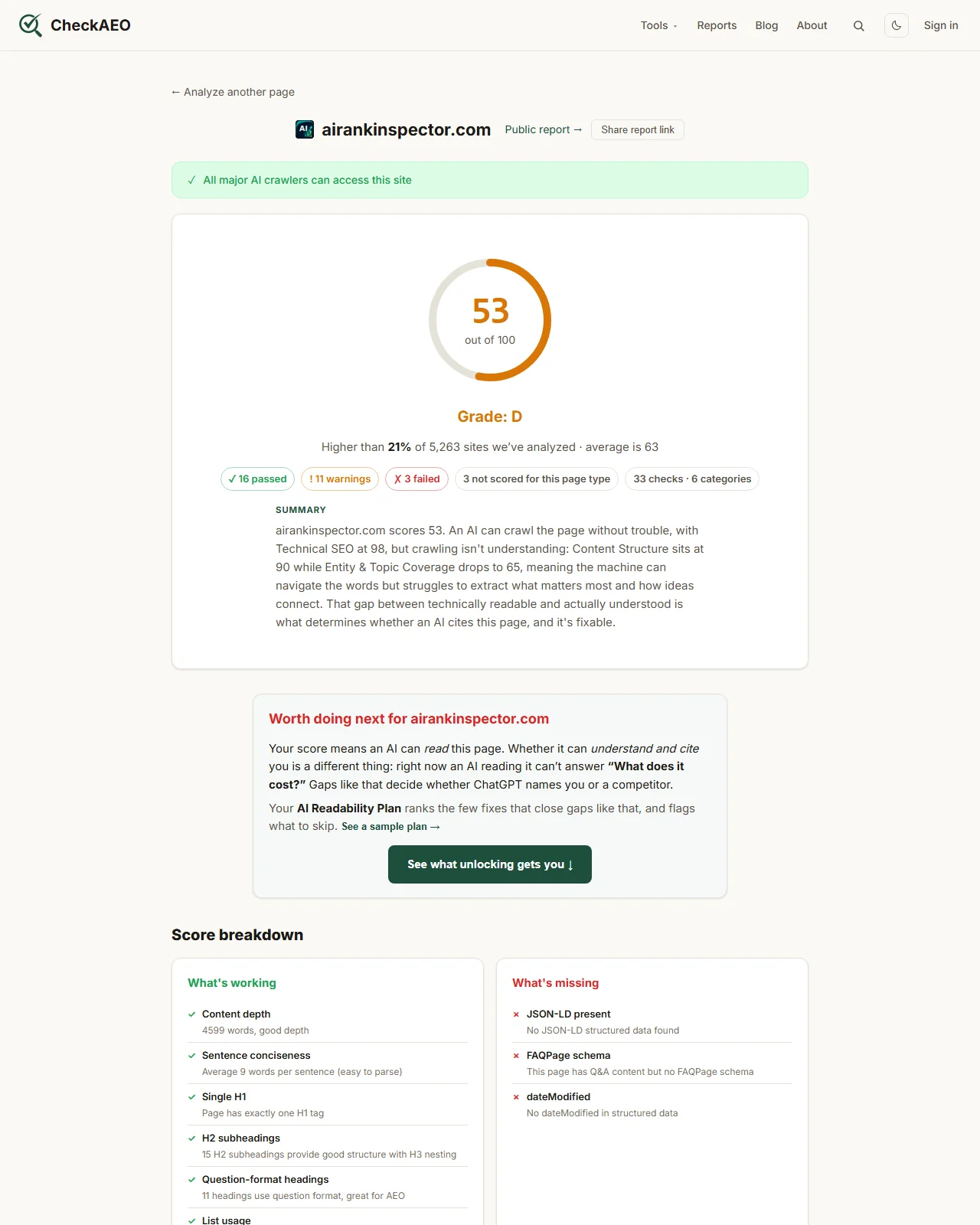
The result: 53 out of 100, Grade D, ahead of 21% of the 5,263 sites in CheckAEO’s own benchmark corpus (average 63).
| Category | Score |
|---|---|
| Technical SEO for AI | 98 |
| Content Structure | 90 |
| Entity and Topic Coverage | 65 |
| Checks passed | 16 of 33 |
| Warnings | 11 |
| Failed outright | 3 |
The tool flagged three concrete gaps on that page: no JSON-LD structured data, no FAQPage schema despite Q&A-style content being present, and no dateModified value. It also separately asked Claude to answer 7 reader questions about the page cold, with no prior knowledge of the site; Claude answered 3 correctly (including what the product does) and missed the rest, including “What does it cost?”, since no pricing appears on that specific page.
Best for: someone who wants a free, no-install page score with a concrete breakdown of what’s missing, and is comfortable running it through a browser rather than an extension.
Limitation: the full prioritised fix list sits behind the paid unlock; the free tier gives the score and category breakdown but not the detailed remediation report.
What Testing Three Pages Through CheckAEO Actually Showed
One test on one page only proves a tool runs. To see whether the result above was typical or a fluke, two more real pages on this site were run through CheckAEO the same way, live, on 13 August 2026.
| Page tested | Score | Grade | Passed / Warned / Failed | Compared against |
|---|---|---|---|---|
| AEO pillar guide | 53/100 | D | 16 / 11 / 3 (+3 unscored) | 21st percentile of 5,263 general sites |
| GEO pillar guide | 52/100 | D | 14 / 12 / 3 (+4 unscored) | 304 SaaS sites (SaaS average 66; no percentile shown for this page) |
| Chrome extensions comparison | 61/100 | C | 18 / 9 / 3 (+3 unscored) | 36th percentile of 304 SaaS sites |
Two things stand out. First, the exact same three gaps (missing JSON-LD, missing FAQPage schema, missing dateModified) showed up on all three pages without exception, which points to a site-wide templating pattern rather than three unrelated one-off issues; fixing it once at the template level would likely move all three scores together, not just one page. Second, CheckAEO compared the first page against “5,263 general sites” but compared the other two against “304 SaaS sites,” a different, page-type-aware benchmark group, without that comparison basis being obvious from the score alone; worth checking what a tool is actually comparing a page against before reading too much into a percentile.
AEO Lite by Maciej Turek
AEO Lite is a free tool built by an independent growth-marketing consultant rather than a company, scoring six buckets: answer readiness, schema markup quality, entity clarity, FAQ/HowTo extractability, technical fundamentals, and trust/authorship signals, out of 100 points across five tiers from Critical to Excellent. Its own page states that pages with a noindex tag, under 150 words, or blocked by robots.txt score zero automatically as hard-fail conditions.
This tool wasn’t run for this comparison. Its free scan requires entering a work email and ticking a consent checkbox before it will analyse a page, and no email was submitted on anyone’s behalf without their consent. Everything here is drawn from what the tool’s own page states about itself, disclosed plainly rather than presented as a tested result.
Best for: someone who doesn’t mind trading an email address for a free, detailed scoring breakdown from a solo-built tool.
Limitation: built and maintained by one person rather than a team or company, and the free scan isn’t accessible without providing contact details.
Also Covered in Our Chrome Extensions Comparison
Three more Chrome extensions check AEO signals and already received full reviews in our Chrome extensions comparison, re-verified live for this article rather than repeated in full:
AEO Analyzer checks question-based sections, answer length and definition clarity, working entirely offline. As of 13 August 2026 it still shows a 1.0-star rating from a single review and 14 users, unchanged since it was first reviewed. Full review →
GEO/AEO Readiness Check scores AEO and GEO together across six pillars with a radar chart and a prioritised “Kill List.” Now at 54 users (up from 53), still 4.0 stars from 4 ratings. Full review →
SEO/AEO/GEO Checker by PPCBlogPro covers standard on-page SEO alongside AEO and GEO readiness, aimed at pre-publish checks. Still the largest install base of any tool on this list at 4,000 users, with a 3.0-star rating from 3 reviews, both unchanged since early August. Full review →
Limitations of Each AEO Checker at a Glance
Every tool above has a “Limitation” noted in its own section; this table puts all six side by side so they’re comparable in one place rather than scattered through six paragraphs.
| Checker | Main limitation | Secondary limitation |
|---|---|---|
| AI Rank Inspector | No web-based version; Chrome only | New product, only 2 ratings to judge reliability against |
| CheckAEO | Prioritised fix list is paywalled ($10/domain) | Benchmark comparison group isn’t always obvious (general sites vs SaaS sites) |
| AEO Lite by Maciej Turek | Free scan gated behind a work email | Built and maintained by one person, not a team |
| AEO Analyzer | AEO-only, no SEO or GEO coverage | Lowest rating of any tool on this list (1.0 stars, 1 review) |
| GEO/AEO Readiness Check | No SEO coverage at all | Small sample (4 ratings) to judge accuracy against |
| SEO/AEO/GEO Checker by PPCBlogPro | Lowest rating-to-scale ratio (3.0 stars despite 4,000 users) | Recommendations are structured and rule-based rather than AI-comprehension-tested like CheckAEO’s |
Feature Comparison Matrix
| Checker | Combined SEO+AEO+GEO | Schema/JSON-LD check | AI comprehension test | Export format | Email required |
|---|---|---|---|---|---|
| AI Rank Inspector | Yes | Yes | No | PDF (optional, emailed) | No |
| CheckAEO | No (AEO only) | Yes | Yes (asks Claude directly) | None on free tier | No |
| AEO Lite | No (AEO only) | Yes | No | None stated | Yes |
| AEO Analyzer | No (AEO only) | No | No | None stated | No |
| GEO/AEO Readiness Check | Partial (AEO+GEO, no SEO) | Yes | No | No | |
| SEO/AEO/GEO Checker by PPCBlogPro | Yes | Not specifically called out | No | JSON/CSV | No |
CheckAEO is the only tool here that separately tests whether an AI model can actually answer questions from a page, rather than only checking the page’s structure. That distinction is covered in more depth in the FAQs below.
Checker, Tracker or Extension: Which Type Do You Need?
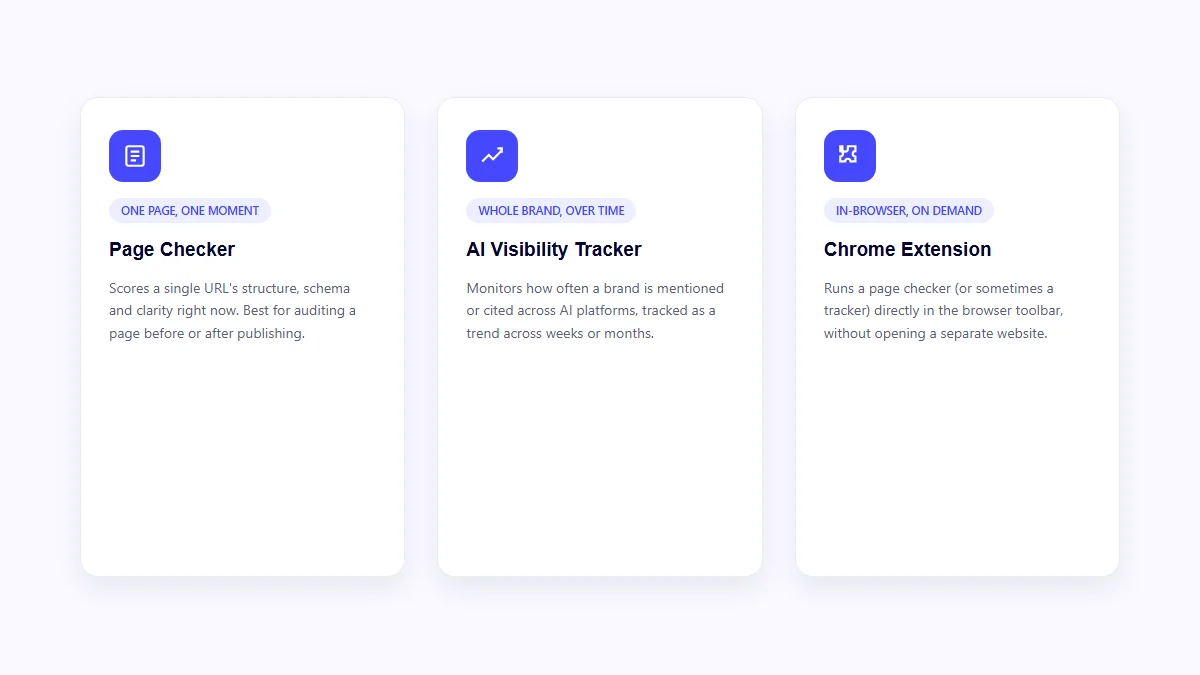
If you want to know whether one specific page is structured well for AI answer engines right now, a page checker (any tool above) is the right category. You paste a URL or install an extension, get a score, fix what’s flagged, and move on.
If you want to know whether your brand as a whole is being mentioned or cited across ChatGPT, Perplexity or Google AI Overviews over time, that’s a different job, covered by AEO checker versus AI visibility tracker rather than by anything reviewed here.
Whether a checker runs as a website or a Chrome extension is mostly a workflow preference. A web-based tool like CheckAEO needs a URL pasted in each time; a browser extension like AI Rank Inspector checks the page you’re already viewing without switching tabs. Neither delivery method is inherently more accurate than the other.
What Should You Check Before Trusting an AEO Checker’s Score?
Whether it’s testing the actual page or just describing best practice. CheckAEO’s live test above shows the difference: a real run surfaces specific, page-specific gaps (missing FAQPage schema, no dateModified), not generic advice.
What counts toward the score versus what’s flagged but unscored. CheckAEO’s test left 3 to 4 of 33 checks unscored on each page tested here because they didn’t apply to that page type; a score that hides this distinction is harder to act on.
What benchmark group a percentile is actually measured against. The three-page test above shows why: CheckAEO compared one page against “5,263 general sites” and two others against “304 SaaS sites,” a narrower, page-type-specific group. A 36th-percentile result against 304 similar sites and a 21st-percentile result against 5,263 general sites aren’t directly comparable to each other.
Whether the categories match what you actually need checked. A tool scoring only AEO signals (AEO Lite, AEO Analyzer) won’t flag a broken canonical tag or a missing meta description the way a combined SEO+AEO+GEO tool will.
Whether running it requires anything beyond a URL. AEO Lite’s email gate is a reasonable trade for a free detailed tool, but it’s worth knowing before you start, not after.
What Mistakes Do People Make Choosing One?
Assuming any tool with “AEO” in the name does the same job. The checker-versus-tracker distinction covered earlier catches most people off guard the first time.
Comparing raw scores across different tools as if they used the same rubric. A 72 from one checker and a 53 from another aren’t measuring identically weighted things; compare what each tool flagged, not just the number.
Treating a passing score as a citation guarantee. Every tool on this list disclaims this explicitly. A high structural score means a page is easier for an AI system to parse and extract from, not that any specific platform will choose to cite it.
Running a checker once and never again. Content and schema drift as pages get edited. The same page re-checked months later can score differently.
FAQs
Does a low AEO score mean AI systems definitely won’t cite the page?
No. A low score flags structural gaps, missing schema, or unclear answers that make extraction harder, not a guarantee either way. CheckAEO’s own disclaimer states its score reflects publicly known best practices, not a proprietary citation-prediction algorithm.
Can scores from two different checkers be compared directly?
Not reliably. Each tool weights its own categories differently. AI Rank Inspector’s four-category Passed/Review/Failed format and CheckAEO’s six-category 0-100 score aren’t measuring the same rubric, even when checking the same page.
Is CheckAEO’s paid unlock worth it over the free score?
Depends on what you need. The free tier already shows the score, letter grade, and a working/missing breakdown, which was enough to identify three concrete gaps in this comparison’s own test. The paid unlock adds a prioritised fix list and copy-paste remediation content, more useful for someone acting on many pages at once than for a single spot-check.
Does the “AI Comprehension Test” CheckAEO ran mean something different from its structural score?
Yes. The structural score measures whether the page is readable and well-marked-up; the comprehension test measures whether an AI model, reading the page cold with no other knowledge, could actually answer reader questions from it. In the test run here, the page scored well structurally but the model still missed questions the page’s content didn’t directly address, like pricing, showing the two measurements can diverge.
Do any of these checkers test how a page performs in an actual AI Overview or ChatGPT answer?
No. All five tools reviewed here analyse the page’s own structure and content; none of them query live AI platforms to see whether a specific page gets cited for a specific prompt. That kind of testing falls under AI visibility tracking, not page checking.
Why do three of the six tools here link out instead of getting a full review?
They received a full, detailed review already, in our Chrome extensions comparison. Repeating that content here would just be duplication; their current ratings and user counts were re-checked live for accuracy instead.
Does testing the same site’s pages through one checker prove anything about the checker’s accuracy?
Not on its own; three data points from one tool can’t confirm CheckAEO’s scoring is correct in an absolute sense. What it does show is consistency: the same three structural gaps were flagged on every page tested, which is either a genuinely accurate, repeatable finding about this site’s templates, or a consistent blind spot in the tool, and either way is more informative than a single untested score would be.
Final Practical Takeaway
Page-level AEO checkers are a smaller, more specific category than the search results suggest, since several well-marketed “AEO” tools turn out to be brand-visibility trackers instead. Of the genuine page checkers, pick based on delivery method (browser extension versus paste-a-URL website), whether combined SEO+AEO+GEO coverage matters to you, and whether you’re comfortable with an email gate for a free detailed report. Testing three real pages through CheckAEO for this comparison surfaced the same three structural gaps every time, a useful reminder that a single-page test tells you less than testing a handful of pages does. Re-run whichever one you choose periodically, since both the pages being checked and the tool’s own scoring criteria can change.