
A GEO checker measures generative-engine readiness by auditing a single webpage’s crawlability, structured data and clarity, then returns a score. This article compares real, page-level GEO checkers only, tested and verified on 13 August 2026, mirroring the same page-checker-only scope used in our AEO checkers comparison.
This article is published by AI Rank Inspector, one of the tools compared below. Its own listing is reviewed using the same criteria and disclosure standard as every other tool on this list.
How Was This Comparison Researched?
This article compares which real tools do the GEO checking; for what GEO itself means and how the audit process works, see how generative engine optimisation works and the step-by-step GEO audit checklist. Every tool below was checked against its own real, live page on 13 August 2026, and two were actually run rather than just described.
LightSite AI was submitted a real, live URL from this site through its actual free checker, and the genuine result is shown further down. Topify was also submitted real URLs from this site through its actual checker, twice, but its own backend returned a JSON parsing error both times rather than a score; that outcome is reported plainly below rather than smoothed over or skipped. AI Rank Inspector is described from its own first-party feature set. The three Chrome extensions on this list (GEO Checker, GEO/AEO Readiness Check, and the SEO/AEO/GEO Checker by PPCBlogPro) already received full reviews in our Chrome extensions comparison; their ratings and user counts were re-verified live for this article rather than reused unchecked, but they aren’t reviewed twice here.
How Do the Six GEO Checkers Compare?
| Checker | Type | Price | What it outputs | Hands-on tested here |
|---|---|---|---|---|
| AI Rank Inspector | Chrome extension | Free | 60 signals, 4 categories, Passed/Review/Failed | First-party |
| LightSite AI | SaaS web tool | Free | 0-100 score, letter grade, 4 categories | Yes |
| Topify | SaaS web tool | Free | 0-100 score, P0/P1/P2 fix list | Attempted, errored both times |
| GEO Checker (Trustdom Oy) | Chrome extension | Free | Crawlability + structured data check | Reviewed separately |
| GEO/AEO Readiness Check | Chrome extension | Free | 0-100 score, radar chart | Reviewed separately |
| SEO/AEO/GEO Checker by PPCBlogPro | Chrome extension | Free | SEO+AEO+GEO scores | Reviewed separately |
Which GEO Checkers Made This Comparison?
AI Rank Inspector
AI Rank Inspector checks 60 page-level signals across four categories: Technical SEO, Content and Relevance, AEO Readiness, and GEO and Trust, each marked Passed, Review or Failed. It runs as a Chrome extension, so a page is checked directly where it’s being edited or reviewed, without pasting a URL into a separate site.
Worth stating plainly, same as in the AEO checkers comparison: this is a small, new product. As of 13 August 2026 it has 2 ratings (5.0 average) and 10 users. Its genuine differentiator for GEO specifically is that trust and structured-data signals are checked alongside SEO and AEO in the same four-category pass, rather than requiring a separate GEO-only tool. Its listing carries an explicit disclaimer that scores don’t guarantee AI Overview inclusion or citations.
Best for: someone who wants GEO checked alongside SEO and AEO in the same pass, from inside the browser.
Limitation: no public web-based version; requires installing the Chrome extension.
LightSite AI
LightSite AI’s GEO checker is a free web tool: paste a URL and it scores four categories (Discovery Files, Crawler Access, Structured Data, Page Clarity) out of 25 points each, combined into a 0-100 AI Readiness Score with a letter grade. A separate email field exists for a fuller report, but the basic scan and score don’t require it.
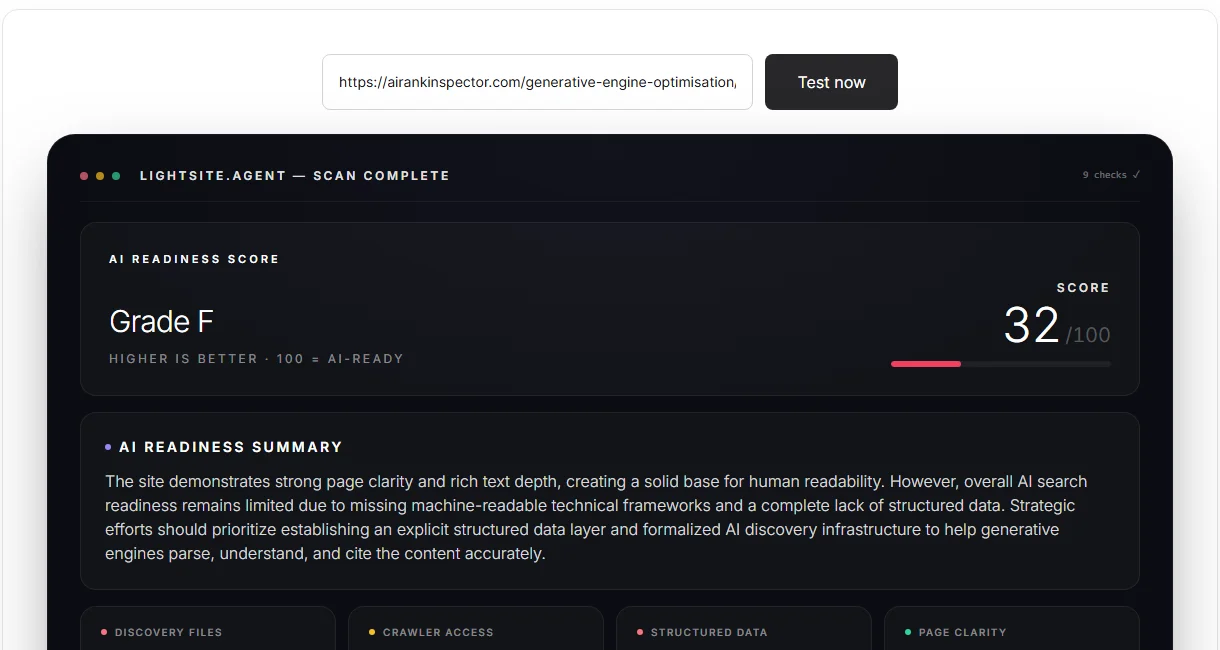
This comparison ran a real test: the live URL https://airankinspector.com/generative-engine-optimisation/ was submitted through LightSite AI’s actual checker, no email entered. The result: 32 out of 100, Grade F. Category breakdown: Discovery Files 2/25, Crawler Access 10/25, Structured Data 0/25, Page Clarity 20/25. Of the checks it ran, 1 passed and 9 failed. The tool’s own summary read the split correctly: strong page clarity and text depth, but limited machine-readable structure underneath it.
One result is worth flagging rather than taking at face value: the tool listed a failed “Robots.txt crawling directives” check, pointing at https://airankinspector.com/generative-engine-optimisation/robots.txt, a URL that returns a 404 because it appended /robots.txt to that specific page’s own address rather than checking the site’s actual robots.txt at the domain root (which exists and returns normally). That looks like a real quirk in how this particular check is built, not a genuine gap on the page being tested, and it’s a useful reminder to spot-check a checker’s flagged failures rather than accepting every one automatically.
Best for: someone who wants a free, no-signup GEO score with a specific breakdown of what’s structurally missing.
Limitation: at least one check type (the robots.txt path check observed here) can produce a misleading result depending on the URL submitted; treat flagged failures as a starting point to verify, not a final verdict.
Topify
Topify’s GEO Score Checker states it scores four dimensions: AI bot access, structured data, content signals, and citation visibility, output as a 0-100 score with fixes tagged P0, P1 or P2 by priority. It’s free with no signup required for the initial scan, per its own page.
This comparison attempted a real test twice: once against airankinspector.com/generative-engine-optimisation/, and again against the plain domain airankinspector.com. Both times, after a “Scanning…” state lasting roughly a minute, the tool returned the same on-page error instead of a score: “Unexpected token ‘A’, ‘An error o’… is not valid JSON,” with a “Try again” button. That’s the tool’s own backend failing to return a valid response, not something guessed at or inferred. It’s reported here factually because a genuine attempt was made and this is what actually happened, not because the tool doesn’t work in general; a different URL or a later attempt might succeed.
Best for: on paper, someone who wants citation-visibility scoring alongside structural checks; in practice, this couldn’t be verified during testing.
Limitation: errored on both real attempts made for this comparison, on two different URLs from the same domain.
Also Covered in Our Chrome Extensions Comparison
Three more Chrome extensions check GEO signals and already received full reviews in our Chrome extensions comparison, re-verified live for this article rather than repeated in full:
GEO Checker by Trustdom Oy checks whether a page’s HTML is crawlable and its structured data supports being found by generative AI systems. As of 13 August 2026 it shows a 5.0-star rating from 1 review and 141 users, down slightly from 142 in early August, a minor fluctuation rather than a meaningful trend. Full review →
GEO/AEO Readiness Check scores AEO and GEO together across six pillars with a radar chart and a prioritised “Kill List.” Now at 54 users, still 4.0 stars from 4 ratings. Full review →
SEO/AEO/GEO Checker by PPCBlogPro covers standard on-page SEO alongside AEO and GEO readiness. Still the largest install base of any tool on this list at 4,000 users, with a 3.0-star rating from 3 reviews, unchanged since early August. Full review →
Checker, Tracker or Extension: Which Type Do You Need?
If you want to know whether one specific page is structured well for generative engines right now, a page checker (any tool above) is the right category. Paste a URL or install an extension, get a score, fix what’s flagged, and move on, the same logic covered in the AEO checkers comparison.
If you want to know whether your brand is actually being mentioned or cited across AI platforms over time, that’s a different job, covered in GEO checker versus AI visibility tracker rather than by anything reviewed here.
Whether a checker runs as a website or a Chrome extension is mostly a workflow preference, not an accuracy difference. A web-based tool needs a URL pasted in each time; a browser extension checks the page already open in the tab.
What Should You Check Before Trusting a GEO Checker’s Score?
Whether a flagged failure is actually correct. LightSite AI’s robots.txt check above shows why: a 404 on a URL the tool itself constructed incorrectly isn’t the same as a real gap on the page. Spot-check anything that looks surprising before acting on it.
Whether the tool actually returns a result at all. Topify’s real test here failed twice. A tool that errors under real conditions can’t be compared on output quality until it actually produces one.
What counts toward the score versus what’s just informational. LightSite AI’s four categories (25 points each) make it clear where points were lost; a tool that only shows a single combined number is harder to act on.
Whether the categories match what you actually need checked. A GEO-only tool won’t flag an SEO or AEO issue the way a combined tool will, and vice versa.
What Mistakes Do People Make Choosing One?
Picking a tool from its feature list without ever running it. Topify’s description reads well; the actual test result didn’t match it. A feature list describes intent, not verified behaviour.
Assuming a tool that errors once is permanently broken, or the reverse. Topify’s error was reproducible twice in this comparison, but that doesn’t rule out it working normally for other URLs or after a fix on their end; it also doesn’t mean it’s safe to assume it’ll work when you need it to.
Comparing raw scores across tools as if they used the same rubric. LightSite AI’s 4-category, 25-points-each structure and AI Rank Inspector’s 4-category Passed/Review/Failed format aren’t the same rubric, even scoring similar underlying signals.
Treating a passing GEO score as a citation guarantee. A high structural score means a page is easier for a generative engine to parse and extract from, not that any specific platform will choose to cite it.
FAQs
Does a checker flagging “missing structured data” always mean it’s actually missing?
Usually, but not always. Schema-presence checks tend to be more reliable than checks that construct their own URL to test (like a robots.txt lookup), since there’s less room for the tool to build the check incorrectly. Still worth a manual spot-check on anything that would change a real decision.
Why report a tool (Topify) that errored instead of leaving it out?
Because it’s real information a reader would want before relying on it themselves. Leaving it out silently would mean the next person hits the same error with no warning; reporting it factually, without exaggeration, is more useful than pretending it wasn’t tested.
Can GEO and AEO be checked by the same tool, or do they need separate checkers?
Several tools on this list check both in one pass (AI Rank Inspector, GEO/AEO Readiness Check, PPCBlogPro’s checker). Others are GEO-only (LightSite AI, Topify, GEO Checker by Trustdom Oy). Neither approach is wrong; it depends on whether you want one combined score or dedicated depth on GEO alone.
Does a 0-out-of-25 category score mean total failure on that category?
It means the tool found none of what it specifically checks for within that category’s rubric, which is narrower than “nothing at all exists on the page.” A checker scoring a category at zero is reporting against its own specific checklist, not making a broader claim about the page.
Is it worth running more than one GEO checker on the same page?
Given how differently these tools are built (as shown by LightSite AI’s URL-construction quirk and Topify’s outright errors), running two independent checkers on an important page is a reasonable way to catch a false result from either one alone.
Does AI Rank Inspector’s GEO category work the same way as a GEO-only tool’s full score?
No, and that’s a fair distinction to draw given it’s this site’s own product. Its “GEO and Trust” category is one of four equally weighted sections in a combined audit, not a dedicated deep-dive the way LightSite AI’s four-category breakdown is. Someone wanting GEO checked in isolation, at that level of granularity, is better served by a GEO-only tool.
Final Practical Takeaway
The two SaaS GEO checkers tested hands-on for this comparison behaved very differently under real conditions: one returned a detailed, mostly accurate result with one identifiable quirk, the other failed outright on both attempts. That gap between what a tool claims to do and what it actually does when you run it is the main reason to test before relying on any single score, rather than picking based on a feature list alone. Whichever checker you use, treat flagged failures as a starting point for verification, not a final verdict, and re-run it periodically since both the page and the tool’s own scoring can change.