
A SERP rank tracker monitors where a website’s pages rank for chosen keywords over time. In 2026, some trackers (SE Ranking, Nightwatch, AirOps, and AccuRanker via a separate module) also monitor visibility inside AI Overviews, ChatGPT or Perplexity, though coverage varies sharply by vendor and the feature is still new and inconsistently defined.
Classic Rank Tracking vs AI Answer-Engine Visibility: Why the Line Is Blurring
A SERP rank tracker’s original job is simple: check a keyword, record where a URL sits in Google’s results, repeat daily, chart the movement. That’s classic keyword-position tracking, and it’s what every tool in this article was originally built to do.
What’s changed is that some queries no longer return a plain list of ten blue links. Google can show an AI Overview above them, and a growing share of research and comparison-shopping behaviour happens directly inside ChatGPT or Perplexity, where there’s no “position 4” to record, only whether a brand gets mentioned in the generated answer.
Several vendors have responded by bolting AI-answer-engine visibility onto their existing rank tracker, under the same product name. That’s a reasonable response to a real shift, but it means “rank tracker” now covers two genuinely different measurements sold under one label, at very different levels of maturity per vendor: some track this natively across every plan, some sell it as a separate paid add-on, some don’t offer it at all yet.
This article covers seven tools built primarily for classic keyword-position tracking, and states plainly, tool by tool, which also track AI-answer-engine visibility and how that tracking is packaged. If your real need is the opposite, tracking brand citations across AI platforms as the primary job rather than a bolted-on feature, that’s a different product category: this site’s best AI visibility and citation tracker roundup covers Profound, Scrunch AI, Conductor and Otterly.ai in full, and isn’t duplicated here.
It’s also worth separating this from a page-level checker. A checker like the ones compared in our GEO checkers article or our AEO checkers article audits one page’s structure right now and returns a score; a rank tracker measures a keyword’s position over time. Different job, different output, not interchangeable; see checker vs AI visibility tracker for that specific distinction in more depth.
Device matters too: mobile and desktop rankings for the same keyword can genuinely differ, for documented technical reasons. See why mobile rankings differ from desktop for the mechanism, plus which tools split mobile and desktop data cleanly.
The 7 SERP Rank Trackers Compared: Price and AI Overview Tracking at a Glance
| Tool | Starting price | Tracks AI Overviews / AI answer engines? | Key differentiator |
|---|---|---|---|
| AccuRanker (accuranker.com) | $224/month | Partial, AccuLLM is a separate paid module | Free Live SERP Checker anyone can use without an account |
| SEMrush Position Tracking (semrush.com) | $117.33/month (SEO plan, annual) | No, AI visibility lives in a separate Semrush product | Bundled into an all-in-one SEO suite, not sold alone |
| Ahrefs Rank Tracker (ahrefs.com) | $129/month (Lite) | Partial, tracks Google AI Overviews only, not chat platforms | Included in every plan, even the cheapest |
| SE Ranking (seranking.com) | $103.20/month (Core) | Yes, ChatGPT, Perplexity, AI Overviews, AI Mode, Gemini | Free daily checker includes a live AI Overviews toggle |
| Nightwatch (nightwatch.io) | €79/month (Starter) | Yes, six AI engines tracked on every plan | Broadest AI-engine list, not gated to a top tier |
| Wincher (wincher.com) | ~€49/month (third-party reported) | No | Lowest classic-tracking-only entry price of the seven |
| AirOps (airops.com) | Free (Insights tier); no published price above that | Yes, tier-dependent (ChatGPT only on Solo, multi-engine on Pro) | Bundles tracking with AI content-production tooling |
Prices shown are each vendor’s own published starting price where available, verified directly on 2026-09-02, and can change; check the vendor’s current pricing page before budgeting. Wincher’s figure is explicitly flagged: its own pricing page did not render a specific dollar/euro amount during two separate verification attempts, so the number above is attributed to third-party listings (G2, Capterra), not confirmed directly from Wincher’s own page.
The 7 SERP Rank Trackers, One by One
AccuRanker (accuranker.com)
AccuRanker is built for scale: white-label reporting, large keyword volumes, a Professional plan starting at $224/month, rising to $764/month for Expert and custom pricing for 25,000+ keywords at Enterprise. No free trial for the full platform is disclosed on its pricing page.
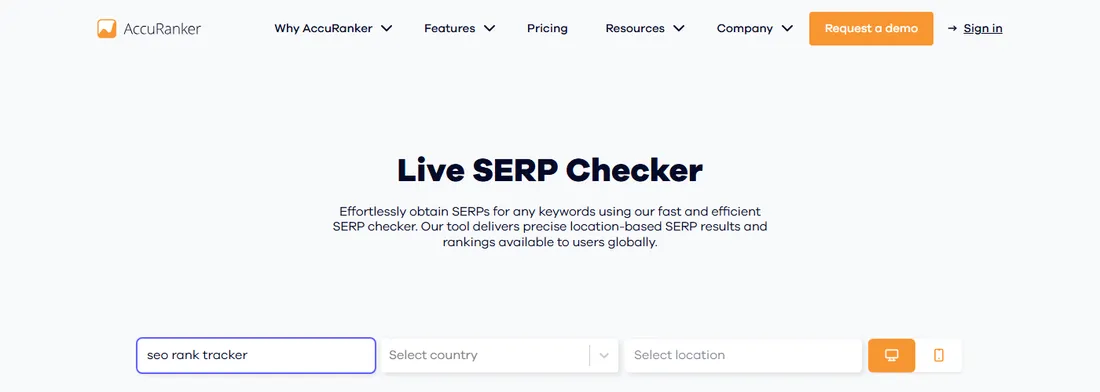
What’s genuinely useful, and hands-on tested for this article, is AccuRanker’s free Live SERP Checker: no signup, five checks a day, real location-based Google results returned instantly. A live query run during research confirmed it works exactly as described, a rare no-friction way to sample a tracker’s underlying data quality before paying anything.
AI-answer-engine tracking exists under a separate name, AccuLLM, tracking “visibility across prompts, sentiment, and cited sources” across ChatGPT, Perplexity, AI Overviews and AI Mode. It isn’t included in the base Rank Tracker pricing above; treat it as a separate line item, not a bundled feature.
Best for: agencies and larger in-house teams that need scale and white-label reporting, and are prepared to buy AI-answer-engine tracking as a distinct add-on rather than expecting it bundled in.
SEMrush Position Tracking (semrush.com)
SEMrush doesn’t sell Position Tracking as a standalone product; it’s one module inside SEMrush’s broader SEO suite, which restructured its plans in 2026 to SEO ($117.33/month annual), Starter ($165.17/month), Pro+ ($248.17/month) and Advanced ($455.67/month), plus custom Enterprise pricing. A 7-day free trial is offered.
Position Tracking’s own product page makes no mention of AI Overview, ChatGPT or Perplexity tracking. SEMrush does offer AI-visibility measurement, but as a separate product (AI Visibility Index), not a feature of Position Tracking itself. Confirm that’s the right product within the suite before subscribing for that reason specifically.
Best for: teams that already need or use SEMrush’s wider SEO toolset (site audits, keyword research, backlink data) and want rank tracking bundled into that existing spend, rather than teams whose only requirement is tracking.
Ahrefs Rank Tracker (ahrefs.com)
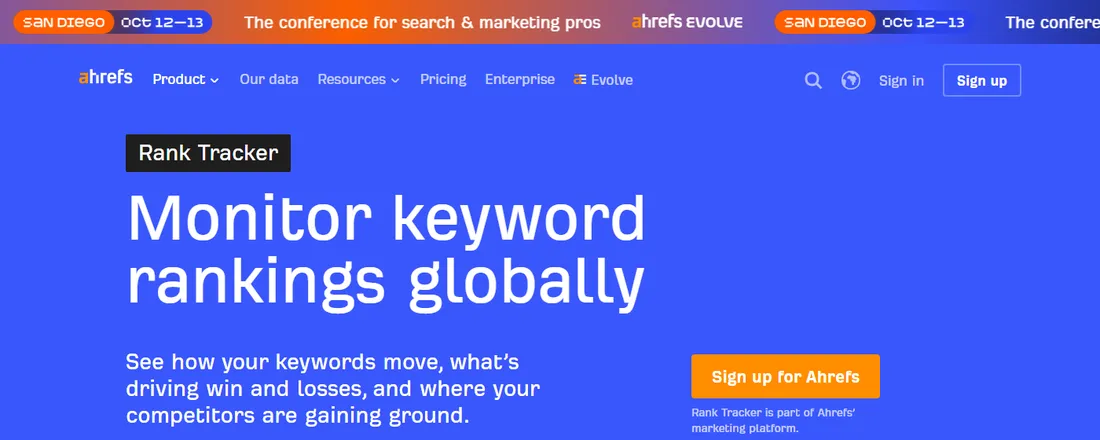
Ahrefs Rank Tracker is included in every standard Ahrefs plan rather than gated to a top tier: $129/month (Lite), $249/month (Standard), $449/month (Advanced), up to $1,499/month (Enterprise, annual commitment). A lower $29/month Starter plan and a limited free “Ahrefs Free” tier also exist.
Ahrefs tracks “19 SERP features, including AI Overviews”: Google’s AI Overview is one SERP element the tool records alongside organic and featured-snippet positions. There’s no mention of ChatGPT or Perplexity tracking, so its AI-answer-engine coverage is narrower than SE Ranking’s or Nightwatch’s, watching whether an AI Overview appears rather than whether a brand gets cited inside a chat-platform answer.
Best for: teams already inside the Ahrefs ecosystem for backlink and keyword research, who want Google AI Overview presence folded into the same rank data rather than a separate chat-platform tracker.
SE Ranking (seranking.com)
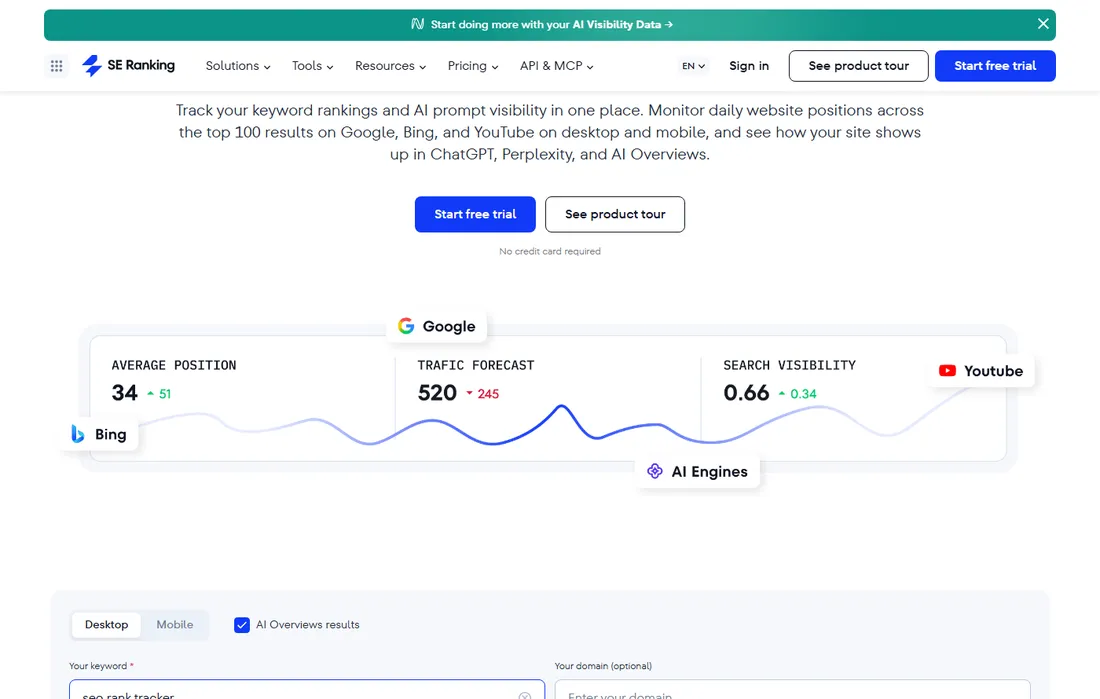
SE Ranking has the most explicit AI-answer-engine coverage of the seven tools reviewed here. Its own page states it tracks “keyword rankings and AI prompt visibility in one place,” monitoring Google, Bing and YouTube positions while also reviewing “how your site shows up in ChatGPT, Perplexity, and AI Overviews,” and separately lists AI Mode and Gemini too.
Pricing starts at $103.20/month for Core, the lowest of the seven paid entry prices found. A 14-day free trial needs no credit card, and a free daily checker (five checks a day, no signup) sits on the product page itself, including a live “AI Overviews results” toggle. Both were confirmed hands-on: entering a real keyword produced the actual tool interface shown above, with the AI-tracking option visible as a genuine part of the same checker, not a separate upsell page.
Best for: teams that specifically want AI-answer-engine visibility built into the same product and price as classic tracking, rather than layered on as a paid extra, and want to try it without a sales conversation first.
Nightwatch (nightwatch.io)
Nightwatch tracks the broadest list of AI engines of any tool in this article: ChatGPT, Claude, Gemini, Perplexity, AI Mode and AI Overview, and states this coverage applies “across every plan,” not reserved for a top tier. Pricing starts at €79/month (Starter), rising through €159/month (Professional) and €399/month (Agency) to custom Enterprise pricing, with a 14-day free trial requiring no credit card.
This wasn’t hands-on tested: like most subscription rank trackers, a fresh trial account wouldn’t return meaningful ranking data in the same research session, since real position data comes from scheduled daily crawls, not an instant lookup. That structural limit applies to every subscription-only tool in this list except the two with genuinely free, no-signup checkers (AccuRanker and SE Ranking).
Best for: a team whose priority is Claude and Gemini coverage specifically, since Nightwatch is the only tool here that names both explicitly, alongside the more commonly tracked ChatGPT and Perplexity.
Wincher (wincher.com)
Wincher is the most budget-oriented classic tracker here, with third-party listings (G2, Capterra) reporting an entry plan around €49/month for 500 keywords. That figure isn’t independently confirmed: Wincher’s own pricing page renders its plan prices via client-side script, and two separate direct-fetch attempts for this article returned the page structure with the price digits missing. A “Try for free” signup is available on the same page.
Nothing on Wincher’s pricing or homepage content mentions AI Overview, ChatGPT or Perplexity tracking. Its only AI-labelled features are “AI Keyword suggestions” and an “AI Content Outliner,” content-optimisation aids rather than answer-engine visibility tracking. For a reader prioritising AI-answer-engine coverage, Wincher currently isn’t the tool for that job.
Best for: a solo consultant or small site that wants straightforward classic keyword-position tracking at the lowest entry price here, and doesn’t currently need any AI-answer-engine visibility layer.
AirOps (airops.com)
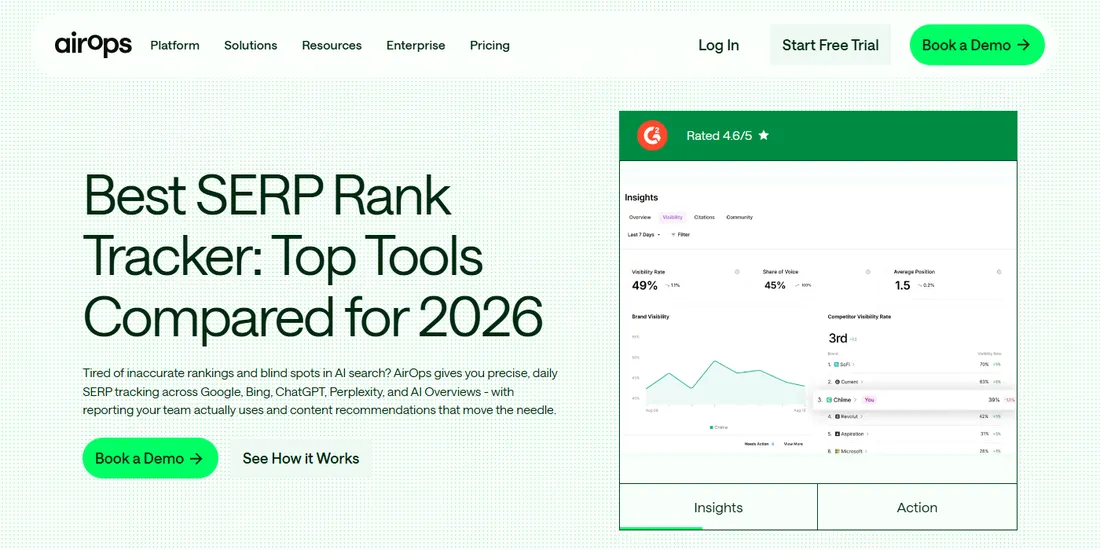
AirOps pairs rank tracking with a broader AI content-production platform, positioned as one tool for tracking and creating content rather than tracking alone. Its free Insights tier starts at $0/month with 1,000 tasks included; a Solo plan is described as “free to start,” and the recommended Pro tier shows feature lists but, per a direct check of every dollar figure on its own pricing page, displays no published monthly price at all, routing instead to a “Start for Free” flow. A 14-day free trial is offered without requiring payment details upfront.
AI-answer-engine tracking is tier-dependent: Solo covers “ChatGPT Insights Only,” while Pro adds “Multi-Engine Insights” across ChatGPT, Google, Perplexity and Google AI Studio.
AirOps’ own marketing page states it achieves “98.7% accuracy,” describing this as the result of “cross-referencing rank data against Google Search Console baselines.” That figure is AirOps’ own claim, made in its own FAQ, not an independently verified measurement, and it’s presented here only as a statement AirOps makes about itself, the same standard applied to every vendor’s self-reported claims in this article. The same page also cites several customer-result percentages from named case studies; those are AirOps’ own marketing material, not independently verified.
Best for: a content team that wants tracking and AI-assisted content production inside one platform, and is comfortable confirming Pro-tier pricing directly with AirOps before committing, since it isn’t published.
Which Tracker Fits Your Team? A Decision Framework
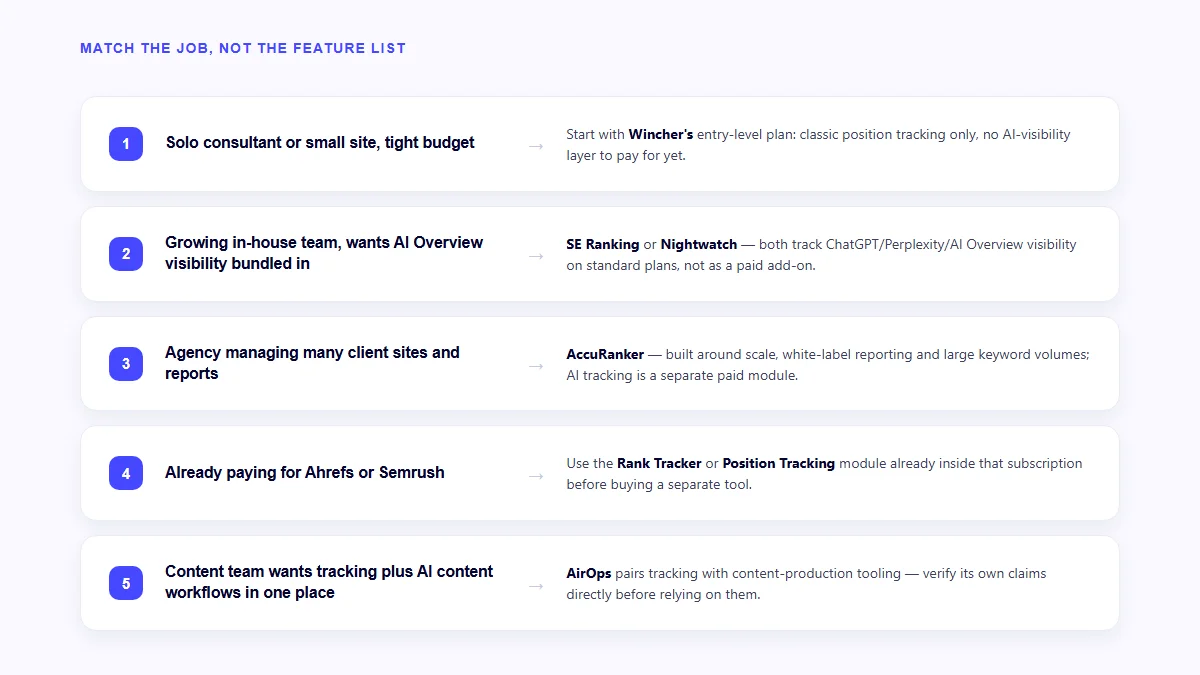
Match the tool to the job in front of you, not the length of its feature list:
- Solo consultant or small site, tight budget: Wincher’s entry-level plan, classic tracking only, no AI-visibility layer to pay for yet.
- Growing in-house team wanting AI Overview visibility bundled in from day one: SE Ranking or Nightwatch, both native, not a paid add-on.
- Agency managing many client sites and reports: AccuRanker, built around scale and white-label reporting; AI tracking is a separate module if a client needs it.
- Already paying for Ahrefs or Semrush: use the Rank Tracker or Position Tracking module already inside that subscription first.
- Content team wanting tracking plus AI content workflows in one place: AirOps, treating its accuracy and case-study claims as marketing to verify, and confirming Pro-tier pricing directly since it isn’t published.
None of these are mutually exclusive; a larger organisation might reasonably run more than one, decided by budget rather than correctness.
Before You Trust Any Vendor’s “AI Visibility Tracking” Claim
“AI visibility tracking” is a genuinely new feature category, not yet defined consistently across vendors, which makes it easy to compare two products that sound similar but measure very different things. Check these specifics directly on the vendor’s current page before treating any claim as settled:
- Native to the plan you’d buy, or a separate paid module? AccuRanker’s base plans and its AccuLLM AI-tracking product are priced and sold separately; SE Ranking’s and Nightwatch’s AI coverage sits inside the same plan as classic tracking.
- Which engines, specifically? “AI visibility” can mean Google AI Overviews only (Ahrefs), or a named list of chat platforms (SE Ranking names five; Nightwatch names six). A vendor that won’t name the engines is worth a direct follow-up question.
- Same coverage on every plan tier, or reserved for a higher one? AirOps’ Solo plan covers ChatGPT only; Pro adds the rest. Worth catching before assuming the cheapest plan gets full coverage.
- What is the tool actually measuring? Google’s own AI Overview documentation states there are “no additional requirements to appear” in AI Overviews or AI Mode beyond normal Search eligibility, and that both “draw from the same index as organic Search.” A tracker reporting AI Overview presence is reporting on an extension of standard Google ranking, not a separate system, and no tracker’s reading changes that.
- How was any accuracy figure produced? A vendor’s own stated accuracy percentage is a claim about its own methodology unless it comes with independent verification. Treat it the way this article treats AirOps’ “98.7% accuracy” figure: a stated claim, not a settled fact.
No single tracker reading, AI-related or not, is a universal “truth,” either. Google personalises and localises results: its own Search Help documentation on why results differ notes that results vary by account activity, location, device, recency and even which data centre answers a query, and that ranking changes roll out gradually. A tracker gives a consistent, repeatable measurement under fixed conditions, useful for spotting trends, not proof of what every individual searcher sees at any given moment.
What a Rank Tracker Can’t Tell You
A rank tracker, however AI-aware, measures position and (for some tools) AI-answer-engine presence. It doesn’t tell you why a page ranks where it does, whether the page is structurally ready for AI systems to parse and cite it, or what to fix if it isn’t; that’s a page-level readiness question, a different layer entirely from position tracking.
If that’s the actual gap, on-page structure rather than tracked position, AI Rank Inspector audits a page’s SEO, AEO and GEO signals directly; it’s a page-level checker, not a rank tracker, and isn’t reviewed or ranked alongside the tools above.
No tool in this article, in any tier or at any price, can guarantee a ranking position, guarantee inclusion in an AI Overview, or guarantee a citation from ChatGPT, Perplexity, Gemini or Claude. Every figure and feature described here is what a vendor states its product measures or does, not a prediction of what it will achieve for any specific site.
FAQs
What’s the difference between a SERP rank tracker and an AI visibility tracker?
A SERP rank tracker’s core job is classic keyword-position monitoring: where a URL ranks in Google (and sometimes Bing) for chosen keywords, day over day. An AI visibility or citation tracker (Profound, Scrunch AI, Conductor, Otterly.ai, covered in our GEO tools comparison) has no position layer at all; it exists specifically to measure whether and how a brand is mentioned across AI answer engines. Some rank trackers here now add AI-answer-engine tracking as a feature, an addition to their core job, not a replacement for it.
Do I need a tool that tracks AI Overviews specifically?
Only if a meaningful share of your target queries actually trigger an AI Overview or get answered inside a chat platform. If most of your traffic comes from queries that still return standard organic results, a tool without AI tracking (Wincher, or Ahrefs and SEMrush’s classic layer) may be entirely sufficient, and cheaper.
Is a higher-priced tracker automatically more accurate than a cheaper one?
Nothing across these seven vendors’ public pages supports that assumption directly. Price differences here mostly reflect keyword volume, team seats, reporting features and AI-tracking breadth, not a documented accuracy gap. Where a vendor makes a specific accuracy claim, like AirOps’ “98.7% accuracy,” it’s presented here as that vendor’s own stated claim, not an independently verified fact.
Can I hands-on test a rank tracker before paying?
Two of the seven, AccuRanker and SE Ranking, offer genuinely free, no-signup checker tools that return real results instantly, both used for this article’s research. Others (SE Ranking, Nightwatch, SEMrush, AirOps) offer trial signups without an upfront credit card, though a trial account won’t show meaningful tracked-position data until it’s had days to run scheduled crawls.
Does Google Search Console do the same job as a paid rank tracker?
Not quite. Search Console shows average position based on your own site’s actual impressions and clicks, genuinely useful and free, but it won’t check a specific keyword on demand, track competitors, or monitor AI-answer-engine visibility. Many teams use both: Search Console for real click data, a dedicated tracker for on-demand and competitive checks.
Does AI Rank Inspector compete with the tools in this article?
No. It’s a page-level SEO, AEO and GEO checker, not a rank tracker. It audits a single page’s structure and readiness signals; it doesn’t monitor keyword positions or AI-answer-engine citations over time. Someone who needs the functionality reviewed here won’t find it there, stated directly rather than blurring the distinction to fit it in.
How to Choose Your First (or Next) SERP Rank Tracker
Start from the job, not the marketing page: decide whether AI-answer-engine visibility needs tracking alongside classic positions right now, or whether that’s a “later” problem once you’ve confirmed which queries actually trigger AI Overviews for your topics. Use AccuRanker’s and SE Ranking’s free checkers to sample real data quality before subscribing. Then verify pricing directly on the vendor’s own current page, since every figure here is a snapshot, and treat any accuracy or AI-coverage claim a vendor makes about itself as something to confirm, not rely on.