
This checklist collects 60 practical SEO, AEO and GEO signals to review before or shortly after publishing a page, grouped into four categories: technical foundations, content and answer structure, entity and trust signals, and AI-specific access and interpretation. It’s a fast reference, not a guarantee of rankings or AI citations.
This is a reference list, not an explainer. If you want the reasoning behind why SEO, AEO and GEO get checked together and in a specific order, how to audit a webpage for AI search readiness covers that process in depth, with a worked example of its own. This article is the fast, skimmable companion: work through it category by category, or jump straight to the section most relevant to what you’re about to publish.
How These 60 Signals Are Organised
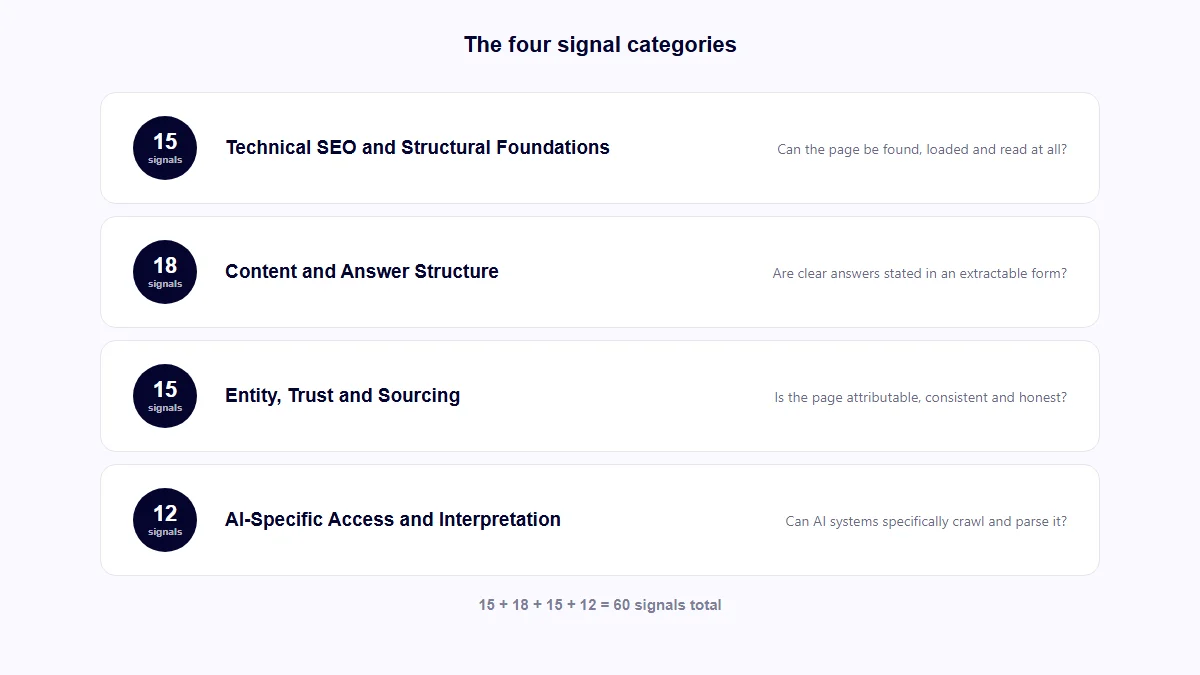
Each of the 60 items sits in one of four categories, roughly in the order a page depends on them: technical foundations first (a page nobody can crawl doesn’t get to compete on anything else), then content and answer structure, then entity and trust signals, then AI-specific access and interpretation items that sit on top of the other three.
- Technical SEO and structural foundations (15 signals): can the page be found, loaded and read at all.
- Content and answer structure (18 signals): does the page state clear answers to real questions, in a form that’s easy to extract.
- Entity, trust and sourcing (15 signals): is the page attributable, consistent and honest about what it claims.
- AI-specific access and interpretation (12 signals): the narrower set of items specific to how AI systems crawl, parse and cite content, on top of the general SEO/AEO/GEO groundwork above.
None of these categories is optional groundwork for the others. A page can pass every content and entity check and still be invisible if a technical issue blocks crawling; equally, a page can be technically flawless and still fail to get a clear answer extracted from it.
Technical SEO and Structural Foundations
These are prerequisites. Get these wrong and nothing downstream (content quality, entity trust, AI interpretation) has a chance to matter.
- Page returns a normal 200 status, not a redirect, error or accidental noindex.
- Page is included in (or eligible for) the XML sitemap.
- robots.txt doesn’t block the page or the assets it depends on.
- Canonical tag points to a single, correct URL, not a duplicate.
- URL slug is short, readable, and uses words a person would actually type.
- Title tag is unique to this page and reasonably concise.
- Meta description is written for a human reader, not stuffed with keywords.
- Page loads at an acceptable speed on a typical mobile connection.
- Page renders correctly and completely on a mobile viewport.
- Images have descriptive file names, not generic camera-export names.
- Images have alt text describing what they actually show.
- Heading hierarchy uses exactly one H1, with H2s and H3s genuinely nested under it.
- Internal links point to pages that are live and genuinely relevant.
- No broken links or missing images anywhere on the page.
- Page sits in the correct category or section and is reachable from site navigation, not orphaned.
Content and Answer Structure
This is the AEO layer: whether the page states something specific enough, and clearly enough, for a reader or a system to extract a usable answer. AEO Audit Checklist for Any Webpage covers this category in far more depth, with its own worked examples, if this is the area you’re auditing most closely. The underlying mechanics of how answer engines discover and select content are covered in how AEO works.
- The page’s main question has a specific answer stated early, not several paragraphs in.
- That answer is self-contained: it would still make sense read on its own.
- The answer is a specific claim, not a vague generalisation.
- Headings reflect real questions a reader would ask, not generic labels like “Overview.”
- The most important question is addressed before minor ones.
- No single question is answered twice under two different headings.
- Multi-step processes are presented as numbered steps, not one dense paragraph.
- Genuine comparisons are presented in a table, not buried in prose.
- Lists are used where there’s an actual list of items to present.
- Unfamiliar terms are defined before they’re used repeatedly.
- Paragraphs are short, generally two to four sentences.
- FAQ content (if present) covers genuinely new ground, not a repeat of the body.
- FAQ questions are phrased the way a person would actually ask them.
- Content matches the likely search intent (informational, comparison or transactional) rather than drifting between them.
- The page covers its topic at a realistic depth, without padding to hit a word count.
- Each section stays on-topic for its own heading, without drifting into the next section’s subject.
- A reader could find the answer to a specific sub-question by scanning headings alone.
- The content reads as useful in its own right, not written primarily to include keyword variations.
Entity, Trust and Sourcing
This is the GEO layer: whether the page is attributable, consistent and honest enough for a system (or a reader) to treat it as a trustworthy source, separate from whether the answer itself is well-formatted. Entity Consistency for SEO, AEO and GEO goes deeper on the naming-consistency items specifically, and how GEO works covers the underlying mechanics of what influences generative-engine trust signals.
- The business, brand or product name is written identically everywhere on the page.
- The author’s name is visible and matches how they’re named elsewhere on the site.
- The author has a bio, or a link to credentials or an About page.
- A publish date is visible.
- A “last updated” date is visible and accurate if the page has been revised.
- Factual claims that need support have a source or clear reasoning attached.
- Any statistics used include enough context to be checked: what was measured, roughly when.
- Opinions and inferences read as distinct from stated facts, not blended together.
- The page states limitations or uncertainty where relevant, rather than overclaiming.
- No unverifiable or invented statistics, quotes or claims appear anywhere on the page.
- The content reads as neutral and informative, not purely promotional in tone.
- Any product or service claims match what that product or service can currently actually do.
- Related people, tools or organisations mentioned are named precisely, not vaguely.
- The page doesn’t contradict factual claims made elsewhere on the same site.
- Contact or About information exists somewhere on the site for a reader to verify who’s behind it.
AI-Specific Access and Interpretation
These sit on top of the three categories above. General SEO, AEO and GEO groundwork still has to be right first. This category covers the narrower set of items specific to how AI crawlers and generative systems access and parse a page.
- robots.txt doesn’t block major AI crawlers unless that’s a deliberate decision.
- Core content is present in the initial HTML, not rendered only by client-side JavaScript.
- Content isn’t hidden behind a login, paywall or interaction that blocks extraction.
- FAQPage schema, if used, matches the visible FAQ content exactly, word for word.
- Article or BlogPosting schema includes author and publish or modified dates.
- Organization or Person schema is present where it genuinely supports entity recognition.
- Any structured data on the page validates without errors.
- No noindex or
data-nosnippettag is applied to content meant to be extracted. - The page doesn’t rely on an image or video alone to convey an answer that should exist in text.
- An llms.txt file, if the site uses one, doesn’t contradict robots.txt.
- The page is revisited and updated periodically rather than left static indefinitely.
- Any redirect pointing to this page is a single hop, not a chain of several.
Which Signals to Prioritise First
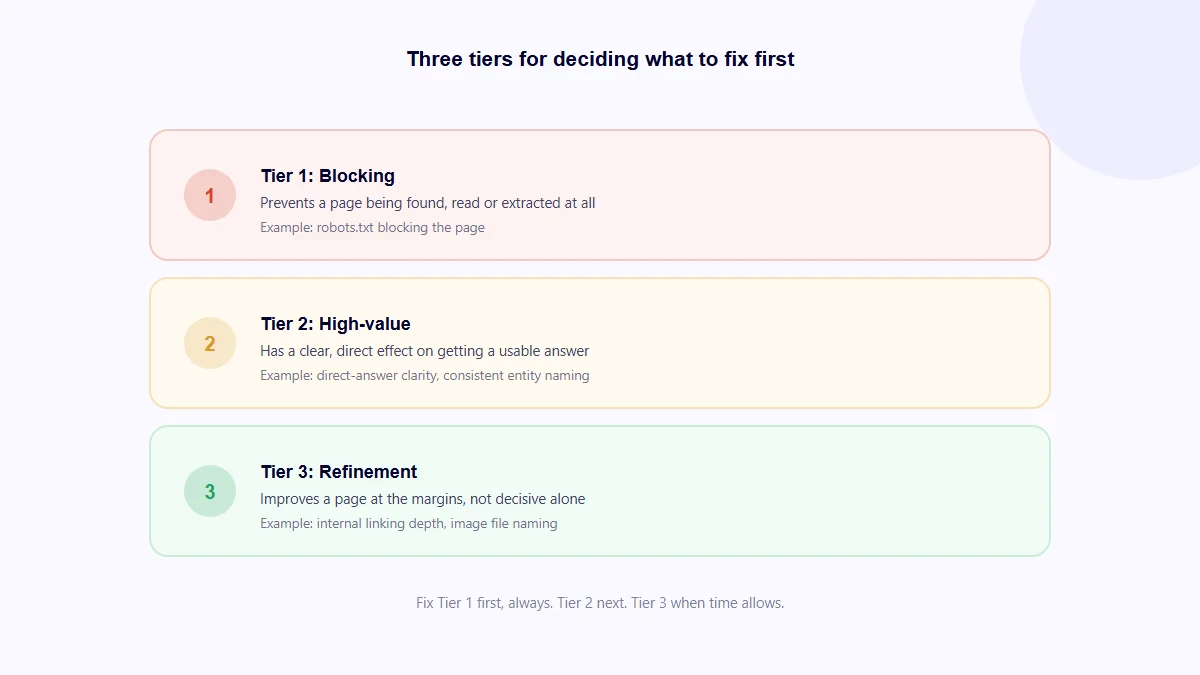
Sixty items is too many to treat as equally urgent on every page. A rough three-tier structure makes triage faster than working through the list in the order it happens to be written.
Tier 1: Blocking. Items that prevent a page from being found, read or extracted at all: an accidental noindex tag, robots.txt blocking the page, content hidden behind a login, or core content that only exists in client-side JavaScript. Fix these before anything else, since every other signal on this list is irrelevant until these are resolved.
Tier 2: High-value. Items with a clear, direct effect on whether a system or reader gets a usable answer: direct-answer clarity, consistent entity naming, accurate publish and update dates, and FAQPage schema matching visible content. These are usually worth fixing on every page that gets meaningful traffic or is meant to answer a specific question.
Tier 3: Refinement. Items that improve a page at the margins without being decisive on their own: internal linking depth, image file-naming conventions, minor formatting polish. Worth doing, but not worth delaying publication over.
This isn’t a formula: how much a specific item matters still depends on what the page is for. But sorting failures into these three tiers before deciding what to fix first tends to produce a better sequence than working straight down the list. For a more formal, numeric alternative to this three-tier triage, what an AEO score measures and what a GEO score measures explain how those scores are typically built.
Worked Example: One Page, Mixed Results
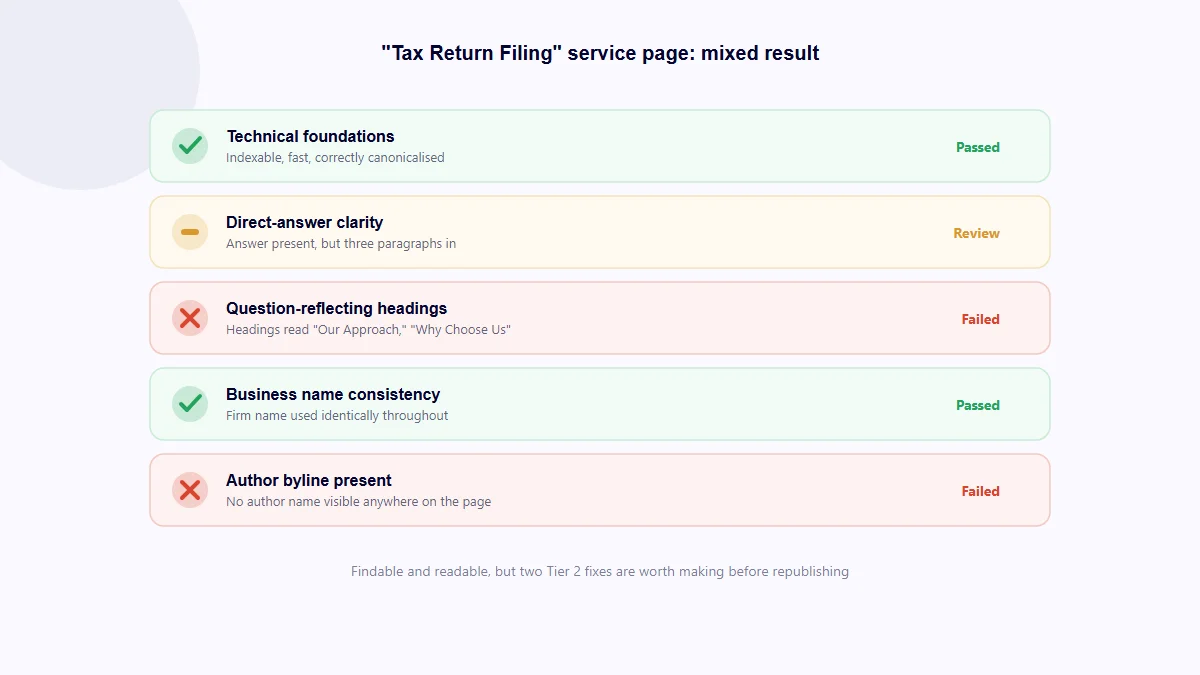
Take a hypothetical example: a service page for a small accounting firm’s “Tax Return Filing” service, about to be republished after a content refresh.
Run it against a sample of items from each category. Technical foundations: the page passes cleanly, indexable, fast, correctly canonicalised (items 1, 3, 4: Passed). Content and answer structure: the main question (“what does this service actually include?”) is answered, but three paragraphs in, after two paragraphs of general framing about why taxes matter (item 16: Review, present but not front-loaded). Headings are generic (“Our Approach,” “Why Choose Us”) rather than reflecting real questions (item 19: Failed). Entity and trust: the author byline is missing entirely, though the firm’s name is used consistently throughout (item 34: Passed; item 35: Failed). AI-specific items: the page has no schema markup at all, so there’s nothing to validate one way or the other, but nothing is blocking a crawler either (item 55: not applicable; item 49: Passed).
The result is a page that would rank and load fine, contains a real answer, but buries it under generic headings and offers no visible author to attribute the content to. Under the tiering above, none of these are Tier 1 blocking issues (the page is findable and readable), but the heading rewrite and author byline are both Tier 2 high-value fixes worth making before republishing, not left for a future pass. Front-loading the buried answer specifically is a writing technique, not just a checklist item; how to structure content for direct answers covers exactly this kind of fix.
How This Differs from the AEO and GEO Checklists
This site has two single-discipline checklists already: one for AEO and one for GEO. This article doesn’t replace either; it sits alongside them as the combined, faster reference.
| This checklist | AEO Audit Checklist | GEO Audit Checklist | |
|---|---|---|---|
| Scope | SEO + AEO + GEO combined | AEO only | GEO only |
| Depth per item | One line per signal | Full explanation, examples, scoring guidance per item | Full explanation, examples, scoring guidance per item |
| Best used for | A fast pre-publish pass across everything | Deep AEO-specific review | Deep GEO-specific review |
| Item count | 60 across four categories | Five detailed categories | Five detailed categories |
If a page fails several items in one category here, that’s the signal to go deeper with the relevant single-discipline checklist rather than trying to diagnose the problem from a one-line item alone.
Common Mistakes When Running Through This List
Treating all 60 items as equally urgent. Working straight down the list in order, rather than sorting by the tiers above, wastes time on refinements while blocking issues sit unfixed.
Checking format without checking whether the underlying claim is accurate. A well-structured, clearly attributed answer that states something factually wrong has passed most of this checklist while still being a worse page than before.
Running this once and assuming it stays valid. A page that passes today can regress after a later edit: a heading gets reworded, a byline gets dropped during a template change. Re-checking after substantive edits catches regressions the first pass wouldn’t.
Applying every item with equal weight to every page type. A short product listing rarely needs the same depth of question-coverage scrutiny as a long-form guide; adjust which categories get the closest attention based on what the page is actually for.
Checking This at Scale
Working through 60 items by hand is realistic for one page, and the tiering above makes it faster, but it doesn’t scale well across dozens of pages checked repeatedly. AI Rank Inspector’s own automated audit reviews 60 page-level signals across four categories (Technical SEO, Content and Relevance, AEO Readiness, and GEO and Trust), each marked Passed, Review or Failed. That structure is similar in spirit to this checklist’s four categories, though it’s worth being precise: this article’s 60 items were built independently from published SEO, AEO and GEO practice and competitor research, not reverse-engineered from the product’s own internal check list, which isn’t published anywhere.
Explore the full feature set or add AI Rank Inspector to Chrome if running an equivalent check automatically would help. It audits what’s observable on a page; it doesn’t guarantee rankings, AI Overview inclusion, or citation by any specific AI system.
Final Practical Takeaway
Sixty items sounds like a lot, but most pages fail only a handful, usually clustered in one or two categories rather than scattered evenly. Sort what you find into blocking, high-value and refinement, fix in that order, and re-check after any substantive edit. That’s a faster and more reliable process than treating every item as equally urgent or working through the list top to bottom regardless of what actually matters for that specific page.
FAQs
Do I need to check all 60 signals for every page?
Not with equal depth. The tiering framework above is meant to speed this up: check Tier 1 blocking issues on every page, and go deeper on Tier 2 and 3 items depending on how much the page matters and how much time is available.
Is this the same list AI Rank Inspector checks internally?
No. AI Rank Inspector’s own audit reviews 60 page-level signals across its own four categories, but its internal check names aren’t published. This checklist’s 60 items were built independently from established SEO, AEO and GEO practice and real competitor research, organised around the same three-discipline logic, not copied from any single tool’s internal list.
How is this different from the AI Search Readiness hub?
That article explains the combined process and the reasoning for checking SEO, AEO and GEO together, with its own worked example. This one is the fast reference list itself: use the hub to understand the process, use this to work through it quickly.
Does passing all 60 items guarantee my page gets cited by an AI system?
No. These are page-level readiness signals. Whether a specific AI system selects a page for a specific query depends on factors outside any one page, including competing content and exact query phrasing.
Should I run this before or after publishing?
Both have value. Before publishing catches obvious issues before they go live; re-running it periodically after publishing catches regressions introduced by later edits.
What if a page fails a lot of items in one category?
That’s a signal to go deeper with the relevant single-discipline checklist (the AEO checklist or GEO checklist) rather than trying to fix everything from this checklist’s one-line descriptions alone.