
An AI search readiness audit checks a webpage against three separate sets of signals: whether it can be found at all (SEO), whether it clearly answers its main question (AEO), and whether it’s trustworthy and well-sourced enough for a generative system to draw on (GEO). Checking only one leaves the other two failure modes invisible.
Most content treats these as separate topics, which makes sense when explaining how each one works. But auditing a real page means checking all three together, in a specific order, because of how they depend on each other. This article walks through that combined process: why the order matters, what to check at each stage, how much each stage matters for different page types, and two worked examples showing how a page can pass some stages and fail others entirely independently.
Why Check SEO, AEO and GEO Together
The three disciplines aren’t peers checking unrelated things. They have a dependency structure. SEO is the prerequisite: a page that isn’t crawlable or indexed has nothing for either AEO or GEO to work with, because no system reaches it in the first place. AEO and GEO, by contrast, are parallel to each other rather than sequential. A page can be strong on one and weak on the other independently, since one is about answer clarity and the other is about trustworthiness, and neither depends on the other directly.
That means the practical audit order is: confirm SEO fundamentals first, then check AEO and GEO, in either order relative to each other, since they don’t depend on one another, but both after SEO. Skipping straight to AEO or GEO checks on a page with unresolved indexing problems means fixing things that won’t matter until the more basic problem is solved.
This dependency structure also explains why a single combined score, or a single pass/fail verdict, can be misleading if it doesn’t show which stage is driving the result. A page that fails on Stage 1 needs a completely different fix (resolve a crawl block, fix a canonical tag) than one that fails on Stage 2 (rewrite a buried answer) or Stage 3 (add a byline, attribute a claim). Treating “AI search readiness” as one undifferentiated number risks pointing effort at the wrong problem.
The Combined Audit Process
Stage 1: Technical Accessibility (SEO)
Confirm the page is actually reachable and indexable before checking anything else: no crawl blocks, a working canonical tag, no accidental noindex directive, and a URL structure that doesn’t bury the page unnecessarily deep in the site. This stage also includes topic relevance in the broader SEO sense: does the page’s content genuinely match what it’s trying to rank for, supported by its title, headings and internal links. A technical SEO review covers this stage in detail.
A practical Stage 1 checklist: confirm the page returns a normal 200 status rather than an error or unintended redirect; check the canonical tag points to itself rather than another page unless that’s deliberate; confirm no noindex directive is present unless intended; check the page is reachable from at least one internal link elsewhere on the site, since orphaned pages are harder to crawl reliably; and confirm the title and headings genuinely reflect the page’s actual topic rather than a mismatched or outdated target keyword.
How much this stage matters varies by page type. A new blog post needs indexing confirmed before anything else is worth checking. An established product page that’s ranked for months rarely needs this stage re-checked unless something’s changed recently: a site migration, a URL change, a robots.txt edit.
Stage 2: Answer and Content Readiness (AEO)
Once a page is confirmed discoverable, check whether it actually answers its main question clearly: is there a direct, self-contained answer near the relevant heading, do the headings reflect real questions, is supporting information presented in extractable formats like lists and tables where appropriate. The full mechanics of how this works, and why it matters, are covered in how AEO works; the detailed, checkable version of this stage lives in the full AEO audit checklist.
This stage is where most content fails even after clearing Stage 1. A page can be perfectly indexed and still bury its actual answer under several paragraphs of scene-setting, which is a content problem, not a technical one. A quick Stage 2 check: read only the first two sentences under the main heading. If the page’s core answer isn’t identifiable from those alone, it’s very likely failing this stage regardless of how good the rest of the content is.
Stage 3: Trust and Interpretability (GEO)
In parallel with (not after) Stage 2, check whether the page’s information is trustworthy enough for a generative system to draw on: is the core entity named consistently, are factual claims attributed to a source, is authorship visible, are dates present where relevant, and does structured data correctly identify what the page represents. The full reasoning behind this stage, including what the available evidence shows actually influences it, is covered in how GEO works; the detailed, checkable version of this stage lives in the full GEO audit checklist.
A page can pass Stage 2 cleanly (a perfectly clear, well-structured answer) while failing Stage 3 if that answer is stated as a bare, unsourced assertion with no visible authorship. The two stages catch genuinely different problems. A quick Stage 3 check: pick any specific claim, statistic or figure on the page and ask whether a sceptical reader could verify it. If there’s no source, no author, and no date attached, that’s a Stage 3 gap regardless of how clearly the claim itself is written.
How Page Type Changes What Matters
Not every stage weighs the same across every page type. An informational blog article leans heavily on Stage 2 (question coverage, direct answers) and Stage 3 (authorship, sourcing), since its whole purpose is providing trustworthy, extractable information. A transactional page, like a checkout flow or a simple pricing page, leans more on Stage 1, since there’s often little “answer” to extract and limited sourcing to display; Stage 2 and 3 checks still apply but matter less. A product listing or service page usually sits in between: a clear answer to “what does this cost and what’s included” matters (Stage 2), and if the page makes specific claims (certifications, guarantees, performance figures), those benefit from Stage 3’s sourcing and trust checks too.
A rough breakdown by page type:
-
Informational articles and guides: heavy Stage 2 and Stage 3 emphasis. The page’s entire purpose is to answer a question and be a credible source for it, so buried answers and unsourced claims are the highest-priority problems.
-
Service pages: balanced across all three stages, with particular attention to Stage 2’s direct-answer clarity for pricing, availability and process questions, and Stage 3 for any claims about credentials, results or guarantees.
-
Product listings: Stage 1 and a narrower slice of Stage 2 (does the listing clearly answer “what is this, what does it cost, is it available”), with Stage 3 relevant mainly where the listing makes specific factual claims (certifications, technical specifications) rather than for the listing as a whole.
-
Transactional pages (checkout, account, booking flows): almost entirely Stage 1. There’s typically little to extract as an “answer” and limited factual content to source, so Stages 2 and 3 contribute little here.
-
Comparison and “best of” content: heavy across all three stages simultaneously. Findable (Stage 1), each comparison point stated clearly (Stage 2), and every claim about the compared items genuinely sourced rather than asserted (Stage 3). This content type tends to fail Stage 3 most often, since comparative claims are easy to write persuasively and easy to leave unattributed.
This is general guidance rather than a fixed rule for any specific platform (crawler behaviour, WordPress structure, Shopify templates and service-page layouts each have their own specific considerations that a general audit process can’t fully capture).
A Worked Example: Auditing One Page Through All Three Stages
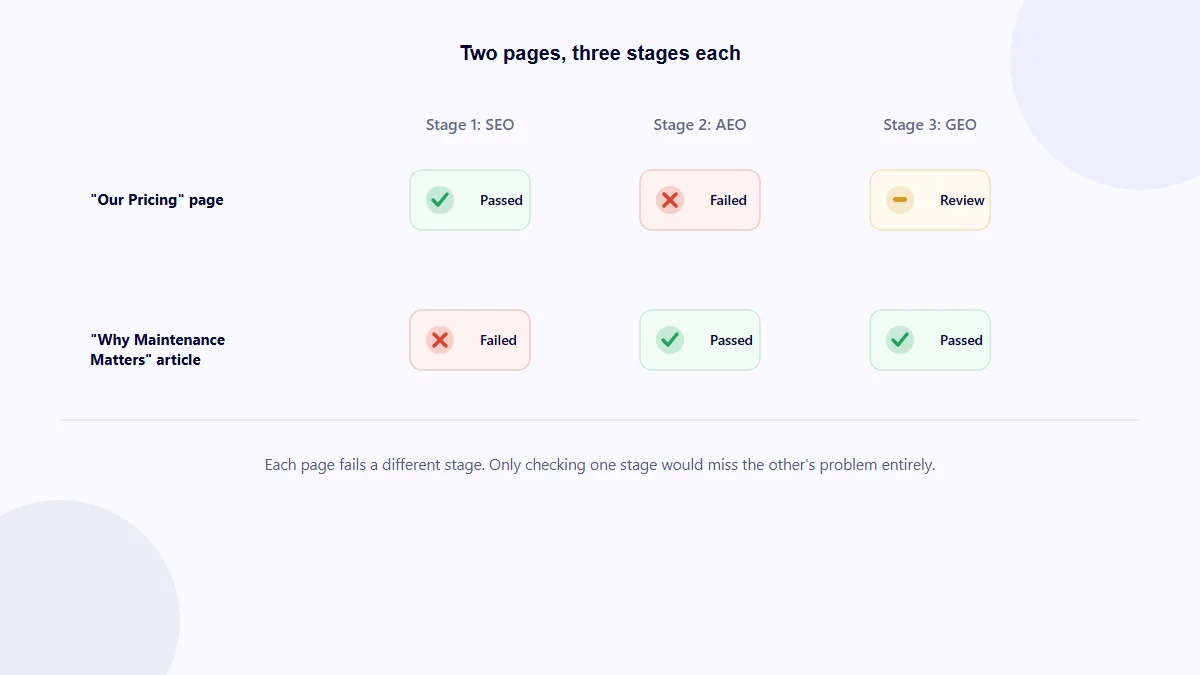
Take a hypothetical page: a service business’s “Our Pricing” page.
Stage 1 (SEO): Passed. The page is indexed, has a clean canonical tag, and ranks reasonably for its target query. No technical issues found.
Stage 2 (AEO): Failed. The actual pricing information is scattered across three paragraphs of qualifying language (“costs can vary,” “typically,” “in most cases”) with no single, specific statement a reader, or a system, could extract cleanly.
Stage 3 (GEO): Review. The business name is used consistently, and there’s a “reviewed by” byline, but a claim about being “the most trusted provider in the region” has no visible source or explanation behind it: present, but borderline.
This page is discoverable, moderately trustworthy, but fails the one job a pricing page most needs to do: state its actual answer. The fix here is entirely a Stage 2 problem (rewriting the pricing statement clearly) and wouldn’t be caught by a Stage 1 or Stage 3 check alone, which is exactly why running all three matters.
For contrast, take a second hypothetical page: a blog article titled “Why Regular Maintenance Matters.”
Stage 1 (SEO): Failed. The page was published recently and isn’t yet indexed. A sitemap issue means it was never submitted for crawling.
Stage 2 (AEO): Passed. The article states its core point clearly in the opening two sentences, with well-structured supporting sections underneath.
Stage 3 (GEO): Passed. Claims are attributed to named sources, the article has a visible author and a publication date, and the business is named consistently throughout.
This second page is the mirror image of the first: strong content and trust signals, but currently invisible to any system because of an unresolved Stage 1 problem. No amount of Stage 2 or Stage 3 quality compensates for a page nothing can find, which is exactly the dependency relationship described earlier.
Common Combined-Failure Patterns
A few patterns show up repeatedly when auditing real pages across all three stages together.
Technically strong, content-weak. A page that ranks well and has no crawl issues, but whose actual answer is diluted across several paragraphs. Stage 1 passes, Stage 2 fails. This is one of the most common patterns on older, well-established pages that were optimised for traditional search years before AEO was a consideration.
Content-strong, trust-weak. A page with a clear, well-structured answer that makes specific claims (statistics, guarantees, comparisons) without attributing any of them to a source or a named author. Stage 2 passes, Stage 3 fails. This is common on marketing-led pages where clarity was prioritised but sourcing wasn’t considered part of the brief.
Both content and trust weak, but technically fine. A page that’s discoverable and ranks, but was written primarily to include a target keyword rather than to answer a specific question or support its claims. Stage 1 passes; Stages 2 and 3 both fail. This pattern is the clearest sign a page needs a genuine content rewrite rather than a small technical fix.
Recognising which pattern a page falls into is often more useful than the raw stage-by-stage results alone, since it points to whether the underlying fix is technical, editorial, or both. A site with many pages showing the same pattern usually points to a process issue rather than a one-off content problem. A content team that consistently produces clear, well-structured pages but never attributes sourced claims, for example, has a sourcing habit to fix across the board, not twenty individual pages to edit in isolation.
What to Fix First
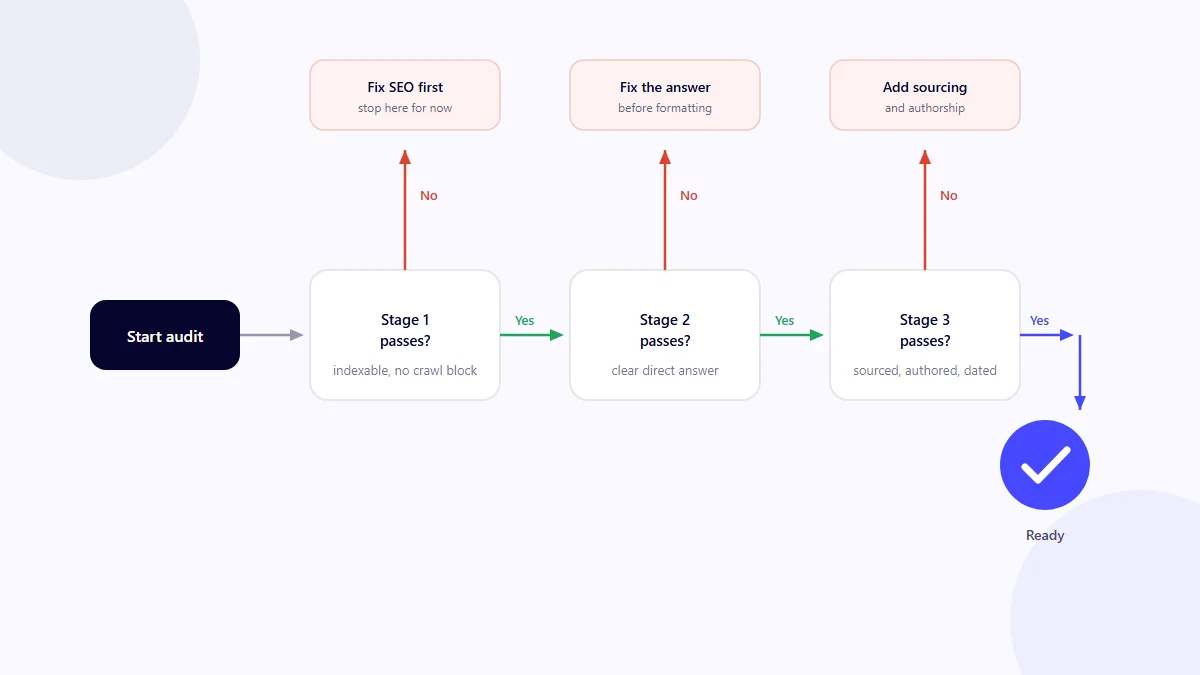
The dependency structure covered earlier turns into a simple decision procedure in practice: check Stage 1 first, and if it fails, fix that before looking at anything else. If Stage 1 passes, check Stage 2. If that fails, fix the answer before worrying about formatting or sourcing. Only once Stages 1 and 2 both pass does Stage 3 become the binding constraint. This isn’t a rigid rule, since a team with spare capacity can reasonably work on more than one stage at once, but it’s the right default order when only one fix can happen at a time.
A Note on AI Crawler Access
Stage 1’s technical-accessibility checks increasingly include a consideration beyond traditional search crawlers: whether AI-specific crawlers (the bots some AI platforms use to access and index web content) can reach a page at all, since some sites block these separately from standard search bots without realising it. This is a fast-moving, still-evolving area with its own considerations around robots.txt directives and emerging standards, detailed enough to warrant its own dedicated coverage rather than a full treatment here. For this audit process, treat it as part of Stage 1: a page an AI crawler can’t reach has the same problem as a page a search crawler can’t reach, just for a different bot.
Common Mistakes When Running a Combined Audit
A few process mistakes show up repeatedly, separate from the page-level failure patterns covered above.
Averaging the three stages into one score. A page that passes Stage 1 and 3 perfectly but fails Stage 2 outright can still look reasonable on an averaged number, even though the failed stage might be the one costing the page the most. Report stages separately, not blended.
Stopping at Stage 1 and assuming the rest follows. A page that’s indexable and ranking isn’t automatically answer-clear or well-sourced. Confirming discoverability is necessary but not sufficient; skipping Stages 2 and 3 because Stage 1 looked fine leaves real problems unchecked.
Applying the same checklist weight to every page regardless of type. Running the full three-stage process with equal rigour on a checkout page and an informational article wastes effort on the checkout page’s Stage 2 and 3 checks, which matter far less there, as covered above.
Auditing once and never returning. A page that passed all three stages at launch can drift: a cited source goes stale, a competing page overtakes it, content gets edited without re-checking the answer’s clarity. Treat this as a recurring process, not a one-off gate.
Doing This at Scale
Running all three stages by hand, across more than a handful of pages, becomes impractical quickly. For a fast, single-list version of every check covered above, see the 60 SEO, AEO and GEO signals checklist. AI Rank Inspector audits observable SEO, AEO and GEO signals together in a single pass, covering the full feature set, and organises results by category so it’s clear which stage needs attention first. It doesn’t guarantee rankings, traffic or citation by any specific platform. It checks what’s observable on the page across all three stages.
Run a combined SEO, AEO and GEO audit with the AI Rank Inspector extension, or check GEO signals on their own with the GEO checker. Add AI Rank Inspector to Chrome to get started.
Final Practical Takeaway
Checking SEO, AEO and GEO as one combined process, in the right order, catches problems that checking any single discipline alone would miss. SEO confirms a page can be found; AEO confirms it answers clearly; GEO confirms it’s trustworthy enough to draw on. A page can fail any one of these while passing the other two, which is exactly why an audit that only checks one discipline leaves real, fixable problems invisible.
FAQs
Do I need to check SEO, AEO and GEO in a strict order?
SEO first, since AEO and GEO both assume a page is already discoverable. AEO and GEO themselves can be checked in either order relative to each other, since they don’t depend on one another.
Can a page pass all three stages and still not get selected by an AI system?
Yes. All three stages check page-level readiness signals, not external outcomes. Selection by a specific platform depends on factors outside any one page: competing sources, exact query phrasing, and systems that change independently of the page itself.
Which stage catches the most problems in practice?
It varies by page, but Stage 2 (AEO) commonly catches issues that Stage 1 alone wouldn’t. A page can be technically flawless and still fail to state its answer clearly, as in the worked example above.
Do all pages need equal attention across all three stages?
No, and page type is the main reason why: a transactional page needs less Stage 2/3 attention than an informational article does.
Is this the same as a general website audit?
No. A general SEO audit typically stops at Stage 1. This process specifically extends that to also check answer clarity and trustworthiness, which a technical-only audit wouldn’t surface.
How often should a page be re-audited?
After any substantive content change, and periodically for pages that make time-sensitive claims (pricing, availability, statistics) even without an obvious edit, since Stage 3 issues can develop simply because a cited source or figure becomes outdated.
How often should a whole site be audited, not just one page?
There’s no documented standard cadence. A practical approach is auditing new or recently changed pages as they’re published, and reviewing a sample of older pages on a recurring basis (quarterly is reasonable for most sites) rather than trying to re-check everything at once.
What if a page fails Stage 1 for reasons outside my control, like a recent site migration?
Fix what’s fixable (canonical tags, sitemap submission, internal links) and treat the rest as a waiting period. Stage 2 and 3 work on that page is still worth doing in parallel, since it’ll be ready the moment Stage 1 resolves, but the SEO problem itself needs its own fix, not an AEO or GEO workaround.
Can a page score well overall but still have a critical problem?
Yes, which is exactly why a single combined score can mislead. A page passing two stages cleanly while failing the third can still look “mostly fine” on an averaged score, even though the failed stage might be the one that matters most for that specific page.