

A direct answer is a specific, self-contained statement placed near the top of the relevant section, stating a clear response to the reader’s question before any supporting detail. Structuring one well means positioning it correctly, stating it specifically, and formatting multi-part answers so each part can be read on its own.
Knowing that direct answers matter for AEO is one thing. Actually writing one well is a different skill, and it’s the part most guidance skips over. This article covers the practical technique: where to place an answer, how to phrase it, how to structure it when it has several parts, and the mistakes that quietly undermine an otherwise reasonable page. It assumes you already know why this matters, covered in full in how AEO works.
What Makes an Answer “Direct”
Three properties separate a direct answer from a page that merely covers the same topic: it’s self-contained, meaning it makes sense read on its own without the surrounding paragraph; it’s specific, meaning it states an actual fact, number or process rather than a general description; and it’s positioned early, meaning a reader or a system encounters it before wading through context they didn’t ask for.
All three matter together. A specific, self-contained sentence buried on line four of a paragraph is still hard to extract, because whatever comes before it has to be read first to reach it. A sentence positioned first but full of hedging (“results can vary,” “it depends on several factors”) is easy to find and useless once found. Getting the position right and the phrasing wrong, or the reverse, both produce the same practical problem: nothing usable to lift out.
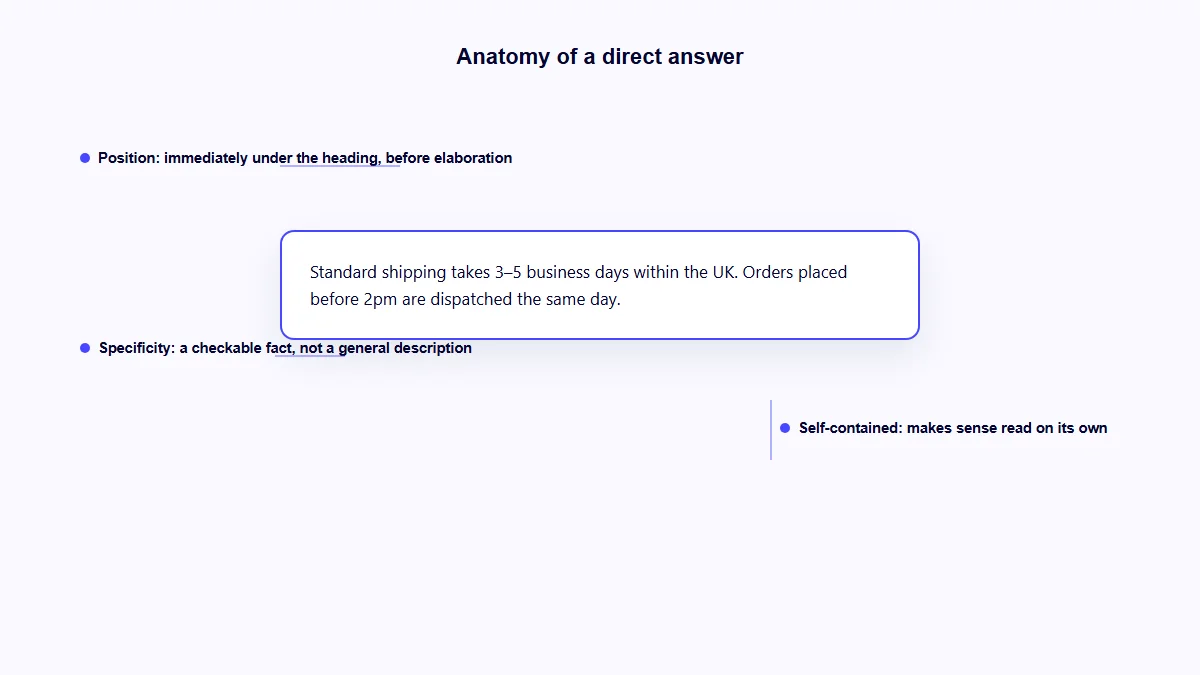
The difference is easiest to see heading by heading. A heading that only names a topic gives a reader no sense of what’s underneath until they read the whole section. A heading phrased as, or closely tied to, the actual question makes the following direct answer easier to write, because the answer has something specific to respond to.
| Heading style | Example | What follows it |
|---|---|---|
| Topic fragment | “Shipping” | Often a general paragraph, since the heading doesn’t commit to a question |
| Answer-ready heading | “How Long Does Shipping Take?” | A specific answer follows naturally: “3 to 5 business days” |
| Topic fragment | “Our Process” | Often vague (“we handle everything carefully”) |
| Answer-ready heading | “What Happens After You Sign Up?” | Invites a concrete, ordered answer |
This isn’t a rule that every heading must be phrased as a literal question. It’s a diagnostic: if a heading is too vague to imply any specific answer, the paragraph underneath usually ends up vague too.
Where to Place the Answer on the Page
The answer belongs immediately under the heading it responds to, before any scene-setting, background or qualification. A reader scanning the page, or a system trying to isolate a response, should be able to read the first sentence or two under a heading and get the actual answer, not a preamble about why the answer matters.
This has a direct implication for how sections get written. If a heading asks (implicitly or explicitly) “how much does this cost,” the very next sentence should state the price, not a paragraph about the factors that influence pricing generally. The context and caveats still belong on the page. They just belong after the answer, not before it.
One answer per section is worth stating as its own rule. A section that tries to address two distinct questions in one paragraph usually ends up giving a partial answer to both rather than a complete answer to either. If a page genuinely needs to answer two separate questions, they need two separate headings, each with its own direct answer underneath.
What the Evidence Actually Supports on Length
The widely repeated 40 to 60 word guideline for a direct answer is a useful editorial target, not a documented requirement from any platform. Google’s own featured-snippet documentation states plainly that it gives no exact minimum length for what qualifies. No other major platform publishes a specific word count either.
Treat the range as a practical default for most short-answer questions, not a rule to force every answer into. A genuinely simple factual answer (“standard shipping takes 3 to 5 business days”) might be shorter than 40 words and still be complete. A comparison-style answer with several relevant factors might reasonably run longer, provided every sentence in it is still doing work rather than padding toward a target length. The point of the guideline is completeness within a tight space, not the specific number.
Sentence-Level Techniques
A handful of sentence-level habits separate answers that read as genuinely direct from answers that merely sit near the top of a section.
Lead with the specific fact, not the topic. “Shipping options and delivery times” describes a topic. “Standard shipping takes 3 to 5 business days” states an answer. The difference is whether the first few words commit to something checkable.
Avoid hedging language before the answer appears. Phrases like “generally speaking,” “in most cases,” or “it can vary depending on” are sometimes genuinely necessary caveats, but they read very differently placed after a specific answer than placed instead of one. State the answer first, then qualify it if a genuine caveat applies.
Use the phrasing a reader would actually search with, not internal or formal terminology the business uses about itself. A page titled with industry jargon but searched for using everyday language creates a mismatch between the words on the page and the words in the question being asked.
Keep one claim per sentence within the answer itself. A sentence trying to state a price, a timeframe and an eligibility condition all at once is harder to extract cleanly than three short sentences each doing one job. This doesn’t mean padding a simple answer into several fragments unnecessarily. It means not compressing several genuinely distinct facts into a single overloaded sentence.
Structuring Multi-Part Answers
Not every direct answer is a single sentence. Where the underlying answer is a process, a set of options, or a comparison, the right structure is a list or table, not a single paragraph trying to hold several distinct pieces of information together.
A three-step process described in one sentence, with steps implied by commas, is harder to extract and harder to read than the same three steps presented as a numbered list. A comparison between two options described in flowing prose is harder to scan than the same comparison in a short table. This isn’t about using structure for its own sake. A genuinely single-fact answer doesn’t need a bulleted list built around it. The test is whether the underlying information actually has multiple distinct parts a reader would want to see separately.
How This Looks by Page Type
The technique doesn’t change across page types, but what counts as “the answer” does. Three short examples make this concrete.
A service page’s pricing section. The question is usually “how much does this cost, and what’s included.” A direct answer states the price and the main inclusion in the first sentence: “Standard installation costs £180 and includes a 12-month warranty.” Everything else, financing options, exceptions, add-ons, follows after.
A product page’s specification section. The question is usually “does this do the specific thing I need.” A direct answer states the relevant spec plainly: “This model supports up to 4K resolution at 60fps.” A page that instead opens with “designed with performance in mind” answers nothing checkable.
A blog article explaining a process. The question is usually “what are the steps, in order.” A direct answer here is often a short numbered list immediately after the heading, not a paragraph promising to explain the process before actually starting it.
In each case, the underlying discipline is the same: identify what the heading is actually asking, then answer that specific thing first, in whatever format (sentence, spec, list) fits the answer’s real shape.
A Worked Example: Rewriting a Buried Answer
Take a service page under the heading “Our Delivery Process.” The original paragraph reads: “We know delivery timing is important to our customers, and we work with a range of trusted courier partners to make sure your order arrives safely and efficiently, with most orders processed within a reasonable timeframe once payment has been confirmed.”
This is a real sentence a page might genuinely contain, and it fails on every property covered above. It’s not self-contained in a useful way, since it never actually states a timeframe. It’s not specific, since “a reasonable timeframe” and “trusted courier partners” commit to nothing checkable. And even though it sits right under the heading, its position doesn’t help, because there’s no answer underneath the position to extract.
A rewritten version: “Orders are dispatched within 1 business day of payment confirmation and typically arrive within 3 to 5 business days via our courier partners. Orders over £50 include free tracked delivery.” This states two specific, checkable facts immediately, with the original paragraph’s reassuring tone (trusted partners, safe arrival) either cut entirely or moved to a supporting sentence afterwards, where it no longer stands in for the actual answer.
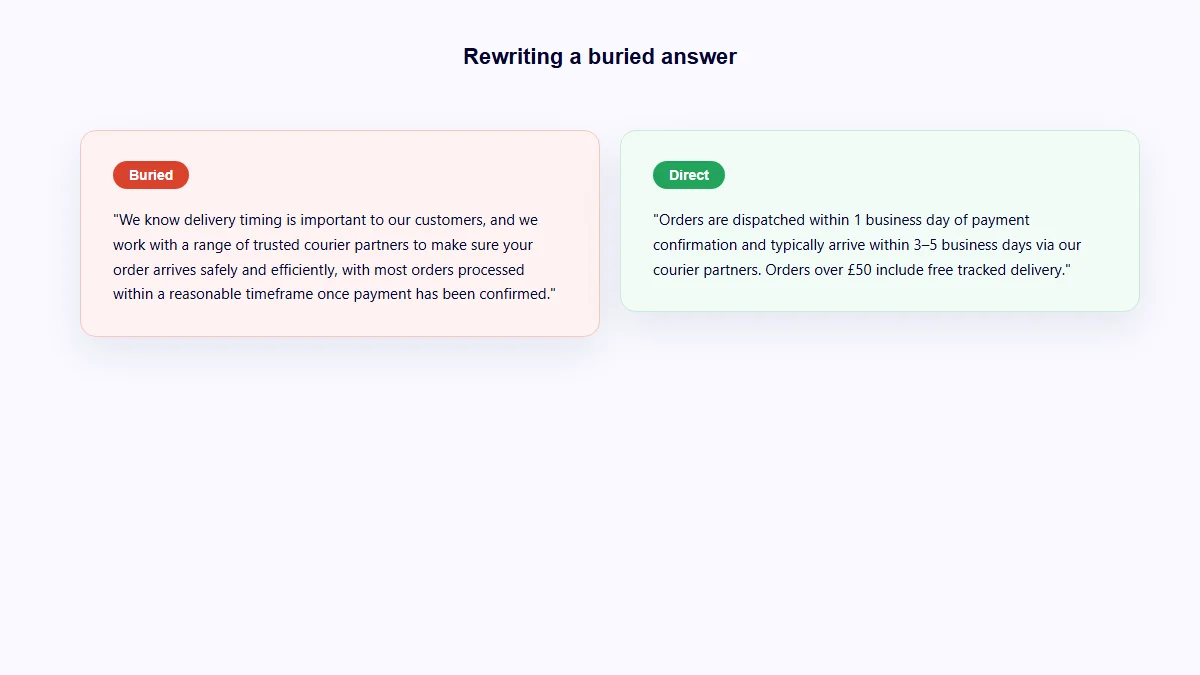
Nothing about the rewrite required new information. Both versions could have been written by someone with identical knowledge of the delivery process. The difference is entirely structural: what got said first, and how specifically it was said.
Common Structural Mistakes
Leading with reassurance instead of information. Sentences built to sound helpful and trustworthy before stating anything concrete (“we’re committed to fast, reliable service”) delay the actual answer without adding anything a reader can act on.
Answering a narrower question than the heading asks. A heading titled “Pricing” followed by a paragraph about the pricing philosophy, rather than an actual price, technically stays on-topic while failing to answer what the heading implied it would answer.
Splitting one answer across two headings. A process explained partly under “How It Works” and partly under a much later “What to Expect” section forces a reader, or a system, to piece together information that should have lived in one place.
Using placeholder specificity. Phrases like “fast turnaround” or “competitive pricing” read as specific at a glance but state nothing checkable. If a number, a timeframe or a named condition would replace the phrase without changing its intended meaning, the vaguer version isn’t adding anything.
Letting the heading and the answer use different terms for the same thing. A heading asking “What Does Onboarding Involve?” followed by an answer describing “the setup process” makes a reader, or a system, work to confirm they’re the same topic. Matching the terminology keeps the question-to-answer link obvious.
How to Check Your Own Page
A short self-check, working through the properties covered above in order:
- Read only the first sentence under each heading, without the rest of the paragraph. If the heading’s implied question isn’t answered by those opening words alone, the section is very likely failing on structure.
- Check whether that opening sentence is actually checkable. A number, a name or a specific process passes; a word like “fast,” “reliable” or “comprehensive” doesn’t.
- Check multi-part answers for format. If the answer describes more than one step, option or comparison point, is it a list or table, or is it still one dense paragraph?
- Scan for hedging language before the answer. Phrases like “it depends,” “generally speaking” or “in most cases” sitting in front of the answer, rather than after it, are a reliable signal the section needs reordering.
A page that fails step 3 repeatedly across several sections is usually worth checking with a tool built to catch this at scale, rather than page by page. AI Rank Inspector’s AEO Readiness category checks direct-answer clarity as one of its audit signals, covering the full feature set, and can help identify which sections on a page are burying their answer rather than leading with it. It doesn’t guarantee selection by any specific answer engine. It checks what’s observable on the page.
Review your page’s direct-answer clarity with the AI Rank Inspector AEO checker, or add AI Rank Inspector to Chrome to get started.
What Good Structure Cannot Fix
Structure makes an existing answer easier to find and extract. It doesn’t create an answer that isn’t there. A page can follow every technique in this article and still fail if the underlying information is missing, inaccurate, or genuinely doesn’t exist yet, because there’s a real gap in what the business has decided or documented.
This connects to a broader distinction worth keeping in mind: page-level structure is something you can act on directly, and it’s what this article covers. Whether a specific answer engine actually selects, cites or surfaces a well-structured answer is a separate, external outcome that page-level structure alone cannot guarantee, covered in more depth in what AEO cannot guarantee.
Final Practical Takeaway
Most weak direct answers aren’t missing information. They’re delaying it behind reassurance, generality or scattered phrasing that never quite commits to a specific statement. Moving the actual answer to the front of the section, stating it specifically, and structuring multi-part answers as lists or tables rather than dense paragraphs fixes the majority of AEO structural problems without requiring any new content at all.
FAQs
How many direct answers should one page have?
Usually one per heading that implies a genuine question, not one per page. A long article with several distinct sub-questions can have several direct answers, each positioned under its own heading; forcing every section to open with a standalone “answer” regardless of what it’s addressing isn’t the goal.
Should the direct answer always be the very first sentence on the page?
It should be the first substantive content under the relevant heading, which usually means the opening of that section rather than necessarily the first sentence of the entire page, since an introduction may reasonably come before the first heading.
Is it acceptable to include a caveat in the same sentence as the answer?
Sometimes, if the caveat is short and genuinely necessary (“standard shipping takes 3 to 5 business days, excluding public holidays”). Longer caveats belong in the sentence or paragraph after the answer, not woven into it.
What if the honest answer really is “it depends”?
State what it depends on specifically, rather than leaving the hedge unexplained. “Pricing depends on order size: £X for small orders, £Y for large orders” is still a direct answer. “Pricing varies” on its own isn’t.
Does rewriting a page for direct answers hurt its readability or tone?
Not necessarily. The worked example above didn’t remove all reassuring language, only moved it after the actual answer. A page can still read warmly and be structured clearly; the two aren’t in tension.
Does a direct answer need its own heading, or can it share one with other content?
It can share a heading, provided it still comes first. A section can open with the direct answer and then continue with related detail under the same H2; what matters is sequence within the section, not a dedicated heading for the answer alone.
How is this different from the AEO audit checklist?
The AEO audit checklist covers what to check across a whole page, including direct-answer clarity as one category among several. This article goes deeper on that one category specifically: the actual writing and structuring technique, not the full audit process.
Does adding more direct answers to a page always help?
Only where a heading genuinely implies a question. Forcing a direct-answer structure onto a section that isn’t actually answering anything specific (a general introduction, for instance) doesn’t help and can read as artificial.