
Entity consistency means naming the same business, product or person the same way everywhere it appears: in a page’s title, body copy, footer, structured data and other pages across the site. It affects all three disciplines differently: SEO’s ability to interpret and deduplicate, AEO’s ability to match a question to the right subject, and GEO’s ability to trust a page as a source.
Most coverage of this topic treats it as a GEO-only concern. It isn’t. This article covers why consistency matters for each discipline specifically, where inconsistency typically creeps in, and how to check for it across a whole site rather than one page at a time.
What Counts as an Entity
An entity, in this context, is anything a page is fundamentally about: a business, a product, a person, a place. A page can have one primary entity (a product page, largely about that product) or several (an article mentioning multiple businesses or people). Consistency matters most for whichever entity the page’s own success depends on being correctly identified.
Why Entity Consistency Matters for SEO
This is the least discussed of the three, but it’s real. Search engines use structured data and on-page signals partly to understand what a page and its entities represent, supporting deduplication and disambiguation, telling the difference between two pages about the same business versus two pages about two different businesses that happen to share a similar name. Correct identification is a separate question from AI citation, though; does structured data actually help AI citations looks specifically at what the evidence shows on that narrower question.
A business referred to inconsistently across its own site (varying legal suffixes, abbreviated names, slightly different spellings) makes this interpretation task harder than it needs to be. This doesn’t directly cause a ranking penalty; no source states that. It does mean the underlying signal search engines use to understand what a page is about is noisier than it could be, for no benefit to the business.
Why Entity Consistency Matters for AEO
Answer Engine Optimisation depends on a system correctly matching a question to the right subject before it can extract or generate a relevant answer. If a page states an answer clearly but names its own subject inconsistently, a system has to do extra resolution work to confirm the answer actually applies to the entity being asked about.
This matters more on pages answering comparison-style or “does X do Y” questions, where the entity being asked about needs to be unambiguous. A direct answer about “our service” without ever naming the service or business specifically is harder to match confidently to a question that names the business directly.
Why Entity Consistency Matters for GEO
This is where entity consistency gets the most attention elsewhere on this site already. How GEO works covers the core reasoning: inconsistent naming forces a generative system to resolve ambiguity about what a page represents rather than being handed a clear answer, and this compounds across a site faster than it does on any single page. This article extends that reasoning across all three disciplines rather than repeating it.
Where Inconsistency Usually Creeps In
Inconsistency rarely happens deliberately. It accumulates from small, reasonable-seeming decisions made at different times by different people.
Page title versus body copy. A title tag might use a shortened brand name for length, while the body copy uses the full legal name, with no one deciding this was a meaningful difference.
Structured data versus visible content. Schema markup added by a developer, separately from content written by a marketing team, can drift out of sync with whatever the visible page actually says, especially after either side gets updated independently.
Footer versus main content. A footer copyright line often carries the full legal entity name (“Acme Consulting Ltd”) while the main content uses a casual shortened form (“Acme”), a small inconsistency that’s easy to overlook because neither section is usually reviewed together.
Across different pages on the same site. A newer page, written later by someone unfamiliar with the established convention, can introduce a third variation without anyone noticing until an audit specifically looks for it.
External profiles and directories. Business listings, social profiles and partner sites often lag behind a site’s own current naming, particularly after a rebrand or a legal name change.
Mid-rebrand transitions. A business partway through a rebrand often runs both names simultaneously on purpose, a legacy name in older content, a new name on recent pages, while the transition is communicated to customers. This is a genuinely different situation from accidental drift: the inconsistency is deliberate and temporary, and the fix isn’t to force one name everywhere immediately, but to have a clear cutover plan and update systematically once the transition period ends, rather than leaving both names live indefinitely by default.
A Practical Consistency Checklist
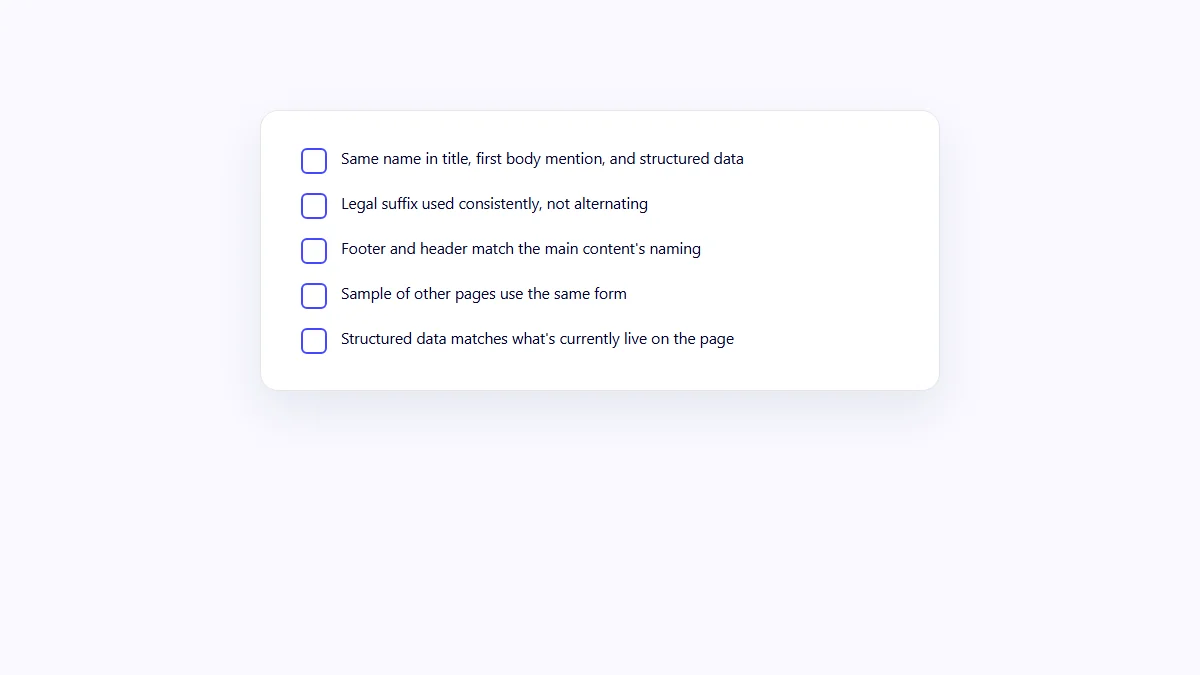
- Does the primary entity’s name appear identically in the page title, the first mention in body copy, and any structured data? Check the exact string, not just a visual impression; “Acme Consulting” and “Acme Consulting Ltd” look similar at a glance but resolve as two different strings.
- If a legal suffix exists (Ltd, Inc, LLC), is it used consistently, either always present or always omitted, rather than alternating? Pick one rule and apply it everywhere, including places that feel minor, like a footer copyright line.
- Do footer and header references match the name used in the main content? These two spots are the ones most likely to have been set up once, early on, and never revisited as the rest of the site’s copy evolved.
- If the site has multiple pages mentioning the same entity, do a sample of them use the same form? Check a handful of pages built at different times, not just the newest ones, since older pages are where drift usually shows up first.
- Does structured data reference a URL, name and description that match what’s currently live on the page, not an outdated version? Schema markup can silently fall out of sync after a content update if whoever made the edit didn’t also check the markup underneath it.
Why This Compounds Faster Than Other Content Problems
Most content problems live on one page and stay there until that specific page is edited. Entity inconsistency doesn’t work that way. Because the same business, product or person gets named repeatedly across a site, a naming decision made once, correctly or not, gets copied forward every time someone writes a new page referencing that entity.
A single inconsistent page is a minor, easily-missed issue. Ten pages using three different naming variants, none of them wrong in isolation, is a genuinely harder problem to resolve, because there’s no longer one clearly “correct” existing pattern to align the outlier to. This is why catching inconsistency early, before it’s copied across many pages, is worth more than the same fix applied later once the pattern has already spread.
A Worked Example
A regional accounting firm’s website refers to itself as “Harlow Finch Accountants” on its homepage title, “Harlow Finch” throughout most body copy, “Harlow Finch & Co” in its footer copyright notice, and its Organization schema markup lists the name as “Harlow Finch Accounting Services,” a fourth variation matching none of the other three.
None of these individually looks wrong to a visitor skimming the page. Together, a system trying to resolve “is this the same business consistently referred to across this site” has four different strings to reconcile rather than one clear answer. The fix isn’t complicated: pick one form (the legal name is usually the safest default) and update all four locations to match, including checking other pages on the site for the same drift.
How to Check Consistency Across a Site
Checking a handful of pages by hand is realistic. Checking an entire site this way, especially one that’s grown over several years with different contributors, becomes impractical quickly. AI Rank Inspector’s GEO and Trust category checks entity naming consistency as part of a combined audit. For the full GEO-specific checklist, see the GEO audit checklist.
If it would help spot where naming has drifted across your own pages, AI Rank Inspector’s GEO checker runs this kind of check, or add AI Rank Inspector to Chrome to try it.
How This Differs for a Person Versus a Business Entity
Everything above focuses on business entities, but the same discipline applies to named individuals, particularly authors, founders and named experts a site relies on for credibility.
A byline that reads “written by J. Harlow” on one article and “by Jane Harlow” on another, with an author bio page that uses a third variation, creates exactly the same resolution problem for a person as inconsistent naming does for a business. This matters more than it might seem, since author identity is one of the more direct trust signals a page can carry, and an inconsistently named author is harder to credit confidently across their body of work.
The fix is the same principle applied to a person: pick one form of the name and use it identically in every byline, author bio and any structured data (Person schema) referencing them.
Common Mistakes
Assuming the homepage sets the standard for the whole site. A consistent homepage doesn’t guarantee consistency on older pages, product pages built by a different team, or pages added after a rebrand.
Treating abbreviation as harmless. A shortened name used occasionally for readability is fine. A shortened name used unpredictably, alongside the full name, with no consistent rule, is what actually causes ambiguity.
Fixing the visible content but not the structured data, or the reverse. Both need to match each other, not just look correct independently.
Never checking external profiles after a rebrand. A site’s own pages can be perfectly consistent while directories and social profiles elsewhere still use a retired name, undermining consistency at the broader entity level.
Final Practical Takeaway
Entity consistency is a small, mechanical thing to get right, and it compounds across a site more than it does on any single page. Checking whether a business, product or person is named the same way in a page’s title, body, footer and structured data catches most of the problem, and fixing it doesn’t require rewriting content, just making sure four places say the same thing.
FAQs
How long does it usually take to fix entity naming across a whole site?
For a small site, an afternoon of find-and-replace across templates and structured data. For a larger site with pages built by different teams over years, it’s more realistic as a rolling fix prioritised by traffic, starting with the highest-traffic pages and working outward rather than attempting every page at once.
If a business operates under multiple sub-brands, does each need its own consistent naming?
Yes, independently. Consistency applies within each sub-brand’s own naming, not across all of them merged into one, since a system needs to resolve each sub-brand as its own distinct entity if that’s genuinely how the business presents itself.
How is this different from the GEO pillar’s coverage of entity consistency?
The GEO pillar’s own treatment introduces the concept and its GEO-specific reasoning briefly. This article covers all three disciplines and goes deeper on practical implementation and checking.
Does a legal name change require updating every mention immediately?
Ideally as soon as practical, prioritising the highest-traffic pages, structured data and external profiles first, since these matter more than an old blog post’s passing mention.
Can inconsistent entity naming cause duplicate content issues?
Not directly, since duplicate content is a different technical concern. It can, however, make it harder for a system to confirm two pages describe the same entity, an adjacent but distinct problem.
Should every mention of a person’s name on a site use their full name?
Not necessarily, but a consistent form (full name in bylines, for instance) used the same way across every article they’ve written is what matters.