
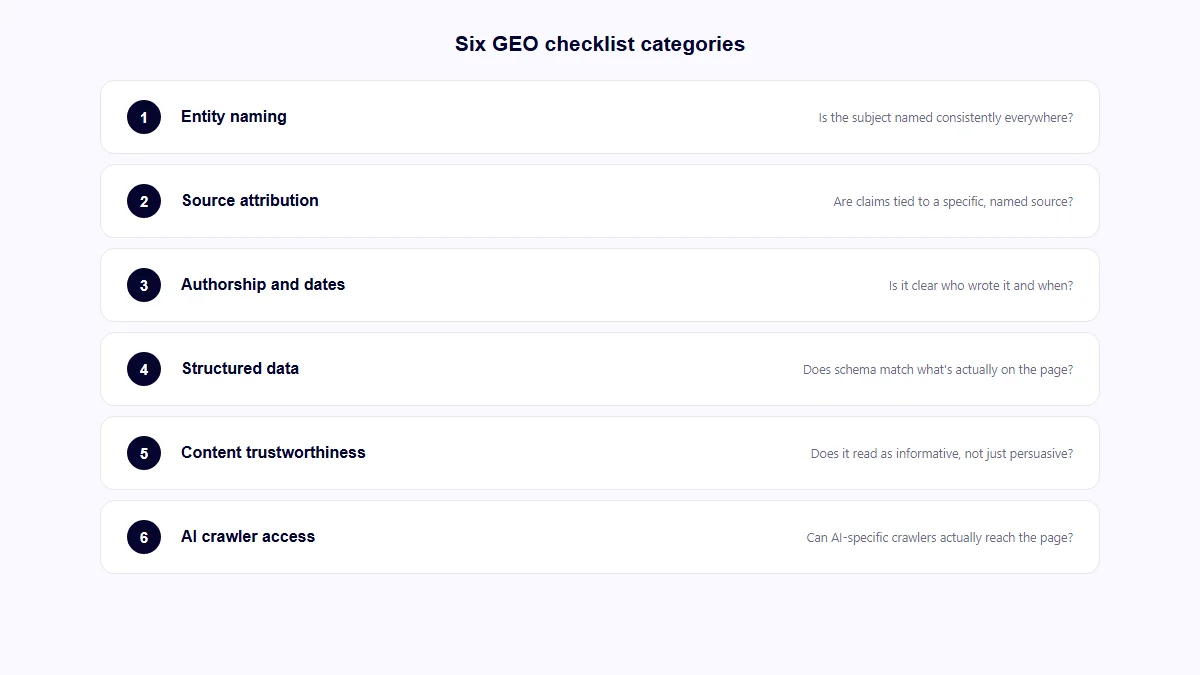
Auditing a page for Generative Engine Optimisation means checking, systematically, whether it names its subject consistently, attributes its claims, and gives a generative system reason to treat it as a trustworthy source. This checklist walks through what to check, in order, on any page.
This assumes SEO and AEO groundwork is already handled. It’s a GEO-only checklist, not a combined audit; how to audit a webpage for AI search readiness covers all three disciplines together, and AEO vs GEO vs SEO compares them directly, if you need either instead. The underlying mechanics of what actually influences generative visibility are covered in how GEO works.
Before You Start
Every item below is a readiness signal, not a guarantee. A page can pass every check and still not be the specific source a generative system draws on for a specific query, for reasons outside the page itself. What this checklist confirms is that a page is a strong, well-prepared candidate to be trusted and used as a source.
This also assumes the page is already indexed and states its answers clearly. If you’re not sure either is true, check those first; a well-sourced page nobody can find or that never answers its own question has bigger problems than GEO can fix.
The Checklist
Entity naming
A generative system needs to resolve who or what a page is actually about before it can decide whether to trust or cite it. Inconsistent naming makes that harder than it needs to be.
- Is the core business, product or person named the same way across the page’s title, body copy, footer and any structured data?
- If the entity has a formal and a shortened name (a “Ltd” or “Inc” suffix, for instance), is one form used consistently rather than alternating?
- Does the page avoid referring to the entity only as “we” or “our company” throughout, with no clear named reference anywhere?
Source attribution
A factual claim without a source is an assertion. Attribution is what turns it into something a sceptical reader, or a generative system, has reason to treat as reliable.
- Are statistics, quotes or factual claims attributed to a specific, named source rather than stated as bare assertions?
- Is the attribution placed near the claim itself, rather than in a general “sources” list disconnected from the specific statement it supports?
- If a claim restates another source’s finding, is that source still current and does it still say what the page implies it says?
Authorship and dates
Knowing who wrote something, and when, is a basic trust signal that’s easy to check and easy to get wrong by omission.
- Is there a visible byline where a reader would reasonably expect one, particularly on informational or advice content?
- Is a publication or last-updated date visible, especially for anything time-sensitive (pricing, availability, statistics)?
- If the content was reviewed or updated, is that reflected in the date shown, not just the original publish date?
Structured data
Structured data doesn’t make a claim more trustworthy by itself, but it removes ambiguity about what a page and its entities actually are.
- Does relevant schema markup (Organization, Product, Article, Person, as applicable) exist and match what’s actually visible on the page?
- Does the markup avoid claiming anything not genuinely supported by the visible content (a rating that isn’t shown to readers, for instance)?
- If the business appears under different names in different places, does the structured data at least use one consistent, canonical form?
Content trustworthiness and neutrality
Google’s own guidance on helpful content states that trust is the most important of the four E-E-A-T qualities, and recommends that content’s primary purpose serve an actual audience rather than attracting search visibility for its own sake. That reasoning applies directly here.
- Does the content read as informative rather than persuasive, avoiding language built primarily to sound convincing rather than to state something checkable?
- Are limitations, caveats or uncertainty acknowledged where genuinely relevant, rather than every claim stated with uniform, unqualified confidence?
- Would the content still be useful to a reader who wasn’t a prospective customer, or does it only make sense as a sales pitch?
AI crawler access
A page with excellent sourcing and entity clarity still needs to be reachable by the systems doing the reading. This is a brief check here, not a deep technical dive.
- Does the site’s
robots.txtblock any AI-specific crawlers unintentionally, alongside standard search bots it means to allow?
How to Score Each Check
The same three-way convention used elsewhere on this site works here: Passed (clearly present), Review (present but borderline, needing a judgement call), or Failed (missing entirely). Fix Failed items first, then work through Review items.
Worked Examples
Take a consultancy’s “About Us” page that reads: “We are industry leaders in delivering exceptional results for our clients, with a proven track record of success across multiple sectors.” Run this against the checklist: Entity naming: Review (the business is only referred to as “we,” never named directly in this passage). Source attribution: Failed (“proven track record” and “industry leaders” are unattributed claims with nothing checkable behind them). Content trustworthiness: Failed (uniformly persuasive language, no acknowledged limitation or specific detail).
A rewritten version: “Acme Consulting has completed over 40 client engagements since 2019, across retail, logistics and healthcare. Case studies for each sector are linked below.” This names the entity directly, states a specific and checkable claim, and points to supporting evidence rather than asserting quality directly.
A second example shows a different pattern. Take a blog article that cites a real statistic well: “According to the Aggarwal et al. 2024 GEO-bench study, citing sources was associated with a 30-40% relative improvement in generative visibility.” This passes source attribution cleanly. But if the same article’s byline is missing and its schema markup identifies the organisation as “Acme Co” while the visible footer says “Acme Consulting Ltd,” it would still fail on authorship and score Review on entity naming, despite the strong sourcing elsewhere. Good performance in one category doesn’t offset a gap in another.
A third example shows the structured-data category specifically. Take a service page whose visible content says nothing about ratings, but whose Organization schema includes an aggregateRating field showing 4.9 stars from 200 reviews, with no reviews actually displayed anywhere on the page. Run this against the checklist: Structured data: Failed (the markup claims something the visible content doesn’t support, exactly the pattern the “adding schema without checking it matches reality” mistake below describes). Entity naming and source attribution might both pass independently, which is the point: a page can be well-named and well-sourced while still failing structured data specifically, because the three checks are genuinely separate diagnostics, not one combined impression. The fix here isn’t rewriting the visible content; it’s either adding the actual reviews the schema claims exist, or removing the aggregateRating field until they do.
How to Prioritise What You Find
On a page with several Failed items across different categories, not all of them are worth fixing in the same order. Two questions help decide: how much does this specific item matter for this specific page, and how much effort does fixing it actually take?
A failed entity-naming check on a homepage is usually both high-impact and low-effort, since it’s often a handful of find-and-replace edits across a few templates. A failed source-attribution check on a long-established article with many claims is higher-effort, since each claim needs a genuine source checked and added, not just a find-and-replace. A failed AI crawler access check, if it turns out to affect the whole site rather than one page, is technically low-effort to fix (one robots.txt line) but high-impact, since it affects every page at once rather than the one currently being audited.
This isn’t a strict formula, since impact depends on how central the failed item is to that specific page’s purpose, which only someone reviewing the actual page can judge. But weighing effort against impact, rather than working through categories in whatever order this checklist happens to list them, tends to produce a more useful fix sequence, especially across a whole site rather than one page.
Common Mistakes
Treating “we have great reviews” as a citable claim. A vague reference to reputation or reviews, without a specific, verifiable source, reads the same as an unsupported assertion to a system trying to judge trustworthiness.
Adding schema without checking it matches reality. Structured data that overstates what’s actually on the page (a review rating with no visible reviews, for instance) risks being treated as misleading rather than helpful.
Naming the entity correctly on the homepage but nowhere else. Consistency has to hold across the whole site, not just the page most likely to be audited manually.
Writing every sentence in a persuasive, sales-oriented register. Content that reads as marketing copy throughout, with no genuinely informative, checkable detail, gives a generative system little reason to treat it as a reliable source over a competitor’s more neutral page.
Assuming a citation once means the sourcing is done. A source that was current when the page launched can go stale. A statistic from a report that’s since been updated or retracted is worse than no statistic, since it’s actively wrong rather than simply absent.
How Long Should This Take?
For a single page, working through all six categories by hand typically takes ten to twenty minutes, depending on how much cross-referencing the entity-naming check requires (checking the page against its own schema markup and footer takes longer than the other categories). Most of that time goes into source attribution, since verifying whether a cited source is still current and still says what the page implies isn’t always a quick check. Auditing a handful of important pages this way is realistic as a one-off review; checking an entire site this way becomes impractical quickly, which is the gap automation is meant to close.
Doing This at Scale
Working through this checklist by hand is realistic for a handful of pages, but checking an entire site this way becomes impractical quickly. AI Rank Inspector’s GEO and Trust category checks entity clarity, sourcing and structured data automatically as part of a combined audit. Add it to Chrome if that would help.
Final Practical Takeaway
Most GEO problems come down to one of two things: the page never says who or what it’s actually about clearly and consistently, or it makes claims nothing backs up. Working through entity naming and source attribution first, before structured data and tone, catches the highest-impact issues on most pages.
FAQs
What should I do if a page passes this checklist but still isn’t being cited?
Check whether the gap is actually AEO or brand recognition rather than GEO. A page can be well-sourced and still go uncited for reasons this checklist can’t diagnose, covered in GEO checker versus AI visibility tracker.
How is this different from the AEO audit checklist?
The AEO audit checklist checks answer clarity and extractability. This checklist checks trustworthiness and sourcing, a genuinely separate concern; a page can pass one and fail the other.
Do I need structured data for every entity mentioned on a page?
No. Focus on the page’s core subject, not every person, product or organisation mentioned in passing.
Is a missing byline always a Failed result?
Not necessarily. On informational or advice content, it usually is. On a short transactional page, authorship matters less, and this item can reasonably be treated as lower priority.
Can a page have too many citations?
Padding a page with citations to hit a perceived quota, rather than because each one genuinely supports a claim, reads as padded rather than trustworthy. Quality and relevance matter more than count.
How often should this checklist be re-run?
After any substantive content edit, and periodically even without one, since cited sources can go stale and entity naming can drift as new pages get added inconsistently over time.
Does this checklist apply to product pages, or only articles?
Any page making a claim a reader might want to verify benefits from this checklist, including product pages stating certifications, specifications or guarantees.