
AI Rank Inspector splits its 100-point score evenly across four audit categories worth 25 points each: Technical SEO, Content and Relevance, AEO Readiness, and GEO and Trust. Within each category, a passed check earns full credit, a review item earns partial credit, and a failed check earns none. The score reflects what’s observable on the page, not a guarantee of rankings or AI citations.
What This Article Covers (and What It Doesn’t)
Two existing guides on this site already explain what an AEO score and a GEO score are in general: what an AEO score measures and what a GEO score measures cover the concept the way most of the industry uses it, across any tool that publishes one. If you haven’t read either, start there for the general idea.
This article is narrower and more specific. It explains how AI Rank Inspector’s own combined score, the single number covering technical SEO, content, AEO and GEO together, is actually built: the real category weighting, the credit logic behind passed, review and failed checks, and what that number deliberately stops short of claiming. Everything below traces to AI Rank Inspector’s own how it works page and its supporting product pages, not to industry convention or a competitor’s method.
The Four Categories and the 25% Weighting
AI Rank Inspector’s audit is organised into four categories, each worth exactly a quarter of the total score:
| Category | Weight | What it examines |
|---|---|---|
| Technical SEO | 25% | Metadata, indexability, canonical signals, links, headings, images and schema |
| Content and Relevance | 25% | Topic coverage, opening copy, headings, depth, readability and internal anchors |
| AEO Readiness | 25% | Direct answers, questions, lists, steps, definitions, tables and FAQs |
| GEO and Trust | 25% | Sources, authorship, dates, entities, claims, policies and structured information |
Each category contributes up to 25 points to the final 0-100 score, and the four totals are simply added together. There’s no further multiplier applied on top, and no category can push the score above its own 25-point ceiling regardless of how the other three perform. A page with an outstanding Technical SEO result and a weak GEO and Trust result cannot have the strong category compensate beyond its own quarter; each section’s points stay capped at 25.
This is a genuinely equal split. It isn’t dressed up as equal while quietly weighting one category more heavily behind the scenes, and it’s worth sitting with for a moment before moving to how the points inside each category are actually earned.
How a Check Becomes a Score: Passed, Review and Failed
Inside each 25-point category sit a number of individual checks. Every check returns one of three results, and the result determines how much of that check’s available credit is awarded:
- Passed: the expected signal was detected and meets the current audit criteria. Full credit.
- Review: the signal is present, but its quality, relevance or implementation may require human judgement. Partial credit.
- Failed: the expected signal was not found or does not meet the audit criteria. No credit.
A review result isn’t the same as an error. AI Rank Inspector’s own product documentation is explicit on this point: a review result “highlights an area that should be checked in context before making changes,” not a definite fault. In AEO terms specifically, a passed check might be a direct answer positioned clearly near its heading; a review result might be an answer that’s present but borderline or partially buried further down the page; a failed check is when no answer to the page’s main question exists anywhere in the content at all.
The product doesn’t publish a total count of individual checks, and this article won’t invent one. What’s documented is the structure: each check nets into its category, each category caps at 25, and the four categories sum to the final score.
AI Rank Inspector also surfaces what it calls recoverable points: a way of flagging which unaddressed issues would move the score the most if fixed, so you can work through the highest-impact gaps first rather than the first thing you happen to notice.
Worked Example: How One Hypothetical Page’s Score Adds Up
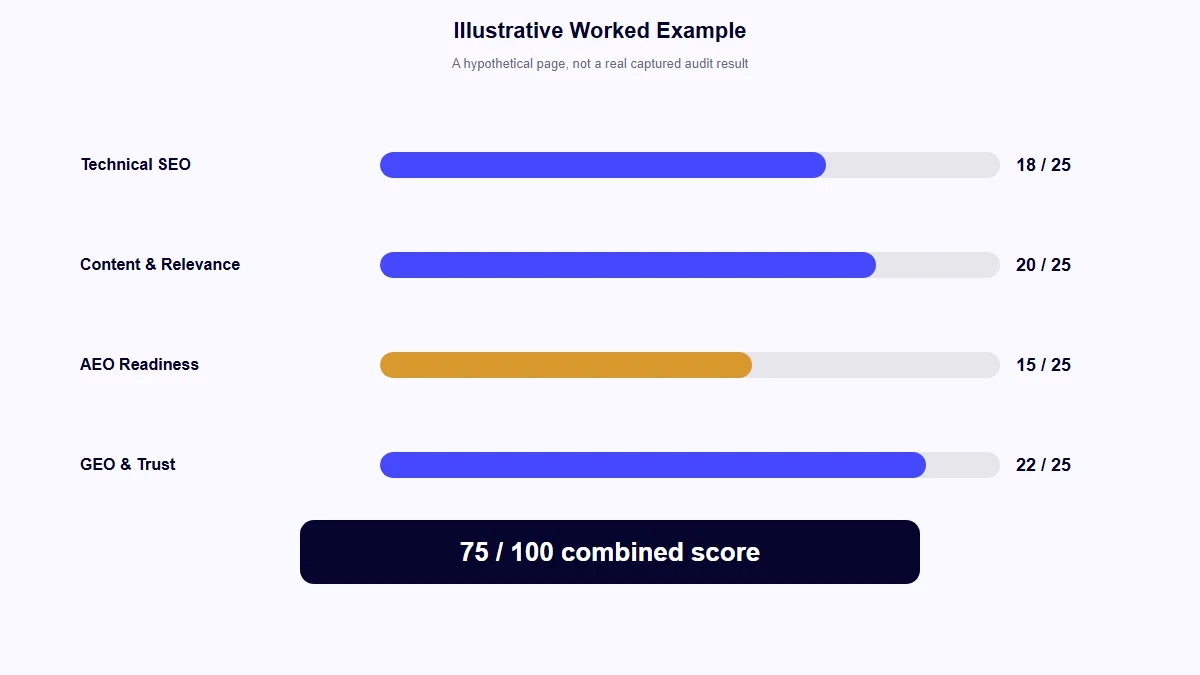
The following is an illustrative example only. It is not a real audit result, and no specific page was scored to produce it; it exists to show how the real weighting and credit logic combine into a final number.
Imagine a mid-length blog article that’s reasonably well built but not fully AEO- or GEO-ready. A hypothetical audit might return a mixed pattern of passed, review and failed checks across the four categories, landing somewhere like this:
| Category | Illustrative result pattern | Points earned (of 25) |
|---|---|---|
| Technical SEO | Mostly passed checks, one review item (a thin meta description) | 18 |
| Content and Relevance | Strong topic coverage, good headings, a couple of review items on depth | 20 |
| AEO Readiness | No clear direct answer near the main heading, missing FAQ structure | 15 |
| GEO and Trust | Author byline and dates present, sources cited, one missing policy link under review | 22 |
Adding those four category totals gives a combined score of 75 out of 100. Notice what that number does and doesn’t tell you on its own: it says AEO Readiness is the weakest of the four sections here, which is exactly the kind of signal the “review and prioritise” step in AI Rank Inspector’s own audit process is meant to surface. Start with the category carrying the most recoverable points, in this case AEO Readiness, rather than polishing an already-strong section further.
Why Equal Weighting Across Four Disciplines
Older SEO tools generally weighted technical factors most heavily; a slow, unindexable, poorly structured page would sink a score even if its content was genuinely good, on the reasoning that technical problems block everything else from mattering. AI Rank Inspector’s stated design takes a different position: it treats technical SEO, content and relevance, AEO readiness and GEO and trust as four separate disciplines of roughly equal importance to how a page performs across both traditional search and AI-assisted search, rather than treating one as the foundation and the others as secondary.
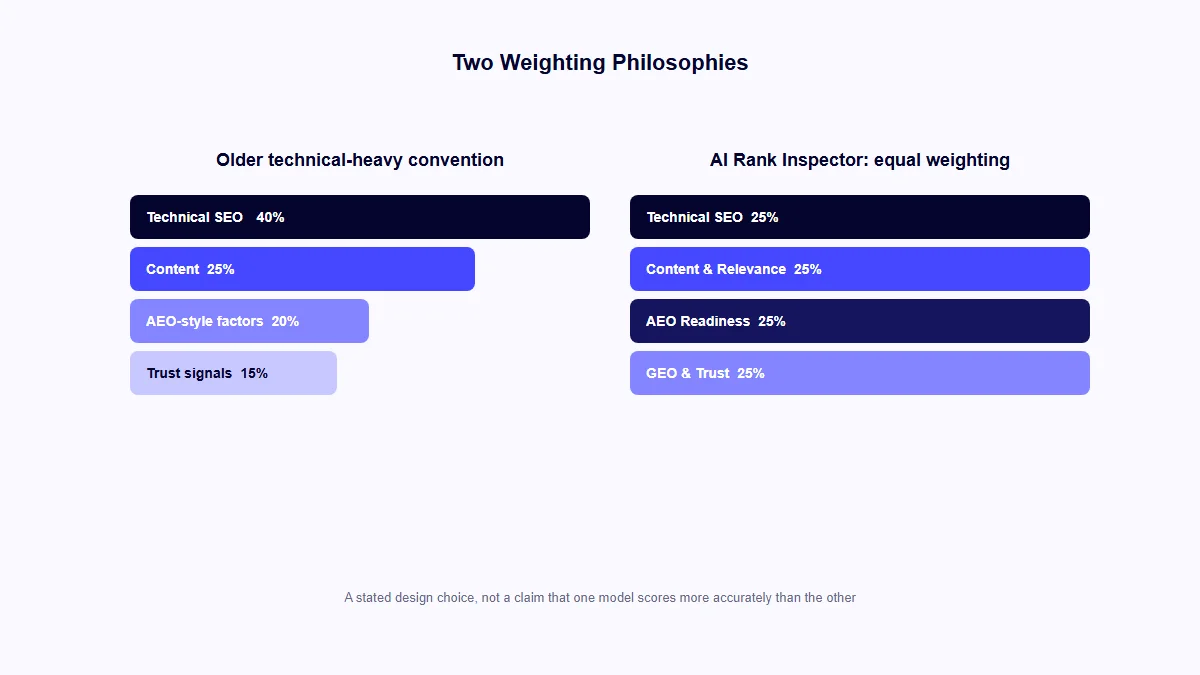
The reasoning is straightforward rather than proprietary: a technically flawless page that never directly answers the reader’s question, or never establishes who wrote it and why it should be trusted, is now just as capable of failing at what a reader (or an AI system summarising an answer) actually needs as a page with broken canonical tags. Equal weighting is a stated design choice, not a claim that it produces a more accurate or more predictive score than a technical-first model; no page-level score, weighted any way, can prove that on its own. It simply reflects a judgement that these four areas deserve equal attention in 2026’s search landscape, rather than one being scored as more foundational than the rest.
Why Two Audits of the Same Page Can Show Different Scores
Running the same URL through AI Rank Inspector twice, days apart, doesn’t always return the same number, and that’s expected rather than a sign of an unreliable tool. A few genuine reasons:
- The page itself changed. Content, metadata, schema or links can all be edited between audits, and each of those maps directly onto one of the four categories.
- Review items are judgement calls, not fixed facts. A signal flagged for review sits in a grey area by design; its quality or relevance “may require human judgement,” in the product’s own words. A borderline case can reasonably be read slightly differently depending on what else changed around it on the page.
- Borderline pass/fail boundaries exist for a reason. Some checks, like whether a direct answer is positioned “near” a heading, aren’t a strict yes/no in the way “does a canonical tag exist” is. Small changes near that boundary can tip a result either way.
This is a different question from what an AEO checker is actually able to automate versus what still needs a person’s judgement; our guide on what an AEO checker actually measures goes deeper on that automatable-versus-judgement distinction specifically.
What the Score Does Not Guarantee
AI Rank Inspector’s own documentation states this plainly, and it’s worth repeating in full rather than softening: the score is a page-level diagnostic. It is not a prediction or guarantee of:
- Google rankings
- Google AI Overview inclusion
- ChatGPT citations
- Gemini citations
- Perplexity citations
- Rich-result eligibility
Nor can it confirm how any specific AI platform internally weighs entity or trust signals; no major platform publishes that formula, and no page-level score can reverse-engineer one. What the score can do is show which observable, page-level signals are present, borderline or missing right now, so you know what’s within your control to improve. What happens after that, whether a given platform actually selects, quotes or cites the page for a given query, depends on factors the page itself doesn’t determine: competing pages, authority signals, exact query phrasing and platform systems that change over time.
This is the same page-level-signal-versus-external-outcome distinction that runs through this site’s broader 60 SEO, AEO and GEO signals checklist (an independently built framework, not a reproduction of this product’s internal check list) and the AEO and GEO audit checklists, worth reading alongside this article if you want the practical checklist version of the same four categories.
FAQs
Does AI Rank Inspector publish the exact number of checks it runs?
No. The product documents the four-category structure and the 25-point weighting per category, along with the pass/review/fail credit logic, but it doesn’t publish a total count of individual checks. Any specific number you see elsewhere for “how many signals” a tool checks should be treated as that source’s own framework, not as this product’s literal internal count.
Can a category score above 25 points if the other categories are weaker?
No. Each of the four categories is capped at 25 points regardless of how the others perform. The four category totals are added together for the final 0-100 score; a strong category cannot borrow headroom from a weaker one.
Is a review result the same as a failed check?
No. A review result means the signal is present but its quality or implementation may need a human judgement call, and it earns partial credit. A failed check means the expected signal wasn’t found at all, or clearly doesn’t meet the audit criteria, and earns no credit for that item.
Does a perfect 100 score mean the page will rank first or get cited by an AI system?
No. A 100 score means every checked signal passed the audit criteria at the time of the check. It doesn’t predict or guarantee Google rankings, AI Overview inclusion, or citation by ChatGPT, Gemini or Perplexity; those outcomes depend on factors outside any single page, including competing pages, site authority and platform systems that change over time.
Why would my score change if I didn’t edit the page?
The most common reasons are a borderline check tipping to the other side of a pass/review boundary, or a review item being reassessed slightly differently, since some checks require judgement rather than a strict binary test. If nothing about the page changed and the difference seems large, re-run the audit and compare which specific category moved.
Is this the same as the AEO Score or GEO Score explained elsewhere on this site?
Related but not the same scope. Our separate guides to AEO scoring and GEO scoring explain the general concept of those two scores across the industry. This article explains specifically how AI Rank Inspector’s own combined score, covering all four categories together, is calculated.
How to Use the Score in Practice
Treat the 100-point total as a starting point for prioritisation, not a verdict. Because each category caps at 25 and the credit logic is transparent, the most useful move after any audit is to identify the weakest category first, then work through its review and failed items using the “recoverable points” the tool surfaces, rather than chasing the last few points in a category that’s already strong. Run the extension from the Chrome side panel on the page you want to check, and read the category breakdown before deciding what to change. The score is diagnostic input for that decision, not a guarantee of what happens once the page is live.