
An AEO checker is a software tool that automatically scans a webpage and evaluates it against Answer Engine Optimisation readiness signals: direct-answer clarity, question coverage, structure and formatting, typically. It measures what’s observably present on the page, not whether any specific answer engine will select, cite or surface that page.
Checker tools are becoming a common way to audit a page quickly, but “what does it actually check” is a reasonable question before trusting the output. This article covers what these tools typically evaluate, what they can automate confidently versus what genuinely needs a human judgement call, and what no checker, however well built, can measure at all.
What an AEO Checker Is
An AEO checker is automated software that scans a webpage’s content and structure, then reports which AEO readiness signals are present, missing or borderline. The main advantage over a manual review is speed and consistency: the same checks get applied the same way every time, across as many pages as needed, without the checks getting skipped when someone’s short on time. For the manual version of the same checks, see the AEO audit checklist.
This is a different tool category from an AI visibility tracker, worth distinguishing briefly here since the two get confused. An AEO checker reads a page directly and reports on what’s there. A visibility tracker tests prompts against live AI platforms and records whether a brand or page gets mentioned, a fundamentally different kind of measurement built by querying platforms rather than reading a page. This distinction is covered in full in AEO checker versus AI visibility tracker.
The Kinds of Signals an AEO Checker Can Evaluate
Most AEO checkers evaluate some combination of the following, since these are the elements most consistently associated with AEO readiness:
- Direct-answer presence and position: whether a specific answer exists near the relevant heading, not buried further down.
- Question-based headings: whether headings reflect real questions rather than generic labels.
- Structure and formatting: whether processes and comparisons use lists or tables rather than dense paragraphs.
- FAQ presence and relevance: whether FAQ content exists and whether it adds genuinely distinct information.
- Heading hierarchy: whether the page’s structure shows a clear, logical reading order.
- Structured data presence: whether relevant schema markup exists and appears to match the page’s actual content.
- Entity coverage: whether the page names its core subject, brand or product consistently, since inconsistent naming makes a page harder for any system to identify confidently. Entity consistency specifically, including cross-site naming, is covered in more depth in how GEO works.
None of this is standardised across every tool. A checker’s specific check list, and how it weights each item, is a design choice made by whoever built it, not a documented industry standard.
What’s Automatable Versus What Needs Human Judgement
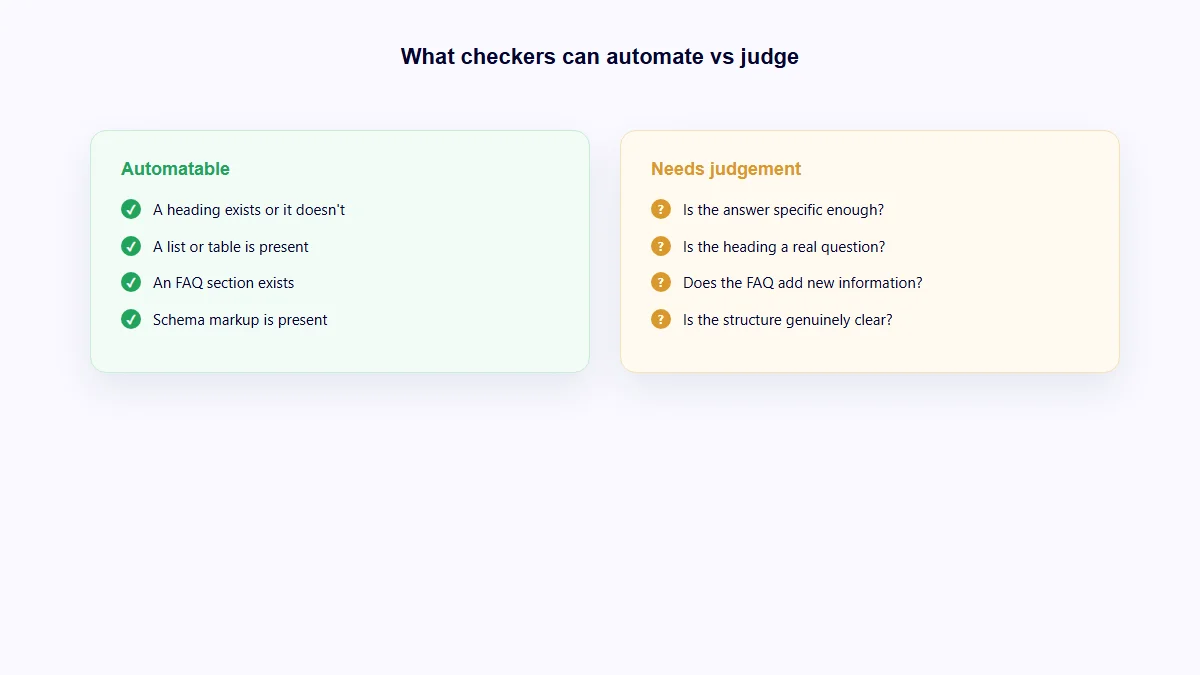
Some of these checks are genuinely objective: a heading either exists or it doesn’t, a list is either present or it isn’t. A checker can evaluate these reliably without much ambiguity.
Others are harder to automate confidently. Whether an answer is “specific enough” to count as a genuine direct answer is partly a judgement call. A sentence might technically state a fact while still being too vague to be useful, and telling the difference between a specific answer and a vague one that merely sounds specific is not always something pattern-matching alone can resolve with confidence.
This is the likely reasoning behind the three-way Passed, Review and Failed convention used by some checker tools, rather than a strict pass/fail result. A clearly present element gets marked Passed. A clearly absent one gets marked Failed. Genuinely borderline cases, an answer that’s technically there but three sentences into a paragraph, for instance, get marked Review, acknowledging that automated confidence has a real limit rather than forcing every result into a binary that would misrepresent genuine grey areas.
What an AEO Checker Cannot Measure
An AEO checker evaluates what’s observable on the page itself. It cannot observe what happens after: whether a specific answer engine actually reads, selects or cites the page for a specific query. That’s an external outcome, decided on a platform the checker has no visibility into.
Google states directly that meeting stated requirements for AI Overviews and AI Mode “doesn’t mean that Google will crawl, index, or serve” a page’s content. The same logic applies to any checker’s output: a page that passes every available check is a stronger candidate for extraction, not a guaranteed one. Selection depends on factors a page-level checker cannot see: competing pages, exact query phrasing, and platform systems that change independently of anything the checker evaluated.
Example: How One Checker’s Categories Break Down
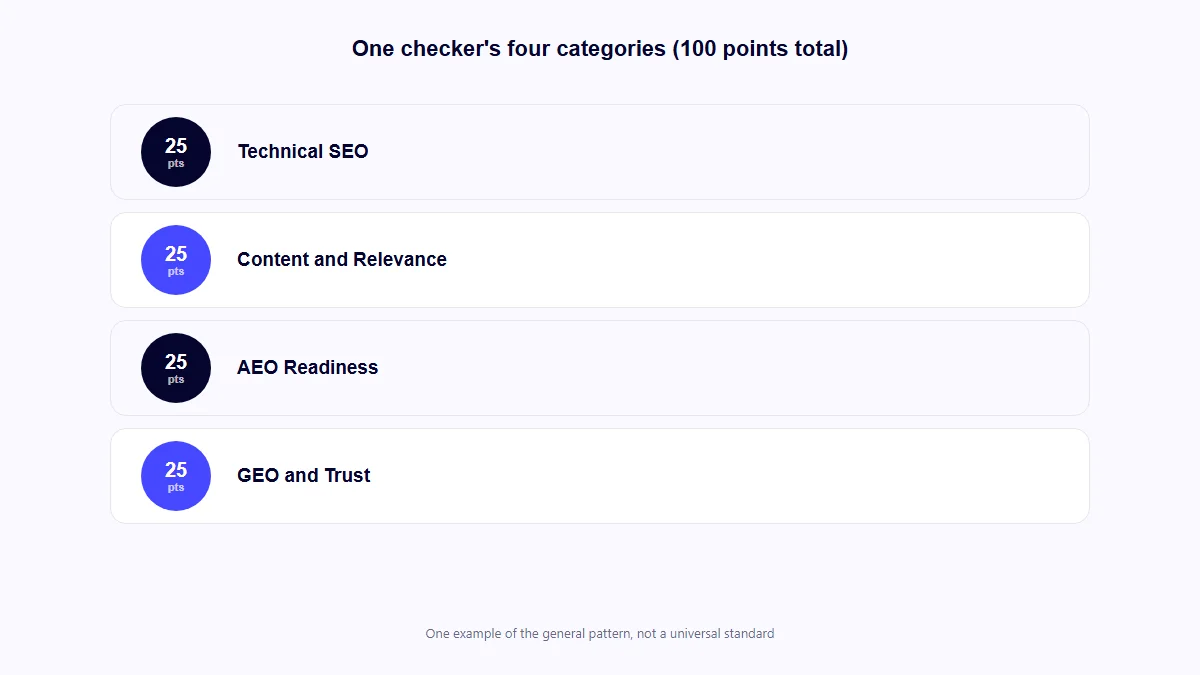
To make this concrete, here’s one real example. AI Rank Inspector’s audit organises its checks into four categories: Technical SEO, Content and Relevance, AEO Readiness, and GEO and Trust, each worth 25 points of a 100-point total. Within AEO Readiness specifically, checks cover direct answers near relevant questions, question-based headings, lists and steps, comparison tables, concise answer blocks, supporting FAQs, and logical heading structure. Each check returns Passed, Review or Failed, with Review items explicitly acknowledged as sometimes needing a human judgement call.
This is one example of the general pattern described above, not a universal standard. A different tool could reasonably use different categories, different point values, or draw the line between Review and Failed differently, and neither approach would be more officially correct, since no official standard for AEO checkers exists.
Questions to Ask When Evaluating an AEO Checker
A handful of practical questions separate a genuinely useful checker from one that just produces a number.
Does it explain why a check failed, not just that it failed? A tool that flags “direct-answer clarity: failed” without saying what’s missing or where forces you to guess at the fix. One that points to the specific section and explains the gap saves real time.
Does it distinguish page-level readiness from external visibility? A checker that implies a high score means a page will get cited by a specific AI system is overstating what a page-level tool can actually know. One that’s explicit about this distinction is being honest about its own limits.
Can you re-check after making changes? AEO readiness isn’t a one-time state. A tool that makes re-auditing quick and easy supports the way this work actually gets done, editing, re-checking, editing again, better than one built for a single one-off report.
Is the check list and scoring logic disclosed, even briefly? A tool that explains what it checks and roughly how results are weighted is easier to trust than one that returns a number with no visibility into how it was reached.
Does it adjust for page type, or apply everything uniformly? A checklist item that makes sense on a long-form article (question-based headings, for instance) may not apply well to a short product listing. A tool aware of this distinction is more useful across a whole site than one that scores every page type identically.
How to Choose Based on Your Use Case
The right checker depends less on which tool has the most features and more on what you’re actually trying to do.
A single pre-publish check on one important page. Here, depth matters more than speed. Look for a checker that explains its reasoning per check, not just a pass/fail count, since the goal is understanding what to fix before the page goes live.
A recurring audit across many pages on an existing site. Here, consistency and re-check speed matter more than depth on any one page. A tool built for repeated runs across a whole site, rather than a single detailed one-off report, fits this better.
A quick sanity check before a bigger content project starts. Here, a fast, lightweight check that flags obvious gaps is enough. Spending a lot of time on a deep audit before any content actually exists is usually premature.
This isn’t a ranking of specific tools. It’s a reminder that “best AEO checker” depends on what you’re checking and how often, not a single universal answer.
Common Misconceptions About AEO Checkers
“A high checker score guarantees AI citations.” This belief usually comes from how scores get presented, a single number that looks like a verdict, not a checklist result. Reading the category breakdown instead of the headline number is a quicker way to remember what the number actually reflects.
“An AEO checker replaces manual review entirely.” It speeds up and standardises the mechanical parts of a review. Judging whether an answer is genuinely useful in context, not just structurally present, still benefits from a human read.
“Any tool that checks for an FAQ section is a real AEO checker.” Checking for the presence of a format isn’t the same as evaluating whether that format is used well. A page can have an FAQ section that fails the underlying question-coverage check just as easily as a page with no FAQ at all.
“More checks always means a better tool.” A long check list padded with items that don’t meaningfully affect extractability is less useful than a shorter list that focuses on what actually matters for a given page type.
Try It Yourself
AI Rank Inspector audits observable AEO signals alongside technical SEO and GEO checks, covering the full feature set, and organises results by what’s worth fixing first, following how the audit process works.
Check your own page with the AI Rank Inspector AEO checker, or add AI Rank Inspector to Chrome to get started.
Final Practical Takeaway
An AEO checker automates what a careful manual review would otherwise do by hand: scanning a page for the structural and content signals associated with AEO readiness, consistently and quickly. It’s genuinely useful for that. What it can’t do, no matter how well built, is confirm what happens once the page leaves the audit, since that depends on systems and competitors no page-level tool can observe.
FAQs
Is there an official standard for what an AEO checker must check?
No. No platform or standards body publishes a required check list for this category of tool. Every checker’s specific checks and weighting are that tool’s own design choice.
Can an AEO checker tell me if my page will appear in an AI Overview?
No. It can tell you whether the page has the readiness signals associated with being a strong candidate for extraction. Whether a specific platform actually selects it is an external outcome no page-level checker can observe.
What should I do if two different checkers disagree on the same page?
Look at which specific check they disagree on rather than which overall score is higher. One tool may weight a borderline case as Review while another calls it Failed; reading both tools’ reasoning for that one item usually resolves the disagreement faster than trying to decide which tool is “right” overall.
What should I actually watch for after publishing, if not citations?
Whether the page’s own readiness holds up over time: re-check after edits, watch for a competing page’s structure improving nearby, and confirm cited sources haven’t gone stale. These are things a page-level checker can observe directly, unlike citation itself.
Do all AEO checkers check the same things?
No. Different tools make different design choices about what to check and how to weight it, which is exactly why two tools can score the same page differently without either being wrong, covered in more depth in what an AEO score measures.
Is an AEO checker the same as an SEO checker?
Not entirely, though some tools combine both. An SEO checker typically evaluates discoverability signals (crawlability, indexing, metadata). An AEO checker evaluates answer clarity and extractability, a related but distinct set of signals.
Can a page fail an AEO checker’s tests but still perform well in AI search?
It’s possible, since a checker only evaluates observable page-level signals, not the full set of factors that influence a platform’s actual selection process. A checker result is a strong indicator, not a complete picture.
How often should I re-run an AEO checker on the same page?
After any substantive content edit, and periodically even without one, since a page’s readiness can drift as content ages or a competing page’s structure improves.