
SEO makes a page discoverable, AEO makes it answerable once found, and GEO makes it trustworthy enough for a generative system to draw on. The three address different questions about the same page, not competing methods for the same goal, and a page can succeed at one while failing another.
Each discipline already has its own dedicated guide on this site. This article is the full three-way comparison: what each optimises for, how they depend on each other, where a page can pass one and fail the others, and how to decide what to prioritise when time is limited.
What Each Discipline Optimises For
SEO is concerned with whether a page is discoverable at all: crawlability, indexing, relevance and overall search visibility. It’s the oldest and most extensively documented of the three, with decades of official platform guidance behind it, and it’s the one pairwise comparison this article doesn’t cover in depth, since AEO vs SEO already does.
AEO is concerned with whether a discoverable page clearly answers a specific question and presents a usable, extractable response. It assumes SEO’s groundwork is already in place and addresses a later, narrower question: once found, can an answer be pulled from this page? How AEO works is the full mechanism explanation.
GEO is concerned with whether a page’s information is trustworthy and well-sourced enough for a generative system to draw on when synthesising a response: entity clarity, source attribution, authorship, structured data. How GEO works covers the evidence behind this in full, including what Aggarwal et al.’s GEO-bench benchmark study found actually influences generative visibility.
How the Three Relate
The three aren’t peers checking unrelated things. They have a dependency structure. SEO is the prerequisite: a page that isn’t crawlable or indexed has nothing for either AEO or GEO to work with, because no system reaches it in the first place.
AEO and GEO, by contrast, are parallel to each other rather than sequential. A page can be strong on one and weak on the other independently, since one is about answer clarity and the other is about trustworthiness, and neither depends on the other directly. A page can state its answer with perfect clarity while making unsupported claims (strong AEO, weak GEO), or be impeccably sourced while burying its actual answer in dense prose (weak AEO, strong GEO).
This means the practical checking order is: confirm SEO fundamentals first, then check AEO and GEO in either order relative to each other, since they don’t depend on one another, but both after SEO.
Comparison Table
| Comparison area | SEO | AEO | GEO |
|---|---|---|---|
| Core question | Can this page be found for a relevant query? | Does this page clearly answer the reader’s question? | Is this page trustworthy enough for a generative system to draw on? |
| What you check first | Indexability, crawl errors, canonical tags | Whether a direct answer exists near the top | Entity naming, source attribution, authorship |
| Typical page signals | Titles, metadata, internal links | Direct answers, question headings, lists, FAQs | Author bylines, dates, citations, consistent entity naming |
| Depends on | Nothing else on this list | SEO (a page must be findable first) | SEO (same prerequisite); largely independent of AEO |
| Failure mode | Page never gets indexed or ranks | Page ranks but nothing is extractable from it | Page is found and answers clearly but reads as unsourced or unreliable |
| How it’s usually measured | Rankings, organic traffic, indexed pages | Direct-answer presence, question-coverage completeness | Entity consistency, citation presence, structured-data validity |
| What it cannot guarantee | Rankings, traffic | Selection or citation by any specific answer engine | Citation or inclusion by any specific generative system |
A Worked Example: One Page, Three Audits
Take a hypothetical page: a consultancy’s “Our Approach” article explaining a proprietary methodology.
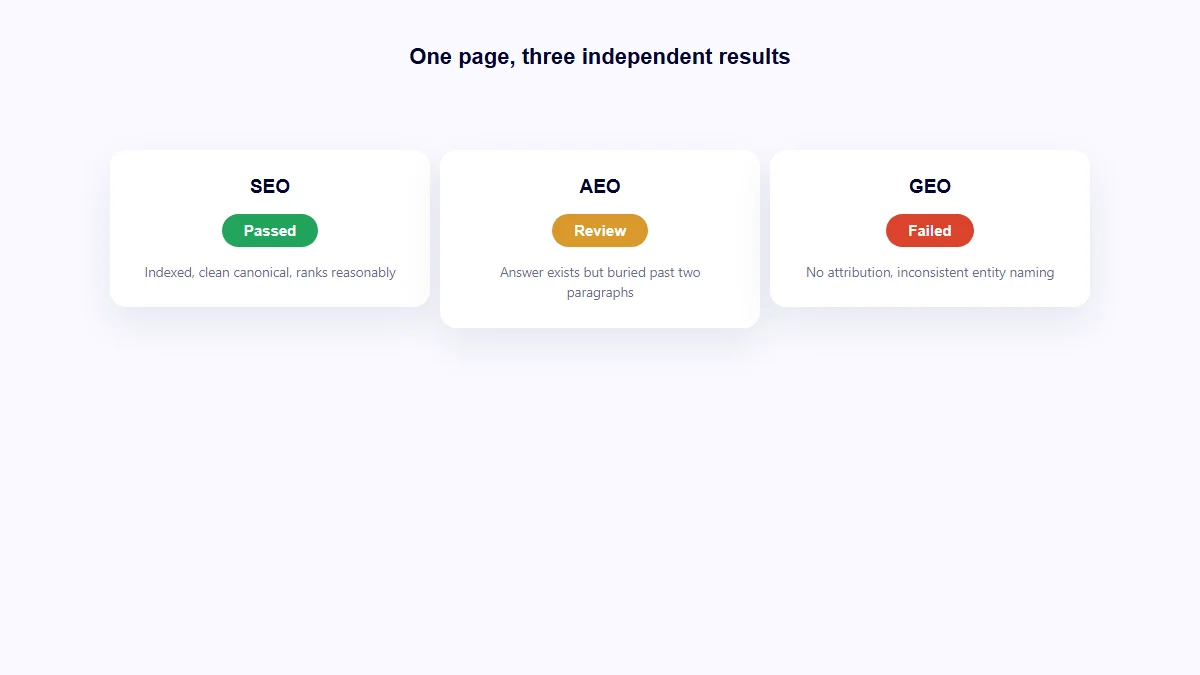
SEO: Passed. The page is indexed, has a clean canonical tag, and ranks reasonably for its target query.
AEO: Review. The page eventually explains the methodology, but the opening two paragraphs are scene-setting rather than a direct answer to “what is this approach.” The actual explanation doesn’t start until the third paragraph.
GEO: Failed. The methodology is described in confident, persuasive language, but no claim in the article is attributed to a source, no author is credited, and the business name is written three different ways across the page and its schema markup.
This page would score reasonably on a combined audit’s technical layer while genuinely struggling on the two content layers, for two entirely different reasons. Fixing the AEO problem (moving the answer earlier) does nothing for the GEO problem (adding a byline and consistent entity naming), and vice versa. Both need addressing, separately.
Common Combined-Failure Patterns
A few two-discipline combinations show up repeatedly when auditing real pages, and recognising the pattern is often faster than checking all three from scratch.
Strong SEO, weak AEO, weak GEO. A page that ranks well but was written years before AEO or GEO were considerations at all: no direct answer near the top, no attribution for its claims. Common on older, high-authority pages that were optimised purely for keywords and backlinks. Both content layers need rebuilding, not just one.
Strong SEO, strong AEO, weak GEO. A page that’s findable and states its answer clearly but was written in a confident, persuasive voice with no sourcing. Common on marketing-led landing pages and service pages, where clarity was the brief and attribution was never considered part of the job.
Weak SEO, strong AEO, strong GEO. A genuinely well-written, well-sourced page that was never properly indexed or internally linked. Common on newer pages published without a technical checklist, or pages accidentally orphaned after a site restructure. The content work is wasted until the SEO problem is fixed.
All three weak. A page written quickly to fill a content calendar, with no structural planning and no sourcing discipline. This is the pattern most worth flagging to a wider content team, since it usually reflects a process gap (no brief, no source pack, no review step) rather than a one-off oversight on a single page.
Noticing which pattern a page falls into is useful beyond that one page: a site with many pages showing the same combination usually has a process issue behind it, not twenty unrelated individual mistakes.
When to Prioritise Which
A brand-new page with no traffic yet. SEO first, always: AEO and GEO work is wasted effort on a page nobody can find yet. Check indexing status in Search Console before touching anything else.
An established page that ranks well but has a high bounce rate on AI-referral traffic. Likely an AEO problem: the page is found but isn’t giving a clear, self-contained answer once someone (or something) arrives. Check whether the first two sentences under the relevant heading actually state the answer, or just lead into it.
A page that ranks and answers clearly but never seems to get cited by AI tools when you’d expect it to. Worth a GEO check: is the content attributed, is the entity named consistently, is authorship visible. Search the page for your own business name in quotes; more than one spelling or format is a common, fast-to-fix cause.
A page that’s part of a comparison or “best of” style article. Needs real strength across all three simultaneously: findable (SEO), each comparison point stated clearly (AEO), and every claim about the compared items genuinely sourced (GEO). This content type tends to fail GEO most often, since comparative claims are easy to write persuasively and easy to leave unattributed. Check whether each comparison point has a specific, checkable source behind it, not just a confident-sounding sentence.
A long-established page nobody has touched in years. Worth checking all three from scratch rather than assuming past performance still holds. A cited source can go stale, a competing page’s structure can improve, and what counted as sufficient sourcing when the page launched may no longer read as credible next to newer, better-attributed competitors. Re-verify every external link on the page still resolves and still supports the claim it’s attached to.
How to Measure Each Discipline Separately
Because the three check different things, they’re also measured differently, and blending the measurements together tends to obscure more than it reveals.
SEO is measured through well-established, widely available metrics: organic rankings for target queries, organic traffic and sessions, click-through rate from search results, and crawl-error counts. Most standard analytics and search-console tools report these directly.
AEO is measured at the page level: whether a direct answer exists and where it sits, how completely a page covers its target questions, and whether structural changes hold up after a re-audit. There’s no equivalent standard reporting to SEO’s rankings and traffic, so this usually means working through a fixed checklist on a recurring basis rather than reading a single dashboard number.
GEO is measured similarly at the page level: whether entity naming is consistent, whether claims are attributed, whether authorship and dates are visible, and whether structured data correctly describes the page. Beyond the page, some separate tools track brand or page mentions across AI platforms by testing prompts, a genuinely different kind of measurement built by querying platforms rather than reading pages.
None of these page-level measurements, for either AEO or GEO, confirm what happens once a page leaves the audit: whether a specific answer engine or generative system actually selects, cites or surfaces it. That’s an external outcome no page-level measurement, however good, can observe directly.
Common Conflations and Misconceptions
“GEO is just AEO for chatbots.” They target different failure modes. AEO is about answer clarity; GEO is about trustworthiness and sourcing, independent of whether the answer itself is clearly stated.
“A high SEO score means the content itself is good.” SEO confirms a page is crawlable, indexed and relevant. It says nothing about whether the answer is clear (AEO) or the claims are sourced (GEO).
“Fixing one discipline improves the others automatically.” Sometimes shared elements help more than one discipline at once (a clear heading helps both SEO structure and AEO extractability), but the three have genuinely separate failure points, and a page can max out one while still failing another.
“These are official, platform-defined categories.” As far as we could find, none of the three appear as named terms in Google’s, Bing’s or OpenAI’s own documentation. They’re industry-coined organising language for real, individually-documented behaviours, not platform-official terminology.
How to Check All Three on the Same Page
Checking all three by hand, one page at a time, is realistic but doesn’t scale across a whole site. AI Rank Inspector audits observable SEO, AEO and GEO signals together in one pass, covering the full feature set, and organises results by category so it’s clear which discipline needs attention first. Add it to Chrome if that would help, without any guarantee of rankings, traffic or citation by any specific platform.
Final Practical Takeaway
Most pages fail one of these three disciplines quietly, since the other two still work fine and mask the gap until someone looks specifically. Treat all three as a standing habit on any page worth the effort, not a one-time pass: re-check after a substantial edit, and don’t assume a page that passed all three a year ago still does, since sources go stale and competing pages improve even when nothing on your own page changes.
FAQs
If I’m a solo content writer with no technical SEO access, is this comparison still relevant to me?
Yes, for the AEO and GEO halves specifically. Both are almost entirely about how content is written and structured, not server configuration or crawl settings, so a writer without technical access can still act on most of what this article covers.
How do I tell which discipline is actually failing without running a full audit?
Read the page’s own main question or claim, then check three things in order: does it show up in search at all (SEO), does the opening of the relevant section actually answer the question (AEO), and is that answer attributed or sourced anywhere (GEO). Whichever check fails first is usually the one to fix first.
Does fixing GEO ever make AEO worse, or the reverse?
Not typically, since the two target different properties of the same content (trustworthiness versus clarity), but it’s possible to damage one while fixing the other carelessly, for example burying a clear answer under a newly added citation and caveat. Fixing one shouldn’t come at the direct expense of the other.
If a tool gives me a combined score, how should I actually read it?
Open the category breakdown before looking at the overall number, and treat the lowest-scoring category as the one worth reading first, not the average. A tool that only shows one blended number without a breakdown is harder to act on, since it can’t tell you which of the three disciplines to fix.
How is this different from the AI Search Readiness audit?
How to audit a webpage for AI search readiness covers the practical combined audit process, in a specific checking order, with its own worked examples. This article is the comparison and relationship explanation the process is built on.
Should every page target all three equally?
No. A purely transactional page (checkout, account settings) has little “answer” to extract and limited claims to source, so it leans mostly on SEO. An informational article leans more heavily on AEO and GEO.
Are SEO, AEO and GEO going to merge into one discipline eventually?
Not something this article can predict. What’s true today is that they check genuinely different things, and treating them as one undifferentiated concern risks missing real, fixable problems in whichever one gets ignored.