
An AEO checker audits a single webpage’s observable readiness signals, direct answers, headings, structure. An AI visibility tracker tests prompts against live AI platforms and records whether a brand or page gets mentioned. One reads a page you control; the other queries systems you don’t. They answer different questions and neither substitutes for the other.
This distinction has come up briefly elsewhere on this site, in an FAQ answer, in passing while explaining page-level versus external AI visibility as part of how AEO works. This article treats it properly: what each tool category actually does, where they genuinely differ, and how to decide whether you need one, the other, or both. It stays deliberately vendor-neutral: judging which named tool in either category is “best” requires real hands-on testing, not general reasoning, and isn’t this article’s job.
What an AEO Checker Does
An AEO checker scans a webpage’s content and structure and reports which AEO readiness signals are present, missing or borderline: direct-answer clarity, question coverage, formatting, and similar page-level elements. It’s a tool you point at a page you control, and it tells you what’s actually there.
This is covered in full in what does an AEO checker measure, including what these tools can automate confidently versus what needs human judgement. The short version relevant here: a checker evaluates the page, not the outcome of publishing it.
What an AI Visibility Tracker Does
An AI visibility tracker works differently. Instead of reading a page, it sends a set of prompts, real or representative queries a target customer might plausibly ask, to one or more AI platforms (ChatGPT, Gemini, Perplexity and similar systems), then records whether a specific brand, domain or page gets mentioned, cited or recommended in the responses. Run repeatedly over time, this builds a picture of whether visibility for a given brand or topic is rising, falling or staying flat across the platforms tested.
This is a fundamentally different kind of measurement from a page audit. It doesn’t inspect any page’s content or structure directly. It queries the platform itself and observes what comes back, the same way a rank tracker queries a search engine’s results page rather than reading the ranking page’s HTML to guess its position.
Because it depends on live platform responses, a visibility tracker’s results can shift for reasons that have nothing to do with any specific page: a platform updates its underlying model, a competitor publishes something more relevant, or the same prompt phrased slightly differently returns a different answer entirely. This variability is a real, expected property of the measurement, not a flaw in how the tracker works.
The Core Difference: What Each Tool Can Actually Observe
This maps directly onto a distinction worth keeping precise: page-level readiness is something that exists on a page and can be checked by reading it. External AI visibility is something that happens on a platform you don’t control and can only be observed by querying that platform directly.
An AEO checker operates entirely in the first category. It can tell you, with reasonable confidence, whether a direct answer exists and where it sits. It cannot tell you whether ChatGPT mentioned your brand in a response to a real user’s question yesterday, because that event doesn’t leave any trace on your page for a checker to find.
An AI visibility tracker operates entirely in the second category. It can tell you whether a specific prompt, tested at a specific time, returned a mention of your brand. It cannot tell you why, since the underlying selection process on the platform’s side isn’t something either kind of tool can see inside. A tracker reports an outcome. It doesn’t diagnose a cause.
Comparison Table
| Comparison area | AEO checker | AI visibility tracker |
|---|---|---|
| What it evaluates | A specific webpage’s content and structure | Live responses from AI platforms to test prompts |
| How it works | Reads and scans the page directly | Sends prompts to platforms and records what comes back |
| Measurement frequency | Point-in-time; re-run manually after changes | Most useful tracked continuously over weeks or months |
| What you can act on | Direct answers, headings, structure, formatting | Little directly; it reports an outcome, not a fixable page element |
| Typical output | A per-page score or checklist result | Mention/citation frequency across tested prompts, tracked over time |
| What it cannot measure | Whether any platform actually cites the page | Why a platform did or didn’t mention a brand |
| Best used for | Finding and fixing page-level readiness gaps | Monitoring whether visibility is shifting over time |
Why the Two Tools Answer Different Questions
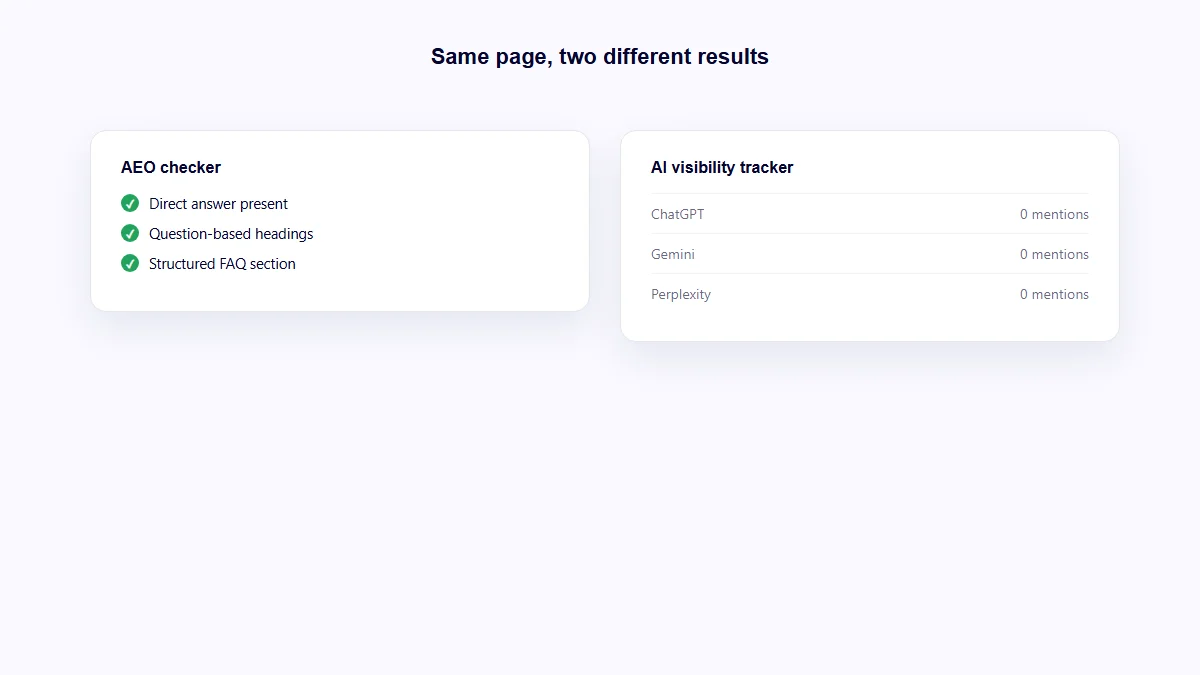
Consider a page that passes every check an AEO checker evaluates: a clear direct answer near the top, well-structured headings, a relevant FAQ section. Run that same page’s brand and topic through a visibility tracker’s test prompts, and the results might show zero mentions across every platform tested. Nothing about this is a contradiction. The checker confirmed the page is well-prepared. The tracker reported that, for the specific prompts tested, at the specific time tested, no platform surfaced it, which could be caused by competing sources, the exact phrasing of the test prompts, or simply how that platform currently handles that particular query, none of which the page’s own structure controls.
The reverse is also possible, if less common: a page with genuine structural weaknesses might still get mentioned in a tracked response, particularly for a well-known brand where a platform’s answer draws on broader brand recognition rather than that one specific page’s content. This doesn’t mean the checker’s findings were wrong. It means the two tools are measuring different things, and a result from one doesn’t validate or invalidate a result from the other.
Do You Need Both?
For most people trying to improve how a site performs in AI search, yes, though not necessarily at the same time or with the same urgency.
Start with an AEO checker. It evaluates things you can act on directly, and fixing what it finds is usually the highest-leverage work available, since a page with no direct answer or a buried structure has little chance of being useful to any platform regardless of what a tracker later reports.
A visibility tracker earns its place once page-level readiness work is already underway or largely done. Its value is in showing whether visibility is actually shifting over a meaningful stretch of time, not in diagnosing what to fix on any individual page, which isn’t a job it’s built to do. Running a tracker before addressing obvious page-level gaps mostly just confirms what a checker would have told you faster and more specifically: the groundwork isn’t there yet.
A single tracker reading, taken once, is genuinely less useful than a trend, for the same reason a single AEO score reading is less useful than one tracked over time: platform responses can shift between one query and the next for reasons that have nothing to do with any page edit. One good reading doesn’t confirm lasting visibility any more than one weak reading confirms a lasting problem. The pattern across several readings is what actually tells you something.
Common Misconceptions
“A visibility tracker replaces the need for an on-page audit.” It reports an outcome, not a diagnosis. Even a strong tracked result doesn’t tell you which page elements are working, and a weak one doesn’t tell you what to fix.
“A high AEO checker score guarantees tracked visibility.” It doesn’t, and the scenario above shows why: page-level readiness and platform-side selection are genuinely separate, and one improving doesn’t automatically move the other.
“Visibility tracking results prove a specific page change caused the shift.” Tracked mentions can move for reasons entirely unrelated to a specific edit, a platform update, a competitor’s new content, or simple variation in how a prompt gets answered. Attributing a tracked change to one specific fix, without controlling for everything else that could explain it, overstates what the measurement can support.
“These are really the same category of tool with different branding.” They measure different things by design, not by marketing choice. A checker that also tracked live platform mentions, or a tracker that also read page structure, would be doing two genuinely distinct jobs, not one job described two ways.
Where AI Rank Inspector Fits
AI Rank Inspector is an AEO checker: it audits observable page-level SEO, AEO and GEO signals, covering the full feature set, and organises results by what’s worth fixing first. It does not test prompts against AI platforms or track brand mentions over time, that’s a different category of tool, described generally above. It checks what’s observable on the page, consistent with the readiness-versus-visibility distinction this article is built on.
Check your own page’s readiness with the AI Rank Inspector AEO checker, or add AI Rank Inspector to Chrome to get started.
Final Practical Takeaway
An AEO checker and an AI visibility tracker aren’t competing tools measuring the same thing two different ways. One evaluates a page you control; the other observes a platform you don’t. Fixing what a checker finds is the work you can act on directly. Watching what a tracker reports over time tells you whether that work is showing up anywhere beyond the page itself, which is a genuinely different, and later, question.
FAQs
Can one tool do both jobs at once?
In principle, a platform could combine page auditing and prompt-based visibility tracking into one product. As of this writing, these remain two distinct measurement approaches, whether offered by the same company or different ones, and it’s worth checking which one you’re actually looking at before relying on its results.
If my visibility tracker shows good results, do I still need an AEO checker?
Yes, if you want to know why, or want to keep that visibility as content changes over time. A tracker’s snapshot doesn’t explain which page elements are contributing to the result.
What should I check first if a tracker shows unexpectedly poor results?
Whether the test prompts themselves match how a real customer would actually ask, before assuming the page is at fault. A prompt phrased more formally or more narrowly than a genuine query can under-represent a page that’s otherwise well prepared.
Is visibility tracking more important than page-level auditing?
Not more important, but a later step. Page-level work is something you can act on immediately. Visibility tracking tells you whether that work is showing up in outcomes over time, which only becomes a meaningful signal once there’s something solid on the page to track the effect of.
How often should visibility tracking be run, compared to an AEO checker?
A checker is worth running after any substantive content edit, since its result reflects the page as it currently stands. A tracker is more useful run at a steady interval over a longer period, since a single reading says little and the value comes from watching a trend.
How should I interpret a sudden drop in tracked mentions?
Check for an obvious external cause first (a platform update, a new competing source) before assuming a page-level problem. A single-run drop can easily be noise; a drop that holds across several consecutive runs is the more reliable signal something has actually changed.
Does a page need to pass every AEO check before visibility tracking is worth running?
Not strictly, but a page with several unresolved Failed items is one where a tracker’s result is unlikely to teach you much beyond what the checker already flagged directly.