
Tracking Google AI Overview “rankings” means checking, on a fixed cadence, whether a target query triggers an AI Overview at all and whether your page is cited inside it, then logging the result against date, location and device. There’s no fixed position to record, only presence, absence and citation, and both studies and Google’s own documentation confirm that reading shifts between checks more than a classic ranking does.
What “Tracking AI Overview Rankings” Actually Means
The phrase borrows its structure from classic rank tracking, where a tool checks a keyword and records a number: position 4, position 11, whatever it is that day. AI Overviews don’t offer that. Google’s own documentation on AI features states plainly that “there are no additional requirements to appear in AI Overviews or AI Mode, nor other special optimizations necessary” beyond being “indexed and eligible to be shown in Google Search with a snippet.” There’s no separate ranking system to measure a position within, because an AI Overview isn’t a ranked list the way the ten blue links are.
What you can actually track is narrower and more binary: did this query trigger an AI Overview at all, and if it did, was your page one of the sources cited. Run the same query a week later and you’re checking the same two things again, not watching a number move up or down a scale.
This article covers that monitoring practice: building the query list, running the checks, logging what you see, and reading the log honestly. It’s a practical companion to how generative engine optimisation works, which explains the broader mechanism this tracking practice sits underneath. It doesn’t cover why a particular page gets cited over another; how pages get cited in Google AI Overviews covers the structural signals research has found correlate with citation, a different question from the one this article answers.
Why There’s No Fixed Position to Record
AI Overviews are built differently from a ranked results page. Google’s documentation describes the process as “query fan-out”: the system issues “multiple related searches across subtopics and data sources” and, “while responses are being generated, our advanced models identify more supporting web pages,” aiming to “display a wider and more diverse set of helpful links” than a classic results page would show for the same query. The output is a generated passage with a handful of linked sources attached to it, not an ordered list with every eligible page assigned a slot.
That has a direct consequence for tracking: a page either appears among the cited sources for a given run or it doesn’t. There’s no “moved from source 3 to source 5” to chart, only presence or absence of the AI Overview itself and the specific set of sources it cites when it does appear.
Google also states directly that AI Overviews “often don’t trigger” even when a query is eligible, and that they’re “only shown when our systems determine that it is additive to classic Search.” That’s a documented reason a query you tracked last month and saw an AI Overview for might show a plain results page today, independent of anything that changed on any page.
Building a Query List Worth Tracking
A tracking log is only as useful as the queries feeding it. Build the list before setting up any routine, using three filters:
- Confirmed trigger. Run each candidate query once, manually, in an incognito window. Only queries that currently show an AI Overview belong on the list; one that’s never shown one tells you nothing new each time you check it.
- Genuine relevance. Prioritise queries where your page is a realistic citation candidate, not every query loosely related to your topic. A broad query with a generic AI Overview naming five major publishers is a weaker candidate than a narrower one where your page could plausibly be a source.
- Fixed phrasing. Write down the exact query text you’ll re-run every time, not a paraphrase. The SIGIR ’26 study below found cosmetic rewordings noticeably change AI Overview output, so “the same query” means the identical string.
Ten to twenty queries is a realistic starting list for a single site. More than that without a tool becomes a logging burden rather than a useful signal; that’s the point at which the tool-based options covered later in this article start to make more sense than a manual spreadsheet.
The Manual Tracking Method, Step by Step
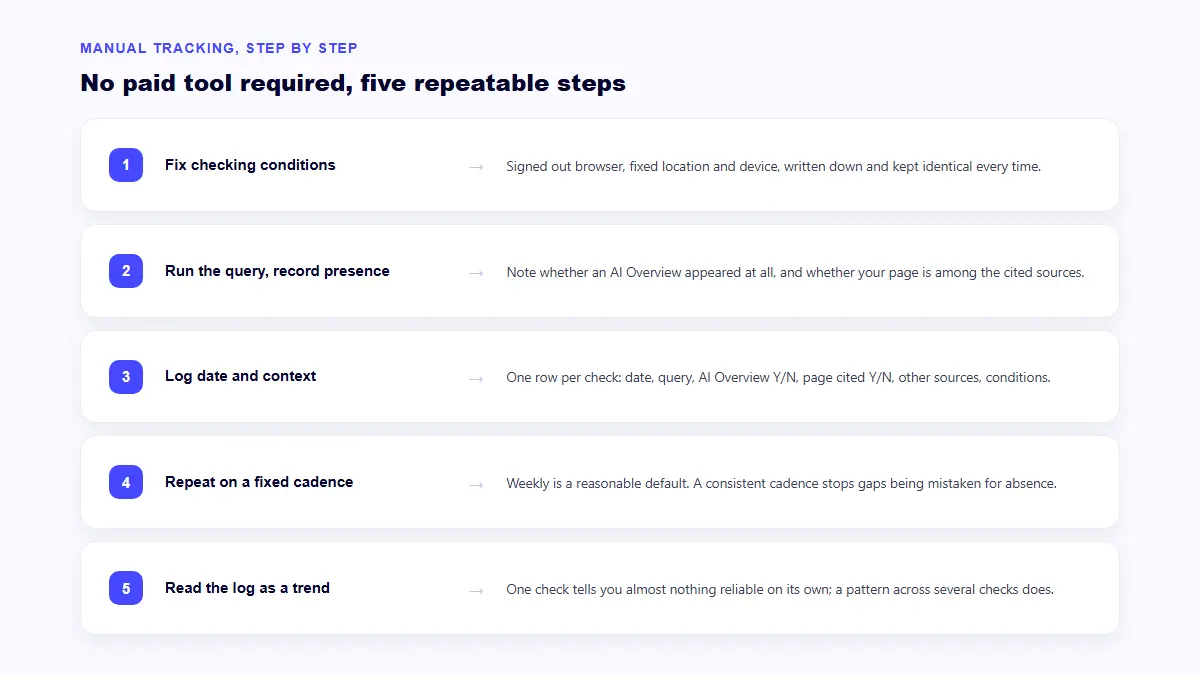
This is the process both the evidence later in this article and Google’s own documented variables (location, device, time) point towards running consistently, by hand, with no paid tool required.
- Fix your checking conditions and write them down. A signed-out browser session (to avoid personalisation skewing results), a location setting if the query is locally relevant, and a device (mobile and desktop can genuinely differ; see mobile rank tracking for why). Keep these identical every time, and note them in the log, since a change in any of them is a reason a result might differ, not evidence anything about the page changed.
- Run each query and record two things. Whether an AI Overview appeared at all (yes/no), and if it did, whether your page is among the cited sources.
- Log the date, and treat the log as a timeline. One row per check, per query: date, query, AI Overview present (Y/N), your page cited (Y/N), other sources cited, and the conditions from step 1.
- Repeat on a fixed cadence, not an ad hoc one. Weekly is a reasonable default; daily adds effort without much extra signal unless you’re watching for a near-term change after a significant edit. A consistent cadence stops gaps in the log being mistaken for gaps in AI Overview presence.
- Review the log as a trend, not any single reading. A page cited twice out of six weekly checks is a different situation from zero or six, and that pattern only becomes visible once several checks exist.
A Worked Example: What a Real Tracking Log Looks Like
The table below is a hypothetical illustration of what a completed log looks like after six weekly checks of one query, not a real tracked result. It shows the shape a useful log takes, not a claim about any specific page’s performance.
| Week | Date | AI Overview shown? | Page cited? | Other sources cited | Conditions |
|---|---|---|---|---|---|
| 1 | checked | Yes | No | Two major publishers, one forum thread | Signed out, desktop, no location set |
| 2 | checked | Yes | No | Same two publishers | Signed out, desktop, no location set |
| 3 | checked | No | N/A | N/A | Signed out, desktop, no location set |
| 4 | checked | Yes | Yes | One of the original publishers, plus this page | Signed out, desktop, no location set |
| 5 | checked | Yes | Yes | Same publisher, plus this page | Signed out, desktop, no location set |
| 6 | checked | Yes | No | Original two publishers, a new third source | Signed out, desktop, no location set |
Read this way, the log tells a specific story: the AI Overview didn’t trigger every week (week 3), citation wasn’t stable even once it appeared (cited weeks 4 and 5, not week 6), and the other cited sources shifted too. That’s a realistic pattern given the evidence below, and it’s why a single check, in either direction, would have been misleading on its own.
Why This Is Harder to Track Reliably Than Classic Rankings
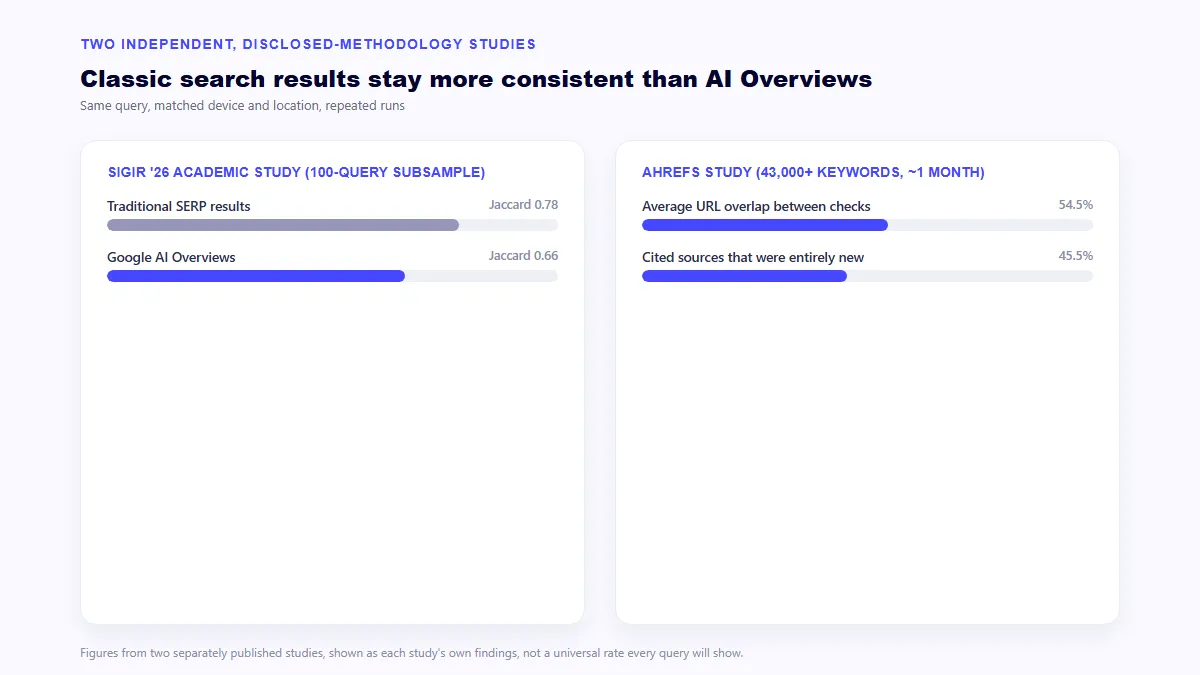
This isn’t a vague claim that “AI is unpredictable.” Two independent pieces of research, each disclosing their own methodology, measured the same thing a tracking log tries to capture, and found AI Overviews genuinely less stable than classic rankings under matched conditions.
A SIGIR 2026 academic study benchmarked 11,500 queries across Google’s traditional results, AI Overviews and Gemini, and re-ran a 100-query subsample twice under identical device and location settings to test same-query consistency. Traditional SERP results scored a Jaccard similarity of 0.78 between the two runs; AI Overviews scored 0.66, meaningfully lower under the same controlled conditions. The paper’s conclusion is direct: “the generative search engines show lower consistency than traditional Google Search.” The same study found AI Overview output was also more sensitive to query phrasing: a cosmetic reword dropped its ranking similarity by nearly 29%, roughly double the decline seen on traditional results for the same kind of edit.
Ahrefs ran a larger, separately disclosed study: over 43,000 keywords, each checked at least 16 times over about a month. It found that, on average, “only 54.5% of URLs overlap” between one AI Overview observation of a query and the next, meaning close to half the cited sources changed on average. Its own worked examples show how wide that range runs: one comparison saw 9 of 10 cited sources change, another saw only 5 change a week apart. That’s Ahrefs’ own study and figures, attributed as such, not a universal rate every query will show.
Google’s own documentation adds a third, non-AI-specific layer: time, data-centre routing, location, device and personalisation are all documented reasons “results vary between people,” and every one of them applies to AI Overviews as much as to classic results. A tracking log for AI Overviews is genuinely measuring a less stable target than a classic rank tracker measures, for reasons that have nothing to do with how well any single page is built.
What Search Console Can and Can’t Tell You
Search Console is free, already connected to most sites, and worth checking alongside a manual log, but it answers a narrower question than people often expect. Google’s own documentation confirms “sites appearing in AI features (such as AI Overviews and AI Mode) are included in the overall search traffic” reported in the Performance report, “within the ‘Web’ search type.” That’s a real signal: if a page’s impressions shift and AI Overview traffic is part of that total, it’s in there.
What Search Console doesn’t offer is a way to isolate AI Overview appearances as their own filterable row, separate from ordinary organic impressions; there’s no “AI Overview” search-type toggle alongside “Web,” “Image” and “Video.” A rising impression count for a query is consistent with more AI Overview visibility, not proof of it. A manual check of that exact query is still how you confirm it either way; treat Search Console as corroborating evidence, not a standalone AI Overview tracker.
Tool-Based Tracking: Which Category Do You Actually Need
Once a query list grows past what a weekly manual check can comfortably cover, or once “my brand” rather than “this one page” becomes the real question, a tool starts making more sense than a spreadsheet. Two different categories exist, and picking the wrong one wastes money rather than time:
Classic SERP rank trackers with an AI Overview module bolted on. Several established rank trackers now report, alongside a page’s classic keyword position, whether an AI Overview appeared for that keyword and whether the tracked site was cited in it. This suits a team already tracking keyword positions that wants AI Overview presence added to the same report. Our full SERP rank tracker comparison reviews seven of these tools and states plainly which ones also track AI Overviews and how that’s packaged (native to every plan, or sold as a separate module); not repeated here.
Dedicated AI visibility and citation trackers. These monitor whether a brand or domain gets mentioned across AI platforms generally, including ChatGPT and Perplexity alongside Google AI Overviews, as the primary job rather than an add-on. This suits a team whose real question is brand-level recognition across AI platforms rather than one page’s citation status for one query. Our AI visibility tracker roundup covers four of these tools in depth, and checker versus AI visibility tracker explains the broader category distinction, including a brand-level version of the logging approach above.
Neither category replaces the manual method for a small, specific query list. A tool adds scale and automation; it doesn’t change what’s being measured, or make the underlying reading any more stable than the evidence above describes.
Common Mistakes When Tracking AI Overview Presence
Treating one check as a settled result. Given the consistency figures above, a single “yes, cited” or “no, not cited” reading is a data point, not a conclusion.
Checking signed in, or without controlling location and device. Google documents personalisation, location and device as real reasons results differ between checks. A log that doesn’t fix and record these conditions can’t distinguish “the AI Overview genuinely changed” from “I checked under different conditions this time.”
Paraphrasing the query instead of re-running the exact string. The SIGIR study’s finding that cosmetic rewording measurably changes AI Overview output means “roughly the same question” and “the identical query” aren’t interchangeable for tracking.
Confusing “no AI Overview shown” with “my page wasn’t cited.” These need separate columns in a log. The first means the feature didn’t trigger at all; the second means it triggered and chose other sources.
Assuming a tool’s detection is instant. Both tool categories above build their readings from scheduled checks against tracked keyword sets, the same limit this site’s classic tracker reviews note about trial accounts: a fresh signup won’t reproduce a manual check’s immediacy.
What Tracking Can’t Tell You
A tracking log, manual or tool-assisted, tells you what happened for the queries and conditions you checked, not why. It can’t tell you whether a specific structural change to a page caused a citation to appear or disappear; this site’s citation reverse-engineering guide covers what independent research has found correlates with citation, with the same caveat that correlation isn’t a guaranteed lever. It can’t predict next week’s result from this week’s, given the consistency figures above. And it can’t substitute for confirming a page’s own structural readiness first: a page that isn’t indexed, lacks a clear answer, or is missing basic entity clarity will show the same “not cited” result every week regardless of how closely it’s tracked.
That’s a page-level readiness question rather than a tracking one. AI Rank Inspector audits a page’s SEO, AEO and GEO signals directly, which is worth doing before spending weeks tracking a page that hasn’t cleared basic readiness yet; it’s a page-level checker, not a tracker, and doesn’t measure or predict AI Overview citation itself.
No method or tool in this article, manual or paid, can guarantee that a page will appear in an AI Overview, guarantee a citation, or promise any specific tracked outcome. Every figure and quote here describes what was measured or documented, not a prediction of what tracking will show for any particular page.
FAQs
Is there a real “AI Overview rank” I should expect a tool to report?
No. AI Overviews cite a handful of sources rather than ranking every eligible page in order, so there’s no position number equivalent to a classic SERP rank. What’s trackable is presence (did an AI Overview appear) and citation (was your page one of the sources), not a position within a list.
How often should I check each query?
Weekly is a reasonable default, since checking daily adds effort without much more signal given how much a single reading can already vary. Check more frequently only around a specific event, such as a significant content change to the page you’re tracking.
Can I track this for free without any paid tool?
Yes. The manual method in this article, incognito checks against a fixed query list logged on a consistent cadence, costs nothing but time, and is the same underlying activity the paid tool categories perform at scale.
Does Search Console show me which queries triggered an AI Overview?
Not directly. AI feature traffic is folded into the Performance report’s existing “Web” search type totals, with no separate AI Overview filter to isolate it. A rising impression count is consistent with more AI Overview visibility, not proof of it; a manual check of that exact query confirms it either way.
Why did my page get cited last week but not this week, with nothing changed on the page?
That’s consistent with the documented behaviour of AI Overviews, not a sign something’s wrong. Independent research (the SIGIR ’26 study and Ahrefs’ 43,000-keyword study, both covered above) found the set of cited sources for an identical query changes noticeably between checks, often for reasons unrelated to the page itself.
Should I use a rank tracker’s AI Overview module or a dedicated AI visibility tracker?
Depends on the question. Already tracking classic keyword positions and want AI Overview presence in that same report? A rank tracker’s AI module (see the seven tools compared here) fits. Want to know if your brand is mentioned across AI platforms generally, not one page for one query? A dedicated AI visibility tracker (see our GEO tools comparison) is the better-matched category.