

Structured data reliably helps machines parse and identify what a page is about, and Google’s own documentation confirms it doesn’t guarantee rich results or ranking. Whether it causes AI citation is unproven: the largest independent test found no meaningful citation gain, and one major AI system strips structured data before generating answers at all.
This is one of the more genuinely contested questions in SEO right now, and it deserves a genuinely contested answer rather than a confident one in either direction. “Structured data is essential for AI search” and “AI doesn’t read schema, it’s just text on a page” are both circulating as if settled. Neither is. This article works through what’s actually documented, what’s actually been tested, and where the real uncertainty sits.
Two Different Questions, Not One
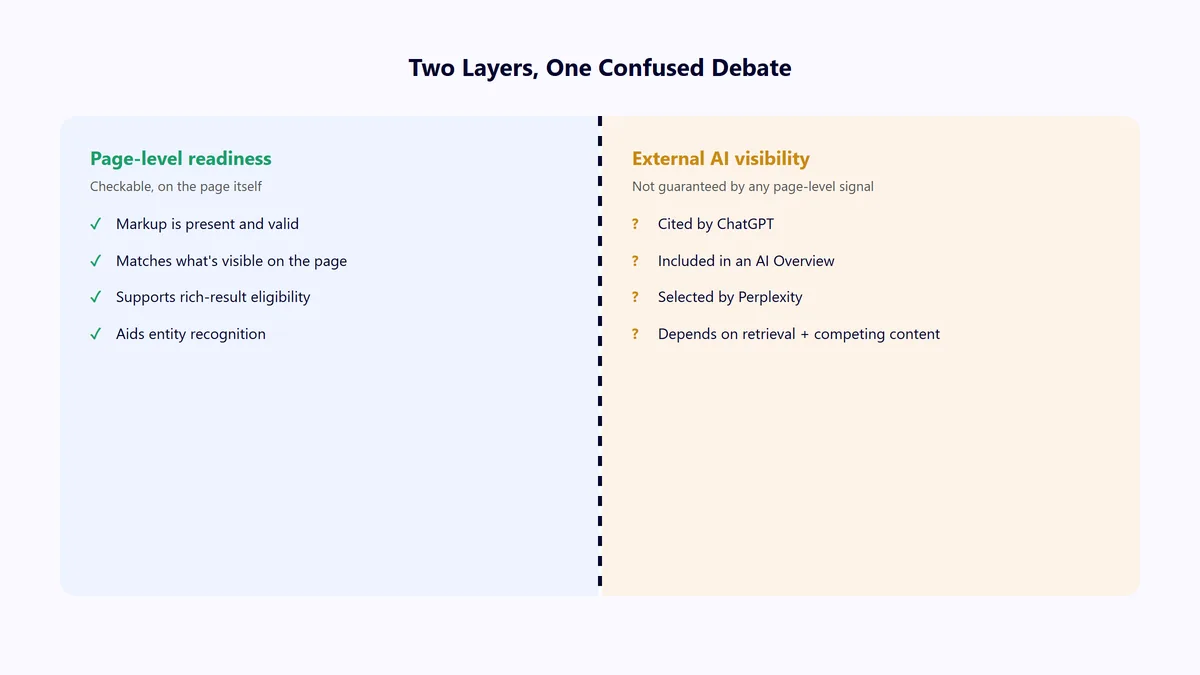
Most of the disagreement about structured data and AI comes from collapsing two separate questions into one.
Question one: does structured data help a machine understand or extract content from a page? This is a page-level readiness question. It’s checkable: does the markup exist, is it valid, does it match what’s visible on the page. The answer here is largely yes, with caveats covered below.
Question two: does structured data cause a page to get cited by a specific AI system for a specific query? This is an external AI visibility outcome. It depends on retrieval mechanics, competing content, query phrasing and the individual AI system’s own selection process, none of which any page-level signal can control or guarantee. The answer here is genuinely unresolved, and the best available evidence leans toward “not much, if anything,” at least for pages that are already being retrieved.
Treating these as the same question is the single biggest source of confusion in this debate. A page can score perfectly on question one and still not be predictably affected on question two. That’s not a contradiction, it’s two different layers of a system, and confusing them produces both the overclaiming (“add schema and get cited more”) and the overcorrecting (“schema is pointless for AI”) sides of the argument.
What Structured Data Actually Does
Structured data (typically written as JSON-LD, using the shared schema.org vocabulary) is machine-readable markup describing what’s on a page: that something is an article with a named author and a publish date, or an organisation with a specific name, or a set of questions and answers. How AEO works and how GEO works both cover its mechanics and role among the wider set of signals in more depth; this article doesn’t repeat that ground, it goes deeper on one specific, narrower question.
The uncontroversial part: structured data makes a page eligible for certain rich-result features in traditional Google Search, and it supports entity recognition, the process of a system correctly identifying which real-world business, product or person a page is actually about. Entity Consistency for SEO, AEO and GEO covers that identification role directly.
What structured data has never done, and what Google’s own documentation is explicit about, is guarantee that a feature appears or that a page ranks better because the markup exists.
What the Evidence Actually Shows
Setting marketing claims aside, four sources speak directly to this question, and they don’t all point the same direction.
Google’s own documentation is direct on this point. Google’s structured data guidelines state plainly: “Google does not guarantee that your structured data will show up in search results, even if your page is marked up correctly.” Its separate documentation on optimising for AI Overviews and AI Mode goes further, stating there are “no additional requirements to appear in AI Overviews or AI Mode, nor other special optimizations necessary,” and specifically that “there’s also no special schema.org structured data that you need to add” for those features.
Google’s John Mueller has given a more nuanced public answer. Asked directly whether structured data helps large language models, Mueller’s reported response was “yes, no, and it depends.” Some information, such as pricing, shipping and availability for shopping-style results, is “basically impossible to read in high fidelity & accurately from a text page,” so structured data genuinely earns its keep there. For most other schema types, in his words, “there’s a lot of wishful thinking.”
The most rigorous independent test found no meaningful uplift. Ahrefs tracked 1,885 pages that added JSON-LD schema between August 2025 and March 2026, comparing citation activity against 4,000 similar control pages that didn’t. Across Google AI Overviews, Google AI Mode and ChatGPT, measuring citations 30 days before and after schema was added, the result was: AI Overviews citations fell 4.6% (a change the researchers report as statistically significant), while AI Mode (+2.4%) and ChatGPT (+2.2%) moved by amounts the researchers describe as statistically indistinguishable from zero. Their own conclusion: “Adding schema produced no major uplift in citations on any platform.” Worth stating plainly, since the researchers state it themselves: every page in this study already had 100+ AI Overview citations before the test began, so it can’t answer whether schema helps a page that isn’t being retrieved by AI systems at all, only whether it changes the citation rate of pages that already are.
At least one major AI system doesn’t appear to use structured data in its main retrieval pipeline at all. Independent technical reporting on ChatGPT’s retrieval process found that when ChatGPT converts a fetched page into the cached, readable format its model actually works from, “scripts, iframes, and JSON-LD are stripped” before that content reaches the model. The system’s separate index layer captures only a page’s title, URL and a short snippet, not structured data either. This is documented behaviour for one specific system’s retrieval pipeline, not a universal claim about every AI product.
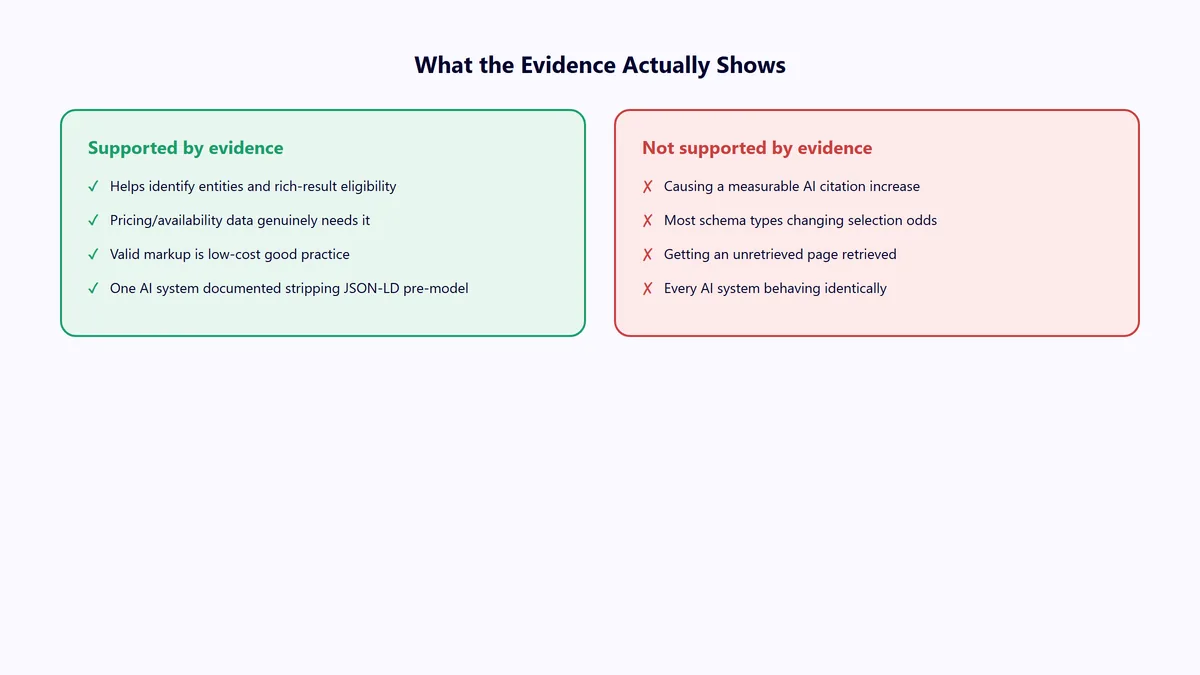
| What the evidence supports | What it doesn’t support |
|---|---|
| Structured data helps a system correctly identify entities and eligibility for rich results | Structured data causing a measurable increase in AI citation rate |
| Some structured data types (pricing, availability) genuinely can’t be reliably extracted from plain text | Most other schema types meaningfully changing whether an AI system selects a page |
| Valid, accurate markup is good practice with established, real benefits elsewhere | Adding schema to a page not currently being retrieved will get it retrieved |
| One major AI system is documented as stripping JSON-LD before its model reads a page | Every AI system necessarily behaves the same way as that one |
What Three Tools Found on This Site’s Own Pages
Separately from the citation question, it’s worth showing what a structured-data readiness gap actually looks like in practice, since it’s a genuinely common one.
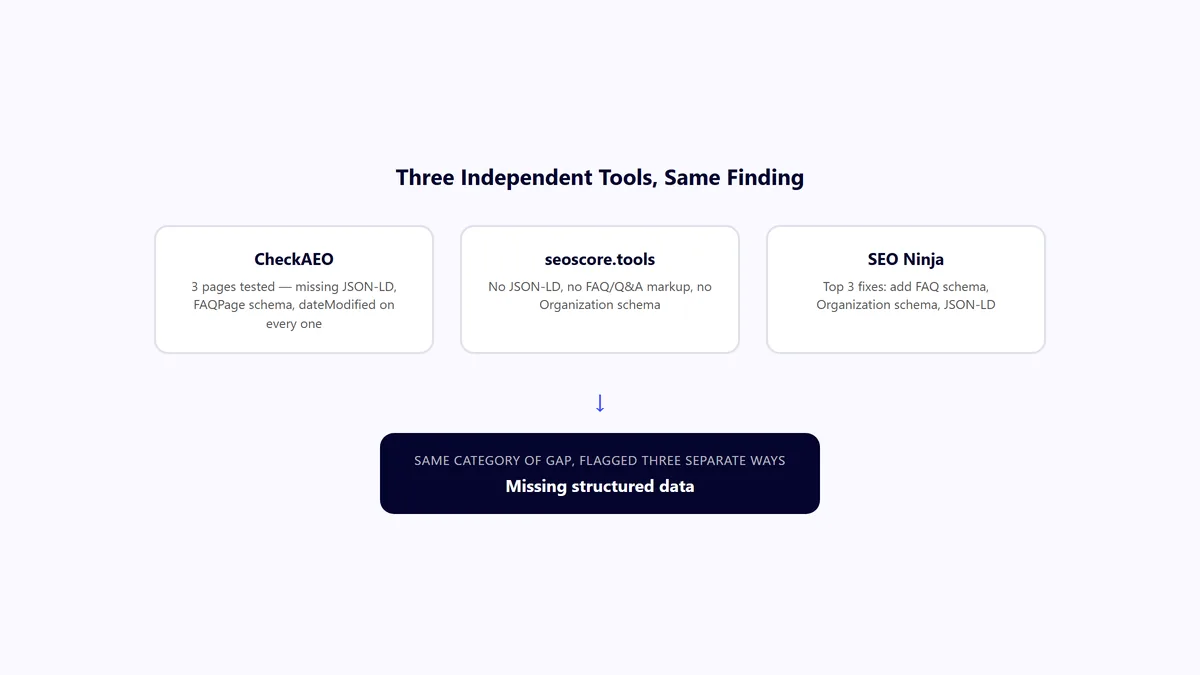
Testing carried out for two earlier articles on this site found the same underlying gap three separate times, using three independently-built tools. CheckAEO’s testing across three real pages on this site found each one missing JSON-LD, FAQPage schema and a dateModified value. seoscore.tools, run against a different page here, separately flagged no JSON-LD structured data, no FAQ or Q&A markup, and no Organization schema. SEO Ninja’s checker, run against the same page, independently listed adding FAQ schema, Organization schema and JSON-LD as its top three priority fixes. The fuller detail and methodology sit in our AI search readiness tools comparison and our AEO checkers comparison.
Three separately-built tools agreeing on the same category of gap is stronger evidence of a common, real-world pattern than any one tool’s opinion alone. It’s worth being precise about what it does and doesn’t prove, though: it shows a missing-structured-data gap is common and independently detectable, not that fixing it would have changed how often those specific pages got cited. No before-and-after citation data exists for this site’s pages, so no such claim is made here. This is page-level readiness evidence, not external AI visibility evidence, and the distinction matters exactly as much here as it does throughout this article.
Why Reasonable People Disagree
Part of the disagreement is genuinely about mechanism, not opinion. Different AI systems retrieve and process pages differently: some route content through summarised index snippets, some open live pages, and (per the documented ChatGPT behaviour above) at least one strips structured markup before the model ever sees it. A claim that’s accurate for one system’s pipeline can be flatly wrong for another’s, which is part of why “does AI use structured data” doesn’t have one clean answer across the whole category.
The rest of the disagreement is about what counts as evidence. A lot of confident claims in this space come from vendors selling schema-generation tools or SEO services, citing multipliers and percentages with no visible methodology behind them. Those claims were checked during research for this article and specifically excluded rather than repeated, consistent with how every article on this site handles unverifiable competitor statistics. The Ahrefs study, by contrast, published its methodology, its control group, and its own limitations openly, which is why it carries more weight here than the marketing claims it contradicts.
So Should You Add Structured Data or Not?
Given the genuine uncertainty on the citation question specifically, it’s worth separating what to do by which layer it actually addresses.
Worth doing regardless of the citation debate: accurate, valid structured data that matches your visible content. It supports rich-result eligibility (an established, real, if non-guaranteed, benefit), supports entity recognition (covered in more depth in the entity consistency article linked above), and costs little once a template exists. None of this depends on the unresolved citation question being answered either way.
Not worth overinvesting in specifically to chase AI citations: treating schema markup as a lever for AI visibility outcomes on its own, adding exotic or speculative schema types with no established purpose “just in case an AI reads it,” or assuming a citation drop or gain on any platform was caused by a schema change without other evidence. The Ahrefs study’s own pages, remember, already had strong citation histories before schema was added, and the change still didn’t move the needle much.
Worth checking periodically, same as any other readiness item: whether structured data is present, valid, and still matches what’s actually on the page after edits, which is exactly the kind of item covered in the 60 SEO, AEO and GEO signals checklist and the GEO Audit Checklist.
Common Mistakes in This Debate
Treating “helps machines understand a page” and “gets a page cited” as the same claim. They’re related but distinct, and most confident statements in this space quietly slide from one to the other without noticing.
Citing a single tool’s flagged issue as proof structured data is the reason a page isn’t performing. A missing JSON-LD block is a real, checkable gap; it isn’t automatically the explanation for a citation outcome without more evidence than that.
Assuming every AI system behaves like the one you’ve read about. Documented behaviour for ChatGPT’s retrieval pipeline isn’t automatically true of Perplexity, Google AI Overviews, or any other system, each of which has its own retrieval process.
Reading a study’s limitations out of a summary of its results. The Ahrefs study’s own authors were explicit that their dataset only covers pages already being cited heavily; repeating “schema doesn’t help citations” as an unqualified conclusion overstates what that specific study actually measured.
Checking Structured Data on Your Own Pages
Whether structured data is present, valid, and consistent with a page’s visible content is a page-level readiness check, the kind AI Rank Inspector’s automated audit reviews alongside the rest of its 60 signals. It can tell you whether the markup exists and matches what’s on the page; it can’t tell you, and no tool honestly can, whether adding it will get a specific page cited by a specific AI system. Explore the full feature set if that page-level check would help, without treating it as a citation guarantee.
Final Practical Takeaway
Structured data has a genuine, documented, page-level job: helping a system correctly identify what a page is and what it’s about, and supporting rich-result eligibility that’s existed for years. It does not have a proven, documented job as a lever for AI citation outcomes specifically. Keep doing the first because it’s real and low-cost. Don’t overinvest in the second because the best evidence available doesn’t support it, at least not yet, and treating an unproven claim as settled fact is a worse mistake than admitting the honest answer is “we don’t fully know.”
FAQs
Does adding schema markup guarantee my page gets cited by ChatGPT or an AI Overview?
No. No page-level signal, structured data included, can guarantee a specific AI system’s citation behaviour for a specific query. The best available independent test found no meaningful citation increase from adding schema to pages that were already being cited.
Should I remove structured data since one study found no benefit?
No. That same study only tested pages already receiving heavy AI citation, and structured data retains its established, real benefits for rich-result eligibility and entity recognition regardless of the citation question. Removing valid, accurate markup would give up a real benefit to avoid a claim this article never made.
Does every AI system ignore structured data the way ChatGPT’s retrieval pipeline reportedly does?
Not necessarily, and this article doesn’t claim that. That specific finding describes one documented investigation into one system’s pipeline. Other systems may process pages differently, and no equivalent public technical breakdown exists for every AI product.
Is this the same as asking whether structured data helps SEO?
No. Structured data’s role in traditional SEO (rich-result eligibility, not core rankings) is separate from, and better established than, its role in AI citation outcomes specifically, which is the narrower and less settled question this article addresses.
What’s the single most useful thing to check about structured data on my own pages?
Whether it’s valid and actually matches the visible content, which is the same principle covered in Entity Consistency for SEO, AEO and GEO. Markup that claims more than the page supports is a bigger risk than markup that’s simply absent.