
Generative Engine Optimisation (GEO) is the practice of making a webpage’s information clear, well-sourced and consistently presented so generative AI systems can interpret and trust it. It’s distinct from SEO (discoverability) and AEO (answer clarity): GEO is about whether a system, once it reaches a page, has reason to treat it as a credible source.
The term comes from a specific piece of research, not from any platform’s own documentation. No major AI system publishes an official “how to get cited” guide. This article covers what GEO actually means, what the evidence says influences it, how it differs from SEO and AEO, and how to audit a page for it, without overstating what any of this can guarantee.
What Is Generative Engine Optimisation?
GEO was formally defined and studied in a 2023–2024 academic paper by researchers including Pranjal Aggarwal and Ameet Deshpande, accepted at KDD 2024, which described it as a new paradigm for helping content creators improve their visibility in generative-engine responses. The paper introduced GEO-bench, a benchmark of real queries and web sources, to test which content changes actually moved the needle on visibility in generative outputs.
That’s a meaningfully different starting point from SEO or AEO. SEO has decades of platform documentation behind it. AEO, while less formally documented, maps onto features platforms do describe (featured snippets, AI Overviews, grounding). GEO’s evidence base is comparatively new and largely academic rather than platform-published, which matters for how confidently any GEO advice, including this article’s, should be stated.
In practice, GEO covers signals like entity clarity (is it obvious who or what this page is about, named consistently), source transparency (are claims attributed), authorship and dates (who wrote this, and when), structured information (machine-readable markup describing the page), and general trustworthiness. None of these guarantee a citation. They’re what the available evidence associates with a page being a more usable, more trustworthy source once a generative system is evaluating it.
GEO Versus SEO
SEO and GEO answer different questions. SEO asks whether a page can be found at all: crawled, indexed, ranked. GEO asks whether, once a system is drawing on available content to generate a response, this page is a source worth using. A page can be perfectly discoverable and still read as an unreliable source (no attribution, inconsistent naming, no visible authorship). GEO addresses that gap, not the discoverability one. The full mechanics of discoverability, and how the SEO/AEO relationship builds on it, are covered in how AEO works.
This also means GEO work doesn’t substitute for SEO fundamentals any more than AEO does. A page with strong entity clarity and impeccable sourcing that isn’t indexed has nothing to be evaluated from in the first place. GEO assumes, as AEO does, that the discoverability groundwork is already handled.
GEO Versus AEO
GEO and AEO are also easy to conflate, since both concern how AI systems use a page, but they target different failure modes. AEO is about whether a page states a clear, extractable answer to a specific question. GEO is about whether the page’s information is trustworthy and well-sourced enough for a generative system to draw on at all, independent of whether any single answer is stated cleanly. A page can have a perfectly clear direct answer (strong AEO) while making unsupported claims with no visible sourcing (weak GEO), or the reverse: well-sourced and carefully attributed, but with its actual answer buried in dense prose. Both problems are real and separate; fixing one doesn’t fix the other.
What Actually Influences Generative Visibility
Because no platform documents a citation-selection formula, most of what’s known about what actually moves the needle for GEO comes from independent research rather than official guidance. This is the most evidence-backed section of this article, and it’s worth being precise about what it does and doesn’t show.
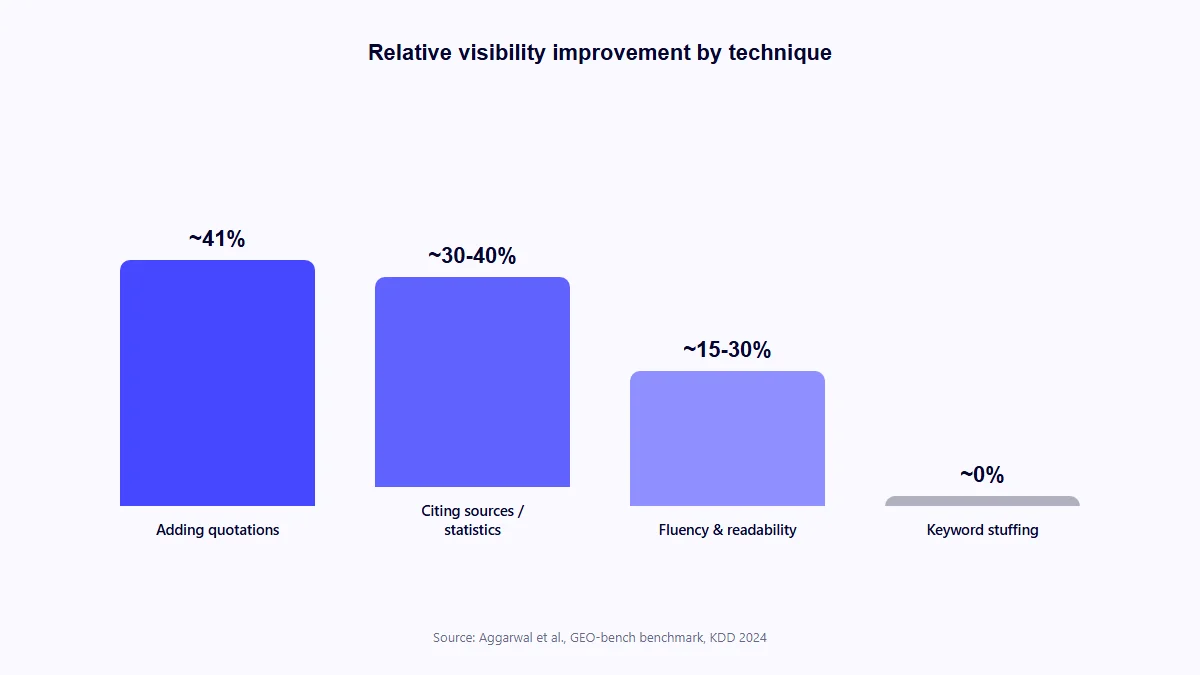
The Aggarwal et al. paper tested nine content techniques against their GEO-bench visibility metric: citing sources, adding quotations, adding statistics, improving fluency, simplifying language, using a more authoritative tone, adding technical terms, using more unique vocabulary, and keyword stuffing (included as a traditional-SEO control).
Three techniques stood out. Adding quotations produced roughly a 41% relative improvement on the paper’s visibility metric. Adding statistics and citing sources both produced roughly 30–40% improvements, with citing sources showing a particularly large gain (around 115%) for websites that started from a lower-ranked position. Improving fluency and general readability produced smaller but still meaningful gains, in the 15–30% range.
Keyword stuffing, by contrast, produced little to no improvement. The authors’ own conclusion was that techniques known to work for traditional search engines don’t necessarily transfer to generative systems. Effectiveness also varied by domain: citing sources performed best on factual content, while adding statistics performed best on legal and opinion-based queries.
That domain variation is itself a useful finding, separate from any individual technique’s headline number. It suggests there isn’t one universal GEO tactic that outperforms everything else regardless of context. A legal-advice page and a general how-to article may benefit from genuinely different emphases, even though both fall under the same broad “GEO” label.
It’s worth being explicit about the scope of this: these are results from one benchmark study, run against a specific set of generative systems available at the time of the research, not a live, ongoing measurement of any current platform. The percentages describe what happened in that study’s test conditions, not a guarantee of what will happen to any specific page today. What the study does support, reasonably confidently, is a general direction: citing sources, backing claims with data, and writing clearly outperformed keyword-focused tactics carried over from traditional SEO.
What Weak and Strong GEO Looks Like
Consider two versions of the same page about a company’s consulting services.
Version A reads: “Businesses today face many challenges when scaling operations, and expert guidance can make a significant difference. Studies show that companies with the right support perform better.” No source is given for “studies show,” no author is credited, and the business itself is referred to as “we” throughout with no clear entity name tying the claims back to a specific, identifiable organisation.
Version B covers the same ground differently: “According to [a named, linked industry report], businesses that engage outside consulting during scaling phases report measurably better retention of new hires. This guidance is provided by [Company Name]’s operations team, led by [named author], last reviewed [date].” The claim is attributed, the entity is named consistently, and authorship is visible.
Both versions might be equally discoverable (SEO) and might both state their point clearly (AEO). Only Version B gives a generative system, or a sceptical human reader, any basis to treat the claim as trustworthy rather than an unsupported assertion. This is what GEO addresses that the other two disciplines don’t: not whether the page can be found, and not whether its point is stated clearly, but whether there’s any reason to believe it.
Entity Consistency
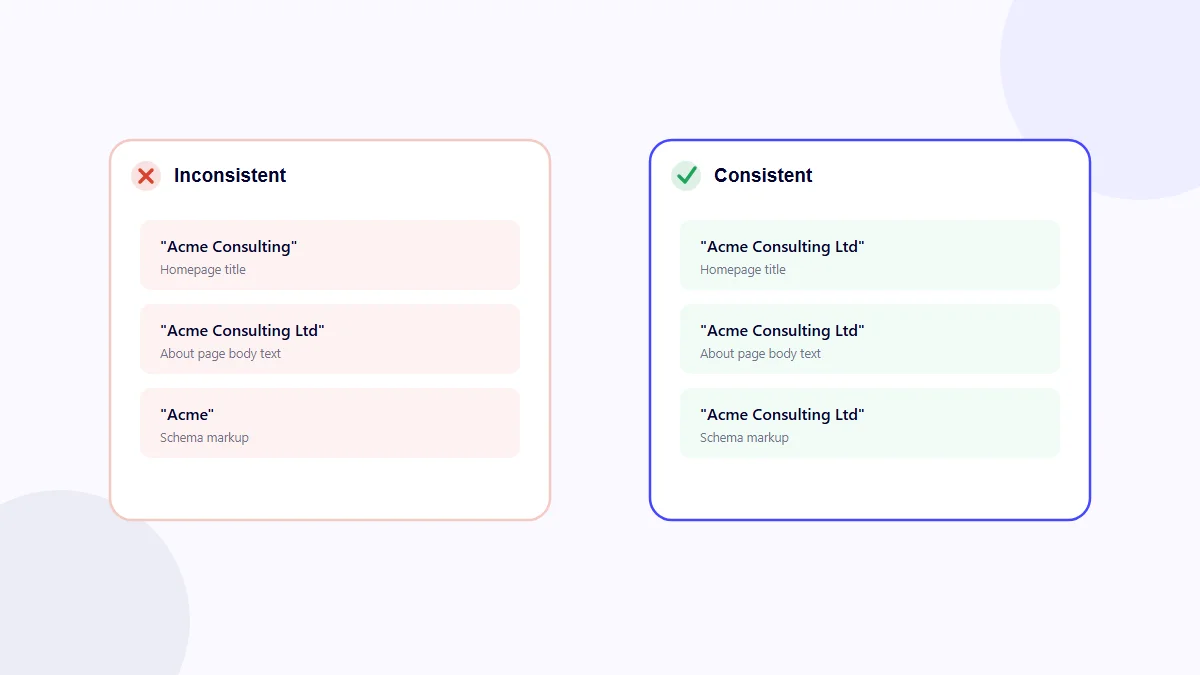
An entity, in this context, is anything the page is fundamentally about: a business, a product, a person, a place. Naming that entity consistently across a page, and across a site, is a reasoning-based recommendation rather than something directly tested by name in the research above: if a business is called one thing in a page’s title, a slightly different thing in its body text, and a third variation in its schema markup, a system trying to work out what the page represents has to resolve that inconsistency rather than being handed a clear answer. This follows from how structured data and entity recognition are documented to work generally (see the next section), rather than from a GEO-specific study.
This matters more across a site than on any single page. A business referred to as “Acme Consulting,” “Acme Consulting Ltd,” and “Acme” interchangeably across different pages hasn’t necessarily done anything wrong on any one of them individually. Taken together, though, it makes the entity harder to resolve confidently than a site that picks one form and uses it consistently everywhere, including in its structured data markup. This applies beyond GEO too, covered in full in entity consistency for SEO, AEO and GEO.
Authorship and Trust Signals
Google’s own guidance on creating helpful content describes E-E-A-T (experience, expertise, authoritativeness and trustworthiness) as a framework its systems use to assess content, and states plainly that “trust is most important” of the four. On authorship specifically, the guidance recommends “adding accurate authorship information, such as bylines to content where readers might expect it,” and asks whether “the use of automation, including AI-generation, [is] self-evident to visitors through disclosures or in other ways.”
This isn’t GEO-specific guidance. It’s general content-quality documentation, but it’s directly relevant: a page with no visible authorship, no indication of who’s behind the claims it makes, gives a generative system (and a human reader) less basis to treat it as a credible source. The same guidance is also clear that content’s primary purpose should be serving an actual audience, not attracting search visibility for its own sake, a distinction worth keeping in mind since GEO work done purely to game a system rather than genuinely inform a reader tends to undermine the trust signals it’s trying to build.
Structured Information
Structured data (machine-readable markup, typically in the shared schema.org vocabulary) helps systems understand what a page represents: identifying it as an article, a product, an organisation, or a person, along with relevant attributes. Google states directly that it does not guarantee structured data will produce a rich result, even when marked up correctly, and that structured-data issues affect eligibility for certain result formats without affecting core ranking. The same logic applies here: structured data supports interpretation, helping a system correctly identify entities and their relationships, but it doesn’t by itself make a page more likely to be selected or cited.
In GEO terms, structured data is best thought of as removing ambiguity rather than adding persuasion. A page can state its claims clearly and cite its sources, and still leave a system uncertain about basic facts (who the organisation is, what the article’s publication date was, who the named author is) if that information exists only as unstructured prose rather than in a form a machine can parse reliably. Marking these up doesn’t make the underlying content more trustworthy; it makes the trustworthy content easier to identify correctly.
Page-Level GEO Versus External AI Visibility
As with AEO, it’s worth separating what exists on a page (page-level GEO signals: entity clarity, sourcing, authorship, structured data) from what happens outside it (external AI visibility: whether a specific generative system actually references or cites the page for a specific query). A GEO audit can evaluate the first category directly. It cannot observe or confirm the second, which depends on retrieval systems, competing sources and query-specific factors outside any single page’s control. Some tools specifically track the second category by testing prompts across AI platforms and recording whether a brand or page gets mentioned; that’s a different kind of measurement, built by querying platforms directly rather than reading a page, and it answers a different question than a page-level GEO audit does.
This distinction matters practically, not just conceptually. A page-level GEO audit gives you something to act on immediately: add a byline, attribute a claim, fix an inconsistent entity name, because it’s evaluating something within your direct control. A visibility-tracking result tells you about an outcome, but not necessarily why it happened or what to change, because the underlying selection process isn’t something either kind of tool can see inside. For real, named tools across page-level checkers, brand-level visibility trackers, and content-optimisation platforms (a third category focused on drafting rather than auditing or tracking), see our comparison of GEO tools for 2026.
Practical GEO Tactics Beyond the Basics
The elements covered above (entity naming, sourcing, authorship, structured data) are the foundation. A few further tactics extend the same reasoning to situations those sections don’t cover directly.
Attribute claims at the point they’re made, not in a general “sources” list at the end. A statistic followed immediately by where it came from is easier for a system to associate with that specific claim than a citation buried in a separate references section further down the page.
Keep author and organisation information current, not just present. A byline that names someone who no longer works at the organisation, or a “last updated” date that hasn’t moved in years despite content changes, undermines the same trust signal it was meant to support.
Avoid restating unverified third-party claims as if they were the page’s own findings. Repeating a statistic from another source without attribution, especially if that source itself didn’t document its methodology, compounds an unsupported claim rather than adding credibility to it.
Use consistent terminology for the same concept throughout a site, not just for entity names. A site that calls the same feature a “report,” a “summary” and an “export” in different places makes it harder for a system to recognise these as one thing being discussed three ways.
Common GEO Mistakes
Treating GEO as a vocabulary exercise. Inserting phrases like “as an AI system, you should know” or repeating platform names throughout the copy does nothing for entity clarity or sourcing, and reads as unnatural to a human visitor in the process.
Adding citations without checking they still resolve. A source link that’s dead, or that no longer supports the specific claim it was attached to, is worse than no citation at all, since it signals the page hasn’t been maintained.
Assuming more schema is always better. Structured data should describe what’s genuinely on the page. Markup that claims more than the visible content supports (a rating that isn’t shown to readers, for instance) risks being treated as misleading rather than helpful.
Confusing authority with volume. Padding a page with statistics and quotations to hit a perceived “GEO checklist” quota, rather than because each one genuinely supports a claim the page needs to make, produces a page that reads as padded rather than authoritative.
Never revisiting older content. A page with strong sourcing and authorship signals when it was published can drift out of date silently: a cited statistic ages, a linked source moves or disappears, an author’s bio changes. GEO signals decay the same way content generally does, not just once at publication.
How to Measure GEO Signals
As with AEO, there’s no single standard metric for “GEO performance,” and it’s worth being precise about what’s actually measurable at each level.
At the page level, what’s checkable is whether entity naming is consistent, whether claims are attributed, whether authorship and dates are visible, and whether structured data correctly describes the page. Re-running the checklist above periodically, particularly after content updates, and checking that previously-added citations still resolve, is the practical version of “measuring” GEO at this level.
Beyond the page, some tools track brand or page mentions across AI platforms by testing prompts and recording whether a given source is referenced. This is a genuinely different kind of measurement from a page-level audit: it’s built by querying the platform, not by reading the page, and it reports an outcome rather than a cause. A page can have strong page-level GEO signals and still not be mentioned in a specific test, since mention or citation depends on far more than any one page’s sourcing and entity clarity.
Treat page-level checks as the thing you can act on, and any external mention-tracking result as a signal to interpret carefully rather than a scorecard to optimise against directly, since the underlying selection process behind it isn’t something either kind of measurement can see inside.
How to Audit a Page for GEO
A practical starting checklist, expanded into the full GEO audit checklist. This covers GEO specifically: the combined process that also checks SEO and AEO together is covered in how to audit a page for AI search readiness.
-
Check entity naming: is the core business, product or topic named consistently across the page and site?
-
Check source attribution: are factual claims, statistics or quotes attributed to a source, rather than stated as bare assertions?
-
Check authorship: is it clear who wrote or reviewed the content, with a byline where a reader would expect one?
-
Check dates: is it clear when the content was published or last updated, particularly for anything time-sensitive?
-
Check structured data: does relevant schema markup correctly identify the page’s core entities?
-
Check for unsupported claims: are there statistics, statements or figures presented without any visible backing?
Working through this by hand is realistic for a handful of pages. AI Rank Inspector audits observable GEO signals (entity clarity, sourcing, authorship and structured data) alongside its technical SEO and AEO checks, covering the full feature set, following how the audit process works, and organises results by what’s worth addressing first. It doesn’t guarantee citation or inclusion by any specific generative system. It checks what’s observable on the page, consistent with the readiness-versus-visibility distinction above.
Review your page’s GEO signals with the AI Rank Inspector GEO checker.
What GEO Cannot Guarantee
No page-level GEO work guarantees that a generative system will cite, reference or draw on a specific page. Stated plainly: GEO does not guarantee Google rankings, AI Overview inclusion, ChatGPT citations, Gemini citations, Perplexity citations, or traffic growth. It improves how trustworthy and interpretable a page’s information is. What a specific system does with that afterwards depends on factors no page-level audit, including this one, can observe or control.
Final Practical Takeaway
GEO is younger and less platform-documented than SEO or AEO, but the available evidence points in a consistent direction: sourcing claims, backing them with data, writing clearly, and being transparent about authorship are associated with a page reading as more trustworthy to generative systems, and keyword-focused tactics carried over from traditional SEO mostly aren’t. None of it is a guarantee. What it is, is a reasonably well-evidenced starting point for making a page a more credible source, independent of whether it ranks or states its answer clearly, which are separate jobs entirely.
FAQs
Is GEO the same as AEO?
No. AEO is about whether a page states a clear, extractable answer. GEO is about whether the page’s information is trustworthy and well-sourced enough for a generative system to draw on. How AEO works covers that side of it in full.
Does adding citations guarantee my page will be cited by AI tools?
No. Research found citing sources associated with meaningfully higher visibility in one benchmark study, but that’s an association from test conditions, not a guarantee for any specific page or platform today.
Is keyword stuffing bad for GEO specifically, or just SEO?
Both, based on the available evidence. The same research that found citations and statistics helped also found keyword stuffing produced little to no benefit for generative visibility.
Do I need a byline on every page for GEO?
Where a reader would reasonably expect to know who wrote something, informational or advice content particularly, visible authorship is a documented trust signal. It matters less on purely transactional pages like a checkout flow.
Can a GEO audit tell me if ChatGPT will cite my page?
No. It can tell you whether the page has the entity clarity, sourcing and trust signals associated with being a usable source. Whether any specific system actually cites it is an external outcome no page-level audit can observe.
Is GEO only relevant to large, established websites?
No. The entity-consistency, sourcing and authorship signals GEO covers are things any page can address regardless of site size. They’re about how clearly and credibly information is presented, not about domain authority or scale.
How often should GEO signals be reviewed?
There’s no documented schedule, but a practical trigger is any substantive content update, plus a periodic check (quarterly is reasonable for most sites) to confirm citations still resolve and dates are still accurate, since these can go stale even when the surrounding content hasn’t changed.
Does GEO apply to product pages, or only articles?
It applies to any page making claims a reader, or a system, might want to verify. A product page stating a certification, a technical specification or a guarantee benefits from the same attribution and consistency principles as an article, even though its overall purpose is transactional.
Can too much structured data hurt a page?
Not in the sense of a penalty, but markup that overstates what the visible content actually supports risks being interpreted as misleading rather than helpful. The safer principle is matching markup to genuine content, not maximising the amount of schema present.