
Answer Engine Optimisation (AEO) is the practice of making webpage information clear, well-structured and easy for search and AI systems to identify or extract as an answer. It complements SEO: SEO supports discovery and visibility, while AEO focuses on question coverage, answer clarity and formats that help systems interpret useful information.
A page can rank well and still fail to answer the question that sent someone searching for it. Ranking is about whether a page is judged relevant enough to appear in results. Extraction is a separate step: whether an answer engine can find a specific, self-contained response inside that page and use it directly, rather than sending the reader to click through and look for it themselves.
These are different jobs, and a page that does one well doesn’t automatically do the other. A well-optimised page that never states its answer plainly may rank but rarely gets extracted. A page with a clear answer but poor technical foundations may never be crawled or indexed at all. Both matter, for different reasons. That’s where Answer Engine Optimisation starts.
What Is Answer Engine Optimisation?
Answer Engine Optimisation is an industry term used to describe practices that improve how clearly webpages present answers for search and AI-assisted experiences. Individual platforms may document the underlying systems and eligibility requirements using different terminology. What’s being optimised isn’t a page’s ranking position, but its usability as a source for a direct answer.
“Answer engine” covers several distinct surfaces: Google’s featured snippets and People Also Ask boxes, AI Overviews, voice assistants, and chat-based systems such as ChatGPT, Gemini and Perplexity. Each works differently: some extract one exact passage, others generate a summarised response. But all share the same underlying task: taking a specific question and returning a specific answer, rather than a list of links.
This creates a meaningful difference between presenting information and being selected to answer with it. A page can cover a topic thoroughly, across several paragraphs, and still never be the source an answer engine draws from, because the relevant answer is never stated in a form the system can isolate and extract. Being comprehensive and being extractable are not the same property.
AEO does not replace SEO. Search engine optimisation is largely about discoverability: whether a page can be crawled, indexed and judged relevant enough to appear for a query in the first place. AEO assumes that groundwork is already in place and addresses a separate, later question: once a page is found, can an answer be pulled from it? A page that is invisible to search engines has no AEO to speak of, because there’s nothing for an answer engine to select from.
This is a reasoning point worth stating plainly, not a rule any platform documents: clear headings, lists and short answer blocks can improve presentation, but they cannot compensate for inaccurate, incomplete or unsupported information. Structure helps systems interpret the substance already present on the page. It doesn’t create substance that isn’t there.
It’s also worth separating two things this article returns to later: what exists on the page itself (page-level readiness: the answers, headings and structure a reader or a system encounters), and what happens outside the page (external visibility: whether a specific answer engine actually chooses to cite, quote or surface that content for a specific query). Improving page-level readiness is something a page owner can act on directly. An AEO audit can evaluate observable page-level signals, but it cannot confirm that any specific platform will select, quote or cite the page. That depends on factors outside the page itself, and outside what any audit can observe directly.
For example, a page might state: “Several factors affect how content performs in search, including relevance, structure and technical setup.” This is accurate but not extractable. It doesn’t answer a specific question a reader is likely to have asked. A more extractable version of the same information might read: “A page becomes more likely to be extracted for a direct answer when it states a specific response early, rather than only describing the topic in general terms.” The second version still has to be true and specific to the actual topic, but the difference in phrasing affects whether a system can isolate it as an answer at all.
How Does AEO Work?
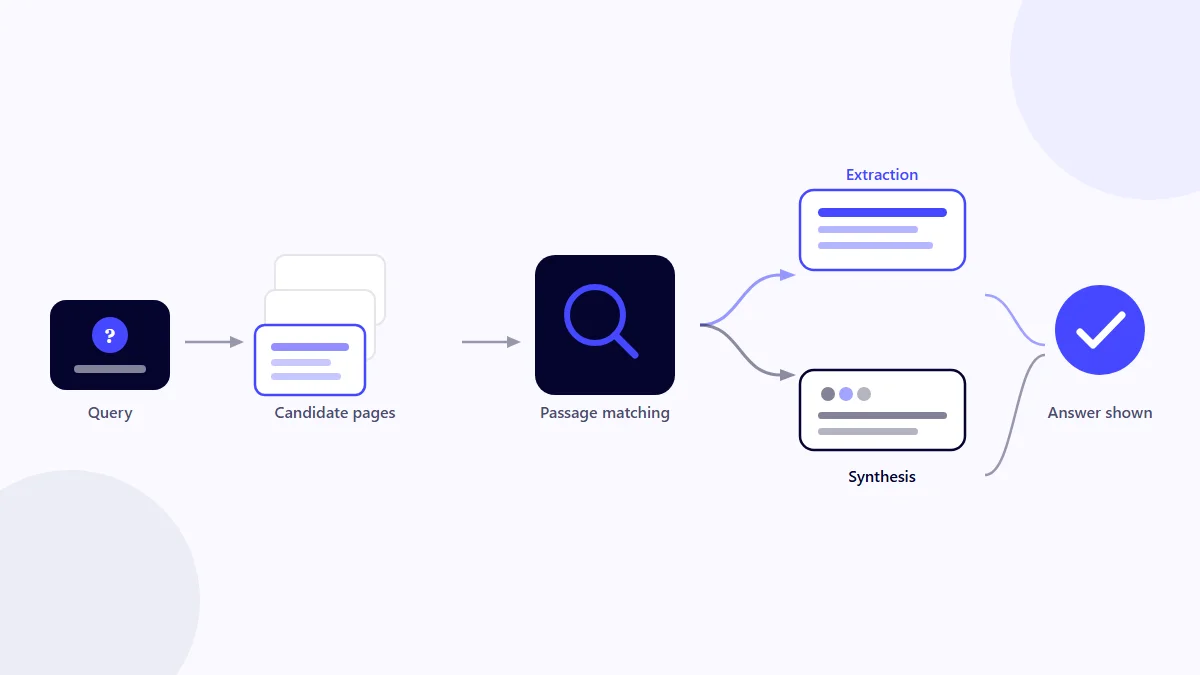
No platform has published one universal formula for how a specific passage or answer gets chosen, and answer engines don’t all follow an identical process. A useful way to understand what generally happens is as three broad stages: making a page accessible and understandable, evaluating what it says in relation to a question, and then either extracting a specific piece of it or generating a new response informed by it.
Discovery and interpretation
Before a page can be considered for an answer, it has to be accessible and understandable to whatever system is looking at it. Google’s own documentation describes this for traditional search as crawling (automated programs downloading a page’s content), followed by indexing, where that content is analysed and stored for later matching to a query. Google states plainly that indexing isn’t guaranteed even for pages it has already crawled.
Not every answer engine works this way. Some AI systems, including chat-based assistants, retrieve information through their own web search or retrieval features instead of a persistent search index. Google’s Gemini API has a documented “grounding” feature connecting a response to live Search results, with citations linked to specific text. Microsoft’s Copilot Studio documentation describes a similar retrieve-then-summarise step for its own product. These are separate, independently documented systems. None of this is one shared pipeline every platform runs. Public documentation varies considerably in detail: some platforms describe parts of their retrieval or grounding process, while others do not publicly explain enough to support precise claims about source selection.
What a system finds on an accessible page matters as much as whether it can reach it: the visible content and HTML structure, headings and how sections relate, and the main topic and specific questions the page addresses. Structured data (machine-readable markup, typically in the shared schema.org vocabulary) supports this stage by helping a system understand what a page represents, such as identifying an article, product or organisation.
Google states directly that it does not guarantee structured data will produce a rich result, even when marked up correctly, and that structured-data issues affect eligibility for certain result formats without affecting core ranking. Taken together, structured data can help systems interpret a page and its entities, but it does not by itself determine whether the page will be ranked, extracted or selected for an answer.
Answer selection: extraction versus synthesis
Extraction
In an extraction outcome, a system selects a specific passage, list, table or other part of a source page and displays it relatively directly, usually crediting the source. Google’s featured snippets are a documented example: Google’s systems determine algorithmically whether a page would work well as a snippet and elevate it if so, with no manual submission process, and Google doesn’t provide an exact minimum length a passage needs to qualify. Not every extraction works identically to a featured snippet. The general pattern appears elsewhere too, but the mechanics vary by platform and aren’t all documented to the same depth.
Synthesis
In a synthesis outcome, a generative system combines information from one or more retrieved sources into a response it generates itself, rather than presenting one lifted passage. The output is newly written, informed by what was retrieved rather than copied from it. Gemini’s grounding feature and Copilot Studio’s documentation both describe retrieval-then-generation approaches for their respective products. The official documentation reviewed for this article did not describe a public source-selection or weighting formula. Depending on the platform, synthesis may draw on several sources at once, which is part of why success with one answer engine doesn’t guarantee the same result with another.
Where AEO influences the process
Page-level AEO work targets the discovery, interpretation and selection stages above, making a page a stronger candidate to be understood and chosen without controlling that choice directly. In practice this means working on: question clarity, answer completeness, section boundaries, semantic relationships between headings and text, extractable formats such as lists and concise answer blocks, supporting context like definitions and examples, and source transparency about where claims come from.
These are readiness signals, not guarantees. A page can address every one of them and still not be the specific source selected for a specific query, for reasons outside the page itself.
Consider the same page in three states. First, it’s fully crawlable and indexed, and covers its topic in detail, but the answer to its main question is scattered across several paragraphs with no self-contained statement, making it discoverable but difficult to extract an answer from. Second, the same information is reorganised: the main question is addressed directly near the relevant heading, in a self-contained statement, with supporting detail underneath. Now it’s discoverable and clearly structured for that question. Third, nothing has changed since the second state, but for a specific search a competing page is selected instead. The well-structured page remains a strong candidate, but readiness is not the same as guaranteed selection.
How Major Answer Engines Currently Differ
The stages above (discovery, interpretation, extraction or synthesis) play out differently across platforms, and the differences matter more than a single shared description would suggest.
Google’s traditional search still runs on the crawl-index-serve pipeline described earlier, with featured snippets as its most documented extraction mechanism and AI Overviews layering a synthesis step on top of the same index. Google’s Gemini API documents a separate “grounding” feature for connecting a generated response to live Search results, with citations tied to specific spans of text, though this describes the developer API rather than confirming identical behaviour inside the consumer Gemini app. Microsoft’s Copilot Studio documentation describes a retrieve-then-summarise approach for its own product, checking retrieved results for relevance before generating a response. No public source-selection or weighting formula has been identified in the official documentation reviewed for this article, for OpenAI’s products or otherwise.
What none of these sources support is a claim that all of this amounts to one shared process. Each platform’s documentation describes its own system, at its own level of detail, and several gaps exist where no official documentation is publicly available at all, Perplexity’s source-selection process being one confirmed example. Treat any claim about “how AI search works” in general, rather than about one specific, named platform, with caution.
AEO Versus SEO Versus GEO
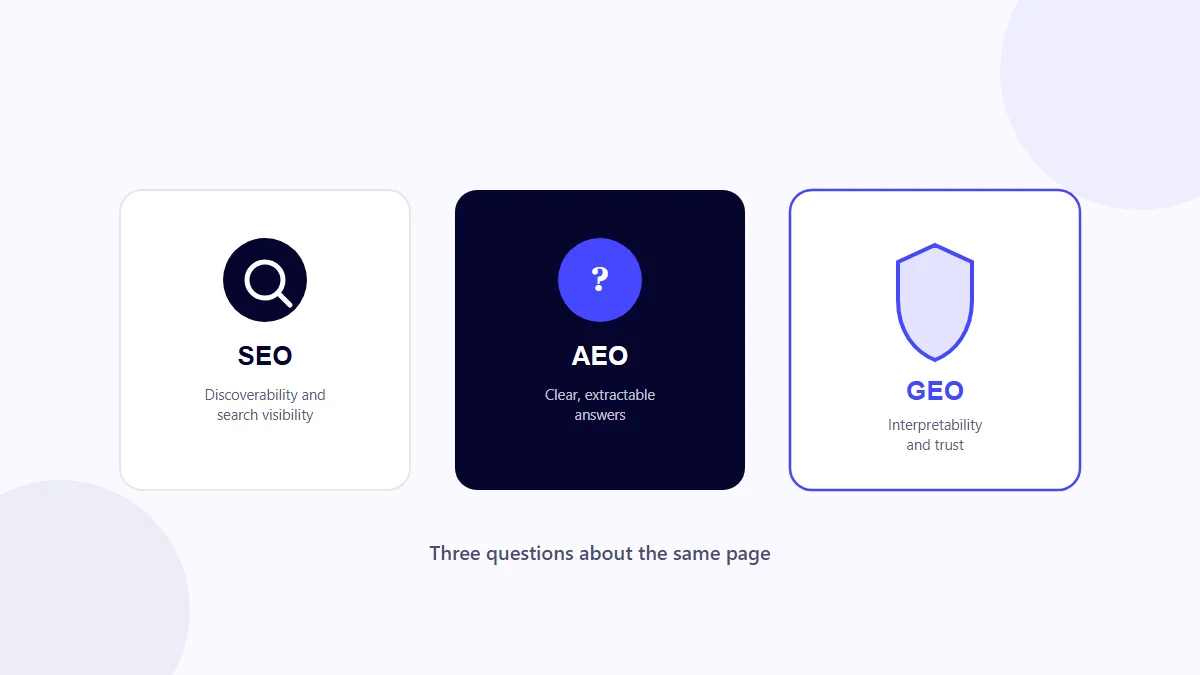
SEO, AEO and GEO address different questions about the same page, and they overlap more than they compete. None replaces the others, and none follows the others in a fixed order. A page can need work in more than one area at once, and the same page element often supports more than one discipline, for different reasons.
SEO is concerned with whether a page is discoverable at all: crawlability, indexing, relevance and overall search visibility, the focus of a dedicated technical review. AEO is concerned with whether a discoverable page clearly addresses a specific question and presents a usable answer, not simply whether it adds FAQs, uses question headings, includes schema, or keeps to a particular word count, which can support answer readiness without defining the whole discipline. GEO is concerned with signals that help generative systems interpret, evaluate, retrieve and potentially reference a page’s content: entity clarity, source transparency, supported claims, authorship, structured information, contextual completeness, content relationships and retrieval readiness. None of the three guarantees ranking, extraction, synthesis or citation, and none of these GEO signals should be read as confirmed universal ranking factors. Platforms vary in what they document and weight, and how GEO works covers that trust-and-sourcing side of the picture in full.
Technical accessibility, useful content, clear authorship, well-identified entities, credible sources and logical structure aren’t assigned to one discipline each. Most support more than one. A crawlable page with a vague or missing answer is SEO-accessible but AEO-weak: search engines can find it, but an answer engine has nothing specific to extract. A clearly written answer on a page that search engines can’t reach, or don’t trust, may still struggle for visibility. Strong entity clarity or well-cited sources (GEO-specific signals) don’t compensate for content that’s irrelevant or factually wrong; a system can interpret a page accurately and still have good reason not to use it.
Take an article answering “What is Answer Engine Optimisation?” as an example. SEO work helps it become discoverable: proper indexing, relevant on-page signals, a structure matching how people search for the topic. Checking the page’s AEO readiness shapes the definition itself: stating clearly what AEO means, near the top, in a form a system can isolate as an answer. GEO work sits alongside both: clear authorship, consistent naming, transparency about where claims come from, and content that fits coherently with the site’s wider coverage. The same article can succeed at one of these and fall short at another, which is worth exploring on its own in AEO vs SEO: what is the difference, or as a full three-way comparison in AEO vs GEO vs SEO.
| Comparison area | SEO | AEO | GEO |
|---|---|---|---|
| Primary objective | Discoverability and search visibility | Clear, extractable answers to specific questions | Interpretability and trust for generative systems |
| Main question being answered | Can this page be found for a relevant query? | Does this page clearly answer the reader’s question? | Can a generative system understand and trust this content? |
| Typical page signals | Titles, metadata, internal links, crawlability | Direct answers, question headings, lists, FAQs | Author information, dates, citations, entity naming |
| Content considerations | Topic relevance, depth, keyword alignment | Answer completeness, clarity, question coverage | Factual support, source transparency, consistent terminology |
| Technical considerations | Indexability, canonical tags, site structure | Heading hierarchy, content structure, page-type context | Structured data, schema, machine-readable entity markup |
| Trust and source considerations | Backlinks, domain relevance | Evidence near the answer itself | Authorship, citations, organisational transparency |
| Common measurement methods | Rankings, organic traffic, indexing status | Snippet/answer appearance, question-coverage audits | Citation presence, entity recognition, where observable |
| What success may look like | The page ranks and is regularly found | The page’s answer gets extracted or referenced | A generative system cites or draws on the page accurately |
| What it cannot guarantee | Extraction, citation or generative use | Selection by any specific answer engine | Ranking, traffic or guaranteed inclusion |
| Example audit finding (illustrative) | Page not indexed due to a crawl block | Answer present but buried mid-paragraph | No author or source information for a factual claim |
Which Page Elements Support AEO?
Several page elements are commonly associated with stronger AEO performance. None is individually required by any platform, and none guarantees selection, but each addresses part of how a page gets discovered, interpreted or extracted.
- Direct answers near the relevant heading give a system a self-contained statement to extract.
- Question-based headings align a section with how people actually ask things.
- Lists and steps break a process into discrete, extractable pieces.
- Comparison tables present options against consistent criteria.
- Concise answer blocks work well immediately after a heading, before supporting detail.
- FAQs extend question coverage, provided each adds something genuinely distinct.
- Logical heading hierarchy shows where one section ends and another begins.
- Structured data supports interpretation of a page’s entities: a signal, not a selection mechanism.
These work together: clear headings without direct answers underneath are still hard to extract from, and a strong answer under a vague heading is harder to match to the right query.
What a Strong Direct Answer Looks Like
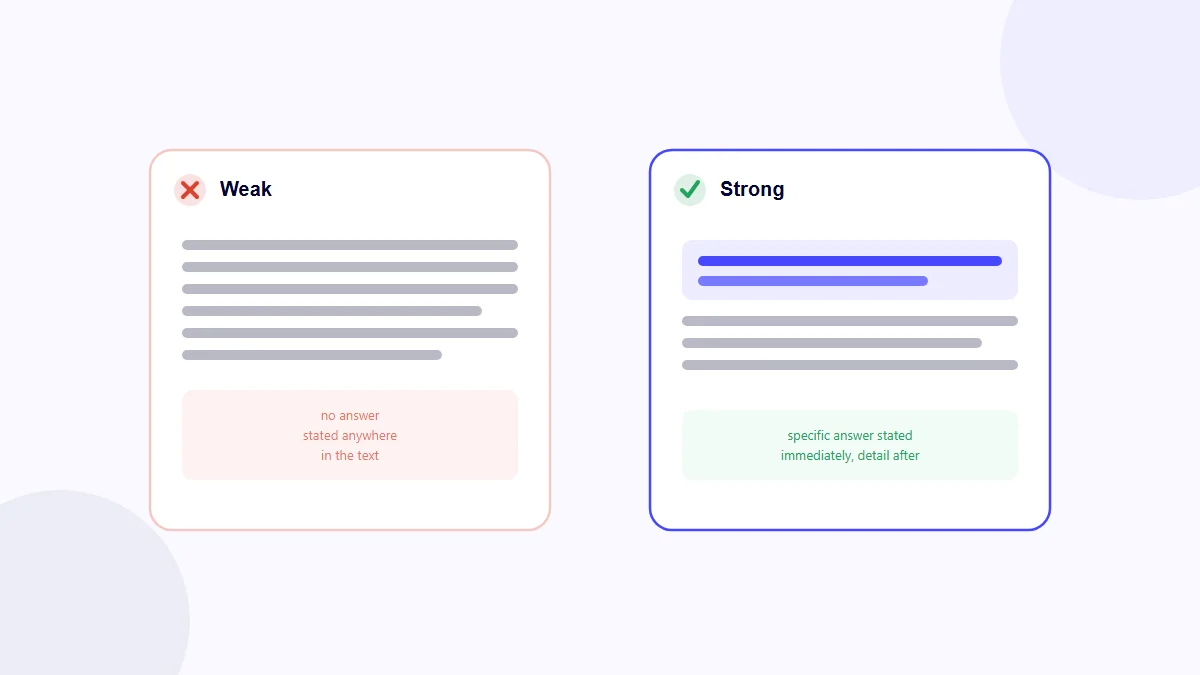
The difference between a weak and a strong direct answer usually comes down to specificity and position, not length.
Weak: “Shipping times can vary depending on your location, the courier used, and current order volumes. We work hard to get orders out as quickly as possible.” This is true, but doesn’t state an actual answer.
Strong: “Standard shipping takes 3–5 business days within the UK. Orders placed before 2pm are dispatched the same day.” This states a specific, checkable answer immediately, with supporting detail after. It isn’t longer, just more direct.
The widely used 40–60 word guideline for a direct answer is a practical editorial convention, not a platform requirement. Google’s own featured-snippet documentation states it gives no exact minimum length. The aim is a self-contained, usable statement, not a specific word count.
How to Audit a Page for AEO Readiness
Auditing an existing page means checking, systematically, whether the elements above are actually present. This covers AEO specifically: the combined process that also checks SEO and GEO together is covered in how to audit a page for AI search readiness.
A practical self-audit checklist, expanded into the full AEO audit checklist:
- Identify the page’s main question.
- Check whether a direct answer exists near the top, not buried mid-page.
- Review heading structure for real questions in a logical order.
- Check supporting formats: lists, steps, tables or FAQs, where they genuinely help.
- Check supporting context: definitions, examples, related information.
- Check source and authorship clarity.
Reviewing this manually is realistic for a handful of pages, but doesn’t scale across a larger site. AI Rank Inspector audits observable page-level SEO, AEO and GEO signals, covering the full range of checks above, and organises results so it’s clearer what’s worth addressing first. It does not guarantee rankings or AI citations, confirm whether any platform will select or cite a page, predict traffic, or detect every platform’s selection process. It checks what’s observable on the page, following how the audit process works, consistent with the readiness-versus-visibility distinction covered earlier. Results like this are often summarised as an AEO score, which is worth understanding on its own terms: what the number can tell you, and what it can’t.
Review your page’s answer readiness with the AI Rank Inspector AEO checker.
What AEO Cannot Guarantee
No platform guarantees that a well-optimised page will be selected, extracted, cited or surfaced by an answer engine, and several state this directly.
Google confirms that meeting all stated requirements for AI Overviews and AI Mode “doesn’t mean that Google will crawl, index, or serve” a page’s content. The same applies to featured snippets, where selection is algorithmic with no exact qualifying criteria. Structured data carries the same caveat: no guaranteed rich result, even when correctly implemented. The official documentation reviewed for this article did not describe a public source-selection or weighting formula.
Selection also depends on factors beyond any one page’s control: other pages may be equally well-structured, authority and trust signals relative to competitors matter, exact query phrasing matters, and platform systems change over time. What works for one query may not transfer to a related but differently worded one.
Stated plainly: AEO does not guarantee Google rankings, AI Overview inclusion, ChatGPT citations, Gemini citations, Perplexity citations, rich-result eligibility, or traffic growth. It improves how clearly a page presents its answer. What happens after that is decided elsewhere.
How to Know If AEO Work Is Helping
Because no platform reports “AEO performance” as a metric, measuring it means checking a different kind of signal to the ones SEO work usually relies on.
At the page level, what’s actually checkable is whether a direct answer exists and where it sits, how completely a page now covers its target questions compared to before, and whether the structural changes made (a reordered paragraph, a new heading) are still in place after a re-audit. This is a before-and-after comparison against the page’s own prior state, not a comparison against a published benchmark, since no such benchmark exists.
What this kind of check cannot tell you is whether a specific answer engine has started citing or surfacing the page as a result. That requires testing actual prompts against a specific platform and recording what comes back, a genuinely different kind of measurement built by querying the platform rather than reading the page. Improving a page’s page-level readiness and confirming a change in its external AI visibility are two separate claims, and conflating them overstates what an audit can actually show. This distinction, and how it compares to measuring SEO performance specifically, is covered in more depth in the article on AEO versus SEO linked earlier.
Which Pages Benefit Most From AEO?
AEO tends to matter most for pages built around specific, answerable questions: informational articles, comparisons, FAQ-heavy service pages, and how-to content. These already organise their content around specific questions readers are likely to ask.
Purely transactional pages, like a checkout page, benefit less directly, though a product page can still use a genuine pre-purchase FAQ without needing a full answer-first structure. This is a reasoned application of how extraction and synthesis work, not a documented platform preference.
Product and service pages sit in between the two extremes. A specific claim, such as a price, a delivery window or a compatibility detail, stated clearly near the top benefits from the same direct-answer treatment as an informational article, even though the page’s overall purpose is transactional rather than educational. Comparison and “best of” style pages benefit unusually heavily from AEO work, since each comparison point is itself a small, distinct question, and a page that states each one clearly rather than burying it in persuasive prose gives a system far more to extract from.
Common AEO Mistakes
A handful of patterns account for most AEO problems found during a page review, and recognising them speeds up fixing them.
Treating structure as a substitute for substance. Adding headings, lists and a FAQ section to a page whose underlying answer is vague or unsupported doesn’t fix the actual problem. Structure helps a system find an answer that’s genuinely there; it can’t manufacture one.
Checking off formats instead of covering real questions. A page can include a table, a numbered list and an FAQ section and still fail to address the specific question a reader came with, if those formats were added for their own sake rather than because the content genuinely called for them.
Confusing page-level readiness with confirmed visibility. Treating a strong self-audit result as proof that a specific platform will now cite the page overstates what any audit, including this checklist, can actually confirm.
Optimising for AI at the expense of accuracy. Restating a claim more directly or more confidently than the underlying facts support makes a page easier to extract from and less trustworthy at the same time. A clear, wrong answer is worse than an unclear, correct one.
Applying the same treatment to every page type. A transactional page forced into an answer-first, question-heavy structure it doesn’t need wastes effort that would matter more on an informational page nearby.
How to Apply AEO to an Existing Page
Once a page has been audited, applying AEO usually follows a similar order:
- Confirm the page’s main question.
- Add or rewrite a direct answer near the top, before expanding on it.
- Align headings with real questions, not generic labels.
- Add supporting formats where they genuinely fit: lists, steps, tables, a short FAQ.
- Re-audit to confirm the changes actually improved clarity.
This is a suggested order, not a fixed one. A missing direct answer usually needs fixing before formatting changes make much difference.
Final Practical Takeaway
AEO isn’t a checklist to complete once. It’s an ongoing question worth asking of any page meant to answer something specific: if a system needed to extract one clear answer from this page right now, could it? If the answer is buried, vague, or spread across several paragraphs, that’s usually the first thing worth fixing. Getting a page discovered and getting a system to extract a clear answer from it are different jobs, and only one of them starts with what’s actually on the page.
FAQs
Is AEO only for AI-generated answers? No. It covers featured snippets and People Also Ask boxes too, alongside voice assistants and chat-based systems.
Does structured data improve AEO? It supports a system’s understanding of a page’s entities, but Google’s own documentation confirms it doesn’t guarantee a rich result or ranking benefit. Does structured data help AI citations specifically goes deeper on that distinction, including what independent research actually shows.
Can AEO work without traditional SEO? Not really. A page needs to be crawlable and indexed before answerability becomes relevant.
Does AEO guarantee featured snippets? No. Selection is algorithmic with no exact qualifying criteria, so a well-optimised page is a stronger candidate, not a guaranteed one.
What’s the difference between an AEO checker and an AI visibility tracker? An AEO checker audits signals on a specific page; an AI visibility tracker tests prompts across AI platforms to see whether a brand is mentioned. One is page-level readiness, the other is an external outcome, covered in full in AEO checker versus AI visibility tracker.
How long does AEO work take to show results? This isn’t something any platform documents a timeline for. Page-level changes (a rewritten direct answer, a reorganised heading) take effect as soon as they’re published; whether and when that translates into any specific platform selecting the page is outside what the page owner can observe or control.
Do I need to rewrite my whole page to improve its AEO? Rarely. The most common fix is moving or restating an existing answer more directly, not rewriting the surrounding content. Check the direct-answer clarity and question-coverage elements first before assuming a fuller rewrite is needed.
Can a page have good AEO but bad GEO, or the other way round? Yes. AEO concerns answer clarity; GEO concerns trustworthiness and sourcing. A page can state its answer perfectly while making unsupported claims, or be impeccably sourced while burying its actual answer, the GEO side of the picture covered earlier.
Is AEO the same across every language or region? This article doesn’t cover that question directly. The mechanics described here are drawn from documentation that’s generally not scoped by language or region, but platform behaviour in specific markets isn’t something the sources used for this article confirm either way.