
SEO optimises whether a page can be found: crawled, indexed and judged relevant enough to appear in results. AEO optimises whether a page that’s already found clearly answers the question behind the search, in a form an answer engine can extract or draw from. AEO doesn’t replace SEO. It addresses a separate, later question.
The two terms get used almost interchangeably in places, which makes it harder to know what to actually check on a page. This article looks at one specific comparison: SEO against AEO, what each covers, where they overlap, how to improve both on the same page, when to prioritise one over the other, and how to measure each separately. It assumes you already know how AEO works at a mechanical level, and focuses purely on the comparison and the practical decisions that follow from it.
What SEO Optimises For
SEO is concerned with discoverability. Google’s own documentation describes this as a pipeline: crawling (automated programs downloading a page’s content), followed by indexing (that content being analysed and stored for later matching to a query), followed by serving results based on relevance signals. Google states plainly that indexing isn’t guaranteed even for pages it has already crawled.
Practically, SEO work covers titles and metadata, internal linking, crawlability, canonical signals, topical relevance and overall site structure. The underlying question SEO answers is: can this page be found at all, for a query it’s relevant to? None of this depends on whether the page states its answer clearly. A page can rank well while burying its actual answer several paragraphs down, and SEO signals alone won’t reveal that problem.
This is also why an SEO audit and an AEO audit can return opposite verdicts on the same page without either being wrong. A technical SEO review checking crawlability, canonical tags and indexability has no reason to look at where in the page an answer sits, because that’s outside its scope. It’s checking a different layer of the same page entirely.
What AEO Optimises For
AEO assumes that discoverability groundwork is already in place and addresses what happens next: once a system has found and indexed a page, can it pull a specific, usable answer out of it? A page can be comprehensively written and still never get extracted, because the relevant answer is never stated in a form a system can isolate.
This covers direct-answer clarity, question coverage, extractable formats like lists and concise answer blocks, and a heading structure that separates one question from the next. The mechanics of how discovery, interpretation and extraction or synthesis actually work, including how this differs across Google, ChatGPT, Gemini and Bing/Copilot, are covered in full in the article linked above. Structured data plays a supporting role here too: it doesn’t create an answer, but it helps a system correctly identify what the page and its main entity actually are.
Unlike SEO, AEO has no equivalent decades-long body of published platform documentation to draw on. Much of what’s practised as AEO today is reasoned from what platforms do document about discovery and interpretation, rather than from a disclosed answer-selection formula, since none has been published by any major platform.
Where They Overlap
Several page elements support both disciplines at once, for different reasons. Clear, logical headings help search engines understand a page’s structure and help answer engines isolate the right section to extract from. Genuinely relevant, well-organised content supports topical relevance for SEO and gives an answer engine accurate material to draw from. Clean technical implementation (a page that loads properly and renders its content) is a precondition for both. An answer engine can’t extract from a page it can’t access, any more than a search engine can index one.
This overlap is why the two disciplines get conflated so often. Fixing one of these shared elements, tightening a heading, removing a rendering issue, often improves both SEO and AEO signals at once, which can create the impression that the two are the same discipline wearing different names. They aren’t. The overlap exists because good page construction happens to serve both goals, not because the goals themselves are identical. A page can max out every shared element above and still fail one discipline specifically: excellent headings and fast rendering don’t, by themselves, guarantee that the actual answer is stated anywhere on the page.
Where They Diverge
Consider two versions of the same service page.
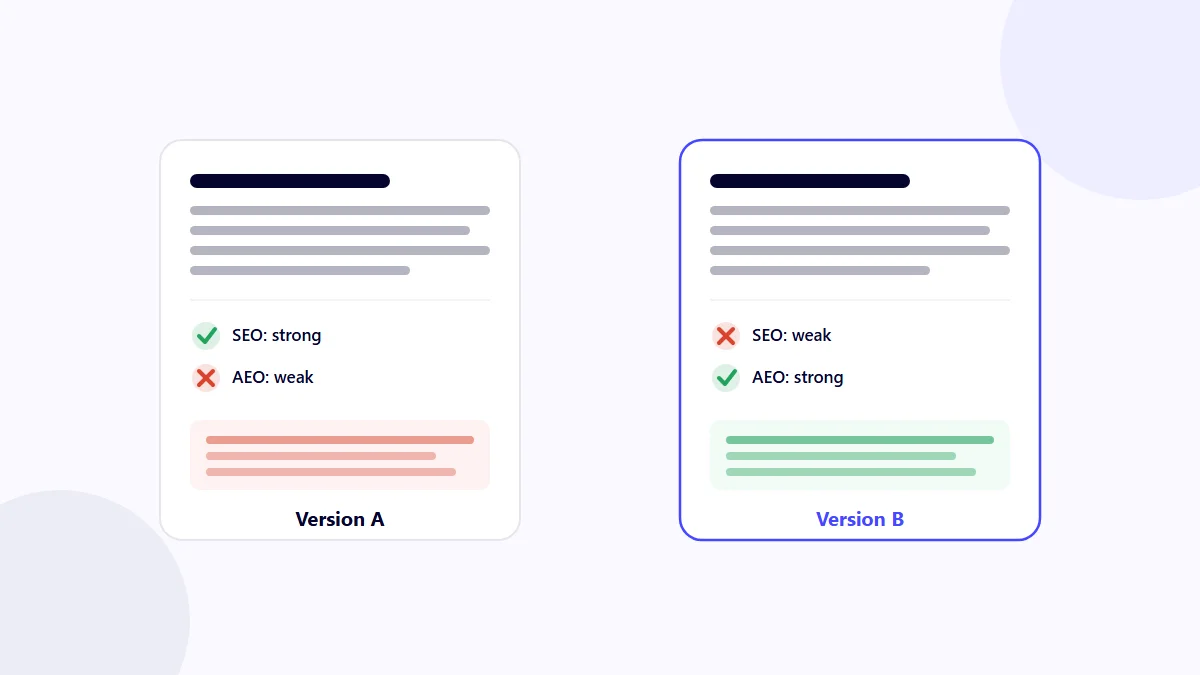
Version A is technically excellent: fast, properly indexed, internally linked, ranking on page one for its target query. But its answer to “how much does this cost” is scattered across three paragraphs of qualifying language, with no single sentence a system could lift out. This page is SEO-strong and AEO-weak: found easily, hard to extract from.
Version B states its answer immediately and clearly (“Standard installation costs £X and takes Y days”), but the page was never submitted to search engines properly, has no internal links pointing to it, and sits several clicks deep in the site’s structure. This page is AEO-strong and SEO-weak: a system that reached it could extract a clean answer, but few systems will reach it at all.
Neither version is functioning well on its own. The two problems require different fixes, and fixing one doesn’t touch the other.
A second pair makes the same point from a different page type. Version C is a blog article that ranks on page one for “how does home insulation reduce energy bills,” is properly indexed, and has a healthy backlink profile. But its opening three paragraphs discuss the history of insulation materials before ever stating a number. A reader, or a system, has to read well past the fold to find anything resembling an answer. Version D is the same topic written by a smaller, newer site: the second sentence states “Well-insulated homes typically use X% less heating energy than uninsulated ones,” a specific, checkable claim stated immediately, but the article sits on a domain with almost no other content, no internal links pointing to it, and hasn’t been submitted to search engines at all. Version C is findable but not extractable. Version D is extractable but not findable. Both need work, and neither problem is fixed by addressing the other.
SEO vs AEO Side by Side
| Comparison area | SEO | AEO |
|---|---|---|
| Core question | Can this page be found for a relevant query? | Does this page clearly answer the reader’s question? |
| What you check first | Indexability, crawl errors, canonical tags | Whether a direct answer exists near the top |
| Typical page signals | Titles, metadata, internal links | Direct answers, question headings, lists, FAQs |
| Content format emphasis | Comprehensive, topically deep pages | Concise, self-contained answer blocks |
| Failure mode | Page never gets indexed or ranks | Page ranks but nothing is extractable from it |
| How success is usually measured | Rankings, organic traffic, indexed pages | Direct-answer presence, question-coverage completeness |
| What it cannot guarantee | Rankings, traffic | Selection or citation by any specific answer engine |
Do You Need Both?
Yes, and the order matters. A page that’s invisible to search engines has no AEO to speak of, because there’s nothing for an answer engine to select from in the first place. This is a reasoning point rather than a platform-documented rule, but it follows directly from how discovery works: extraction happens after a page is found, not instead of it. In practice, that means checking SEO fundamentals first (is the page indexable, does it rank for a relevant query) and then checking AEO readiness (does it answer that query’s underlying question clearly), not the other way round, and not as a one-time choice between the two.
This also means the two checks look different in practice. A technical SEO review covers titles, metadata, canonical tags, headings and indexability: whether the page qualifies to be found at all. An AEO review starts from the assumption that the page is findable and asks a narrower question: once someone, or something, lands here, does it get a usable answer? Running both isn’t duplicate work. Each one catches a failure mode the other can’t see. For the detailed, checkable version of the AEO half specifically, the AEO audit checklist goes deeper.
How to Improve Both SEO and AEO on the Same Page
Most of the work below serves both disciplines at once, though each item’s primary benefit sits more on one side than the other.
Clarify the heading hierarchy first. Each H2 should map to one real question or subtopic, with H3s genuinely nested underneath rather than added to repeat a target keyword. This helps SEO’s topical structure and gives an answer engine a clear boundary between one question and the next.
State the direct answer before the supporting detail. Placing a specific, checkable statement near the top of a section, before the explanation and caveats, is the single highest-leverage AEO change on most pages. It rarely costs anything on the SEO side, since search engines don’t penalise a page for being direct.
Add structured data that matches what the page actually is. Article, Product, Organisation or FAQPage schema, applied only where it genuinely describes the page’s content, helps a system correctly interpret entities and relationships. Google states directly that structured data doesn’t guarantee a rich result even when marked up correctly, so this is a clarity aid, not a ranking or citation lever.
Keep internal links topically relevant, not just numerous. A link that connects genuinely related content supports SEO’s topical authority signals and gives an answer engine additional context about how pages on the site relate to each other. A large number of loosely related internal links does neither job well.
Update content when the underlying facts change. A price, a policy or a statistic that’s gone stale is a real problem for both a search engine deciding whether a page is still trustworthy and an answer engine deciding whether to extract from it. Editing on a fixed schedule regardless of whether anything has actually changed doesn’t serve either goal.
Match content depth to the page’s actual purpose. An answer-first paragraph doesn’t require sacrificing depth elsewhere on the page. A service page can state its price clearly in the first two sentences and still go on to cover process, timelines and exceptions in full further down.
Write in the vocabulary the reader actually searches with. A page titled with formal industry terminology but searched for using everyday phrasing creates friction for both disciplines: SEO relevance signals weaken when the target query and the page’s language don’t align, and an answer engine has to work harder to match a plainly worded question to formally worded content.
Test extractability by reading only the opening of each section. Read just the first sentence or two under each heading, without the rest of the paragraph. If the answer to that section’s implied question isn’t identifiable from those opening words alone, the section is very likely failing AEO even if it ranks fine. This is a five-minute manual check that catches a large share of buried-answer problems before any tool is involved.
When to Prioritise SEO, AEO or Both
Not every page needs the same sequencing, and treating every page identically wastes effort on the wrong problem.
A new page built from scratch should get both from the start. Building answer-clarity into a first draft costs little extra; retrofitting it into an established page later usually means restructuring content that’s already been written, reviewed and possibly translated.
A page with an unresolved indexing or crawl problem needs SEO fixed first, regardless of how clearly it might answer a question once found. AEO work on a page nothing can reach doesn’t produce any result worth measuring.
A page that already ranks reasonably for a genuinely question-shaped query (“how much does X cost,” “what is Y,” “does Z work with W”) is a strong candidate for AEO work next, since the discoverability groundwork is already in place and a clearer answer is the more likely remaining gap.
A purely transactional page (a checkout flow, an account settings page) benefits far less from AEO investment, since there’s rarely a specific question being answered. SEO fundamentals and basic usability matter more here than answer-clarity work.
An established page whose rankings have recently dropped needs an SEO diagnosis before anything else. A ranking drop is usually caused by a technical change, a competitor improvement, or an algorithm update, none of which an AEO review is positioned to detect. Rewriting the page’s answer clarity before understanding why rankings fell risks fixing the wrong problem, or masking the real one.
A page that’s part of a comparison or “best of” style article benefits from both disciplines applied unusually heavily at once. It needs to be findable for a competitive query (SEO), state each comparison point clearly enough to extract (AEO), and, in practice, tends to fail on answer clarity most often, since comparative claims are easy to write persuasively but easy to leave vague about which option actually wins on which point.
How to Measure SEO and AEO Separately
SEO and AEO are checked differently, and it’s worth being precise about what each measurement approach can and can’t tell you.
SEO is typically measured through: organic rankings for target queries, organic traffic and sessions, click-through rate from search results, the number of pages actually indexed versus submitted, and crawl-error counts. These are well-established, widely available metrics, and most standard analytics and search-console tools report them directly. A ranking tracked weekly, a traffic trend reviewed monthly, and a crawl-error count checked after any site change together give a reasonably complete SEO picture without needing anything specialised.
AEO is measured differently, because there’s no equivalent standard reporting. At the page level, what’s actually checkable is whether a direct answer exists and where it sits, how completely a page covers the questions it’s targeting, and whether its structure is extractable: the same page-level readiness signals covered by the full AEO audit checklist. In practice, this usually means working through a fixed set of pages against that checklist on a recurring basis, the same way a rankings report gets checked weekly, rather than relying on a one-off review. Some tools roll these page-level checks up into a single number, often called an AEO score, as a way of prioritising which pages need attention first; what that kind of score can and can’t tell you is worth understanding before treating it as a benchmark.
What neither of these measures directly is external AI visibility: whether a specific answer engine actually selects, cites or surfaces a given page for a given query. That can only be observed by testing real prompts against a specific platform and recording what comes back, a different kind of measurement built by querying the platform itself rather than reading the page. A high page-level AEO score is not the same claim as “this page gets cited by ChatGPT,” and the two shouldn’t be conflated when reporting results internally. Treat page-level measurement as leading indicators you control, and external visibility as a lagging outcome you can observe but not directly control.
The Trade-off Between SEO and AEO Investment
The two aren’t equally predictable, and that’s worth factoring into how a team allocates limited time.
SEO’s payoff is comparatively well understood. Search engines publish substantial documentation about crawling, indexing and ranking factors, and the relationship between a technical fix and a measurable outcome, like a resolved crawl error leading to a page being indexed, is generally traceable.
AEO’s payoff is less certain, precisely because no platform publishes a selection formula. Improving a page’s answer clarity is reasoned, evidence-informed work rather than a documented guarantee. It’s built on what platforms describe about how their systems find and interpret content, not on a disclosed mechanism for why one page gets selected over another.
In practice, this means teams with limited capacity generally get more predictable value from securing SEO fundamentals first. AEO improvements on a page that already ranks well are a reasonable next investment, not a reason to skip SEO work in favour of chasing a less certain outcome.
Consider a team with one week of capacity and two candidate pages: one has a known crawl error keeping it out of the index entirely, the other ranks well already but states its answer poorly. Fixing the crawl error has a predictable, measurable outcome: the page becomes indexable, and its existing content becomes available to be found at all. Rewriting the second page’s answer clarity is very likely a genuine improvement, but whether it changes any specific answer engine’s behaviour toward that page is not something either team can know in advance. Spending the week on the crawl error is the higher-confidence choice, not because AEO work doesn’t matter, but because its payoff is real but unverifiable in the short term, while the SEO fix is both real and directly observable.
What Happens When a Page Fails at Both
A page that’s neither discoverable nor answer-clear doesn’t fail twice as visibly; it usually just fails quietly. It won’t rank, so it won’t generate the traffic that would otherwise expose a weak or buried answer to real readers, and it won’t be reached by an answer engine either, so its answer-clarity problems never get tested against anything. This is worth knowing because it means the SEO problem, in a specific sense, “hides” the AEO problem: fixing discoverability first is often what surfaces answer-clarity issues that were always there but never visible, because nothing was reaching the page to notice them.
Common Misconceptions
“AEO makes SEO obsolete.” It doesn’t. It depends on it: a page that search engines can’t find has nothing to be extracted from.
“Adding an FAQ section is AEO.” FAQs are one supporting format among several, and only help where they answer genuinely distinct questions. Google’s own featured-snippet documentation gives no exact minimum length or required format for an extractable answer. The underlying clarity matters more than the presence of any specific block.
“Structured data guarantees AI citations.” Google states directly that it does not guarantee structured data will produce a rich result, even when marked up correctly, and that structured-data issues don’t affect core ranking. Structured data helps systems interpret a page; it doesn’t determine whether the page gets selected for an answer.
“A high SEO score means the page is AEO-ready too.” They measure different things. A strong technical SEO score confirms a page is crawlable, indexed and relevant. It says nothing about whether the page’s answer is stated clearly enough to extract. Version A above would likely score well on SEO fundamentals while still failing an AEO review.
“AEO work always takes longer than SEO work.” Not necessarily. Many AEO fixes, restating an answer more directly, reordering a paragraph, are smaller edits than the technical or content-depth work SEO sometimes requires. The two aren’t comparable in effort by default; it depends on what’s actually wrong with the page.
“If a page isn’t ranking, its AEO must be the problem.” Not necessarily, and often not at all. A non-ranking page usually has an SEO problem: a crawl block, a missing sitemap entry, weak topical relevance, or a genuinely more competitive query than the page can win. AEO addresses answer clarity once a page is found; it has no bearing on why a page isn’t being found in the first place.
How to Check Both on the Same Page
Checking SEO fundamentals and AEO readiness separately, by hand, is realistic for one page at a time but doesn’t scale. AI Rank Inspector audits observable page-level SEO and AEO signals together, covering the full feature set, so both checks can run in one pass rather than two separate reviews. It doesn’t guarantee rankings, traffic or selection by any specific answer engine. It checks what’s observable on the page.
Review a page for both by adding AI Rank Inspector to Chrome.
Final Practical Takeaway
SEO and AEO answer different questions about the same page: one about whether it can be found, one about whether it clearly answers what someone was looking for. Checking only one leaves the other’s failure mode invisible: a well-optimised page that never states its answer, or a clear answer that nobody reaches. Both are worth checking, in that order, measured separately, on any page meant to do more than just rank.
FAQs
Is AEO a replacement for SEO? No. AEO assumes a page is already discoverable and addresses a separate, later question about answer clarity.
Can a page rank well but still fail at AEO? Yes. Version A above is exactly this case: ranking well doesn’t mean a system can extract a clean answer from the page.
Does good AEO improve SEO rankings? Not directly, and no platform documents this as a ranking factor. Answer clarity and search ranking are evaluated separately, though a clearer page is often also a better-organised one.
Which should I fix first on an existing page? Check indexability and crawlability first. A page with no SEO problems but a buried answer is a smaller fix than one that isn’t being indexed at all.
Do I need separate tools to measure SEO and AEO? Not necessarily separate tools, but separate metrics. Rankings and traffic answer the SEO question; direct-answer presence and question coverage answer the AEO question. A single tool can report both without them being the same measurement.
Should every page on a site get the same AEO treatment? No. Informational and comparison pages benefit most, since their whole purpose is answering a question. Purely transactional pages benefit far less, since there’s rarely a specific question to extract an answer to.
If I can only fix one page this month, how do I decide which discipline to prioritise? Check whether the page is indexed and ranking at all first. If it isn’t, that’s an SEO problem and fixing it comes first regardless of how the page reads. If it already ranks reasonably, the more likely remaining gap is answer clarity, which points to AEO.
Does hiring separate SEO and AEO specialists make sense, or should one person handle both? Either can work. The disciplines require different checks, not necessarily different people. What matters more than headcount is that both sets of checks actually get run on a page, rather than one being assumed to cover the other.