

SEO optimizer software, in the on-page sense, scores a draft against the pages currently ranking for your target query and flags gaps in term coverage, headings, structure and length while you write. Surfer SEO, Clearscope, Frase, MarketMuse, NeuronWriter, PageOptimizer Pro, Scalenut and Rankability are the main options in 2026, with published starting prices from about $19 to $129 a month.
What “SEO Optimizer Software” Means for On-Page Content
“SEO optimizer software” is a loose phrase. It gets attached to rank trackers, backlink tools, site crawlers, all-in-one suites and content editors, which do genuinely different jobs. This article is about one of those categories only: on-page content optimisation software, the tools that grade a draft against the pages already ranking for your target query and tell you what terms, headings and structure they have that you don’t.
The distinction matters because these tools are often compared against products they do not replace:
- A rank tracker (AccuRanker, SE Ranking) records where a URL sits in Google over time. It measures an outcome after publication; a content optimiser works on the draft and never checks a position.
- A technical crawler (Screaming Frog, Sitebulb) audits site architecture, status codes and indexability. A content optimiser ignores all of that and looks only at the words on one page.
- An all-in-one suite (Semrush, Ahrefs) bundles a writing assistant alongside keyword, backlink and audit tools. The writing assistant is a content optimiser; the rest of the suite is not.
- An AI visibility tracker (Profound, Otterly.ai, and others in our guide to generative engine optimisation tools) measures whether a brand gets cited across ChatGPT, Perplexity and AI Overviews after content is live. That is an external measurement, not a drafting tool.
What the eight tools below share is the core loop: pull the top-ranking results for a keyword, extract the terms, entities and structure they have in common, and score your draft on how closely it matches that profile while you write. For the answer-engine side of the picture, our explainer on how answer engine optimisation works covers that discipline in full.
The 8 Content Optimisation Tools Compared: Price, Score Basis and AI-Search Adaptation
| Tool | Starting price | What the score is based on | AI-search / AEO adaptation | Key differentiator |
|---|---|---|---|---|
| Surfer SEO (surferseo.com) | $49/month (Discovery, billed yearly) | NLP term coverage versus the top-ranking pages, plus headings, length and paragraph structure (Content Score, 0 to 100) | Partial: Surfer markets its Content Score as targeting AI citations too, and sells a separate AI Search Analytics tracking plan (vendor page, 2026-09-10) | Highest-volume content-editor workflow; visibility tracking bundled into the same product |
| Clearscope (clearscope.io) | $129/month (Essentials) | Term and entity coverage versus top-ranking pages via a dual NLP engine, plus readability (Content Grade, A++ to F) | Partial: adds “query fan-out awareness” at the brief stage and prompt tracking for ChatGPT and Gemini mentions; the grade itself is unchanged (vendor page, 2026-09-10) | Cleanest editorial term report; query fan-out informs what a brief should cover, not just the draft score |
| Frase (frase.io) | $39/month (Starter, billed yearly; $49 monthly) | Term and topic coverage versus the SERP results for a query (Topic Score) | Yes: publishes a separate GEO score alongside the classic SEO score, plus AI Visibility tracking across ChatGPT, Google AI, Perplexity, Claude and Gemini (vendor page, 2026-09-10) | Lowest full-workflow entry price; clearest split between a classic SEO score and a distinct GEO score |
| MarketMuse (marketmuse.com) | Free tier; paid plans quote-only (no public price) | Coverage of a modelled set of subtopics and their relationship to the main topic (Content Score), plus site-personalised difficulty | No: no mention of AI search, AEO, GEO or AI-visibility tracking anywhere on its pricing page (vendor page, 2026-09-10) | Topic-model approach and domain-level topic authority rather than a flat top-10 term list |
| NeuronWriter (neuronwriter.com) | $23/month ($19 billed yearly) | Competition-based term and entity coverage versus top-ranking pages, plus a target length | Partial: adds an “AI Visibility” brand-tracking feature; the content score is not described as changed for AI answers (vendor page, 2026-09-10) | Lowest entry price for a genuine competition-based term and entity editor |
| PageOptimizer Pro (pageoptimizer.pro) | $40/month (Basic) | Recommendations derived from PageOptimizer Pro’s own recurring on-Google tests, comparing your page against the actual ranking competitors across 100-plus on-page factors | Partial: includes a “POP AI Visibility Tracker” and an AI writer; the recommendation engine itself is unchanged (vendor page, 2026-09-10) | Recommendations grounded in controlled ranking tests rather than a straight term-frequency comparison |
| Scalenut (scalenut.com) | $24/month (Starter, promotional; list $59) | NLP term coverage versus top-ranking pages inside an editor and a brief-to-draft “Cruise Mode” (SEO score) | Partial: markets a “GEO content engine” and tracking across ChatGPT, Google AI Overviews and Perplexity; the editor score stays classic (vendor page, 2026-09-10) | Cheapest brief-to-draft automation for high-volume producers |
| Rankability (rankability.com) | $99/month (Starter) | Term and topic coverage versus the ranking set for a keyword (content grader), now inside a wider “AI Search Toolkit” | Yes: repositioned around AI-search visibility, tracking mentions and citations across a tiered list of AI platforms; the grader is one module (vendor page, 2026-09-10) | Unlimited seats on every plan; content grader sits inside a broader AI-search and rank-tracking product |
Prices are each vendor’s own published starting price, verified directly on 2026-09-10, and change often. Billing period matters: Surfer’s, Frase’s and NeuronWriter’s lowest figures are annual-billed, and monthly rates are higher. Scalenut’s $24 is a standing promotional price against a $59 list price. MarketMuse and MarketMuse alone publishes no dollar figure for its paid tiers. Check the current pricing page before budgeting.
What an Optimisation Score Actually Measures (and What It Doesn’t)
Every tool here produces a headline number: a Content Score out of 100, a letter grade, a topic score. It is easy to treat that number as a verdict on the page. It is not. It is a measurement of one specific thing.
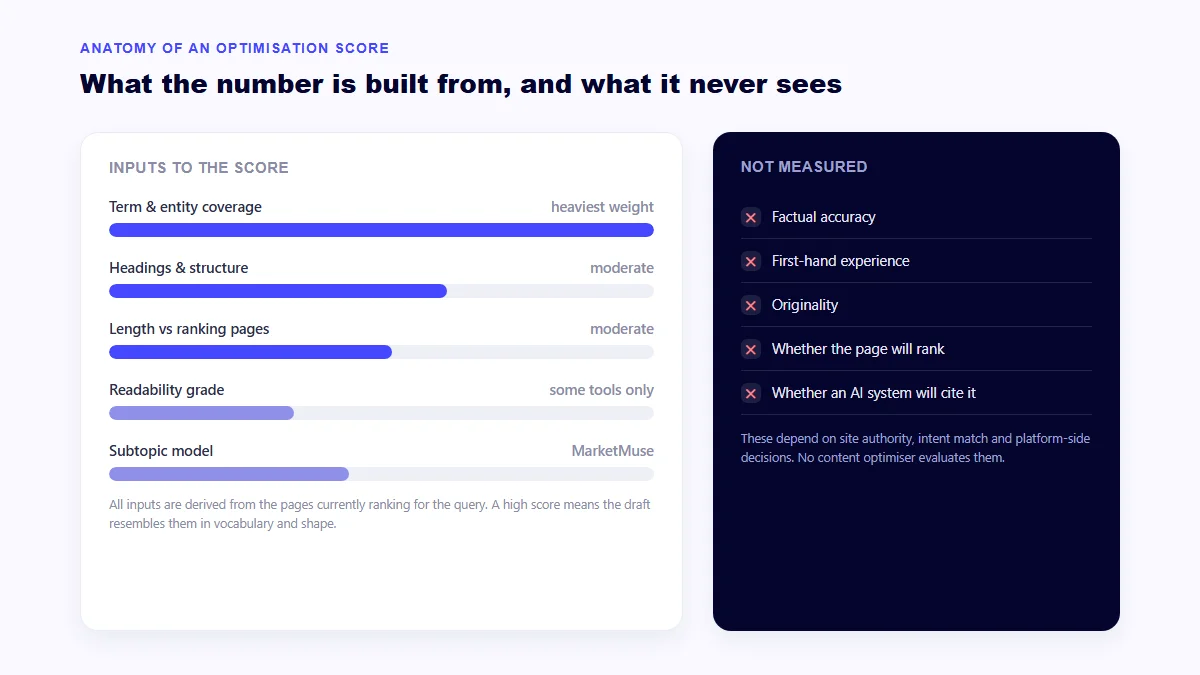
Across the tools that document their method, an optimisation score is built from a small, consistent set of inputs:
- Term and entity coverage carries the most weight in Surfer, Clearscope, Frase, NeuronWriter and Scalenut. The tool reads the pages ranking for your query, extracts the words, phrases and named entities they share, and scores your draft on how many it uses, and in what context.
- Structure: whether the draft has a title, an H1, a sensible spread of headings, and paragraph or list density in the range the ranking pages use.
- Length: your word count against the recommended count for the ranking set.
- Readability: a reading-grade metric in some tools (Clearscope, Scalenut).
- Topical model: MarketMuse scores coverage of a modelled web of subtopics and their relationships, not a flat term list.
Every one of those inputs is derived from the pages currently ranking. So a high score means one thing precisely: your draft closely resembles the pages Google already ranks for this query, in vocabulary and shape. That is genuinely useful, since a page missing half the terms its competitors treat as core has often not covered the topic properly.
But the score cannot measure several things that matter: factual accuracy (it rises just as happily for a well-structured page full of errors), originality (rewarding resemblance to existing top pages, by design, does not reward saying something new), or first-hand experience. Google’s own guidance on creating helpful content asks whether content “clearly demonstrate[s] first-hand expertise and a depth of knowledge,” and no term-coverage model can see whether you have actually used the product you are writing about.
It also cannot tell you whether the page will rank or be cited. A high score is a page-level content signal; the ranking depends on site authority, links, competition and intent match, none of which the tool evaluates, and AI citation is an external outcome decided on the platform side. Our explainer on what a GEO score measures covers the same page-level-versus-external distinction for generative engines, and our analysis of whether structured data helps AI citations works through it in detail.
There is also a ceiling on how far the term-coverage number should be pushed. Google’s spam policies define keyword stuffing as “filling a web page with keywords or numbers in an attempt to manipulate rankings,” and Google states plainly that it has no preferred word count. Chasing a score from 85 to 100 by forcing in every recommended term, or padding to hit a target length, works against the page. Treat the score as a floor to clear, not a number to maximise.
The 8 Tools, One by One
Surfer SEO (surferseo.com)
Surfer SEO is the most widely used content editor in this category. Its Content Score, from 0 to 100, is built mainly from NLP term coverage against the top-ranking pages for your query (default top 10, adjustable), plus heading structure, length and paragraph count. Surfer’s documentation stresses that term context matters more than raw frequency.
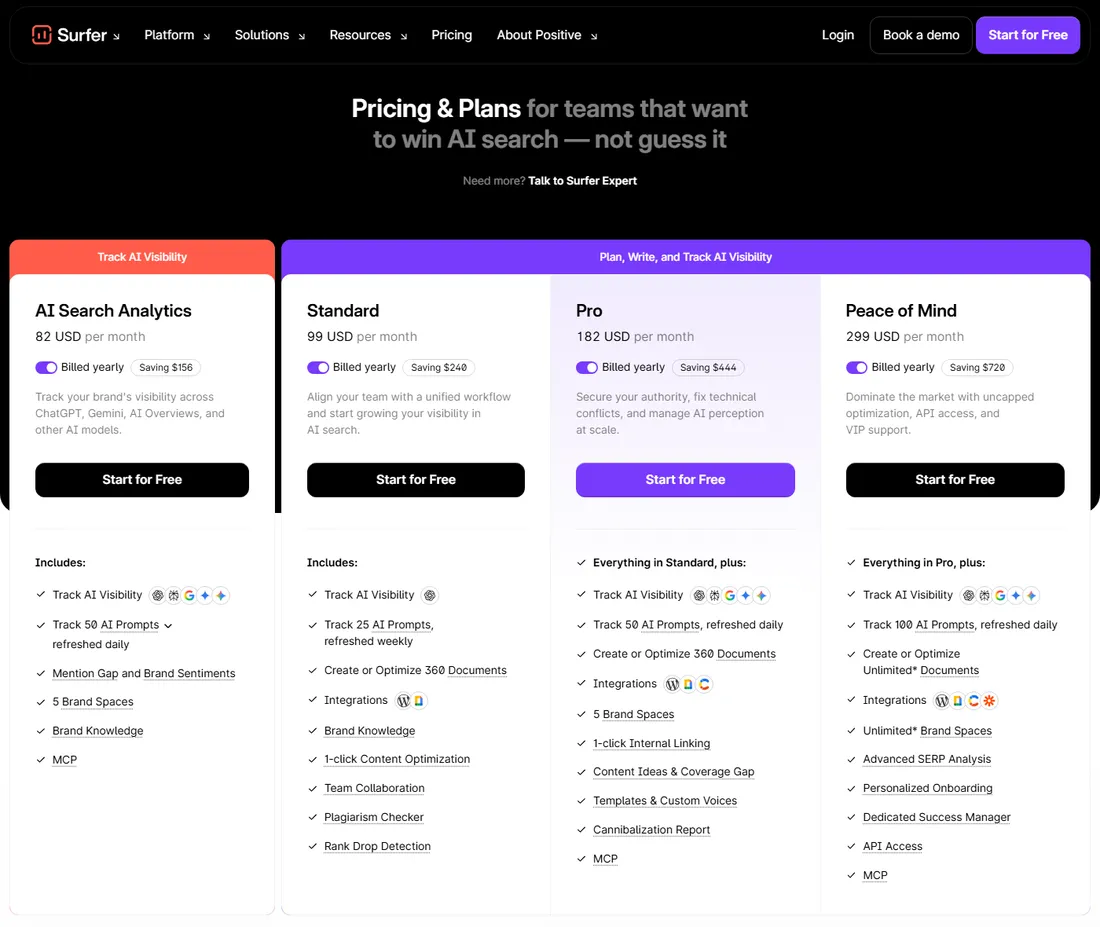
Pricing runs from $49/month (Discovery, billed yearly, 120 documents) through Standard ($99), Pro ($182) and Peace of Mind ($299, unlimited documents) to Enterprise ($999). A separate AI Search Analytics plan ($82/month) does brand-visibility tracking only.
Best for: teams producing a high volume of pages that want drafting, optimisation and light visibility tracking in one tool. Limitation: the term-coverage number invites over-optimisation if writers treat it as a target, and the cheapest rate is annual-billed.
Clearscope (clearscope.io)
Clearscope is the most editorial of the term-coverage tools. Its Content Grade runs from A++ down to F, based on relevance and comprehensiveness against the top-ranking pages for a keyword, using a dual NLP engine (Google Cloud Natural Language plus IBM Watson) to surface terms, entities and related topics rather than simple density.
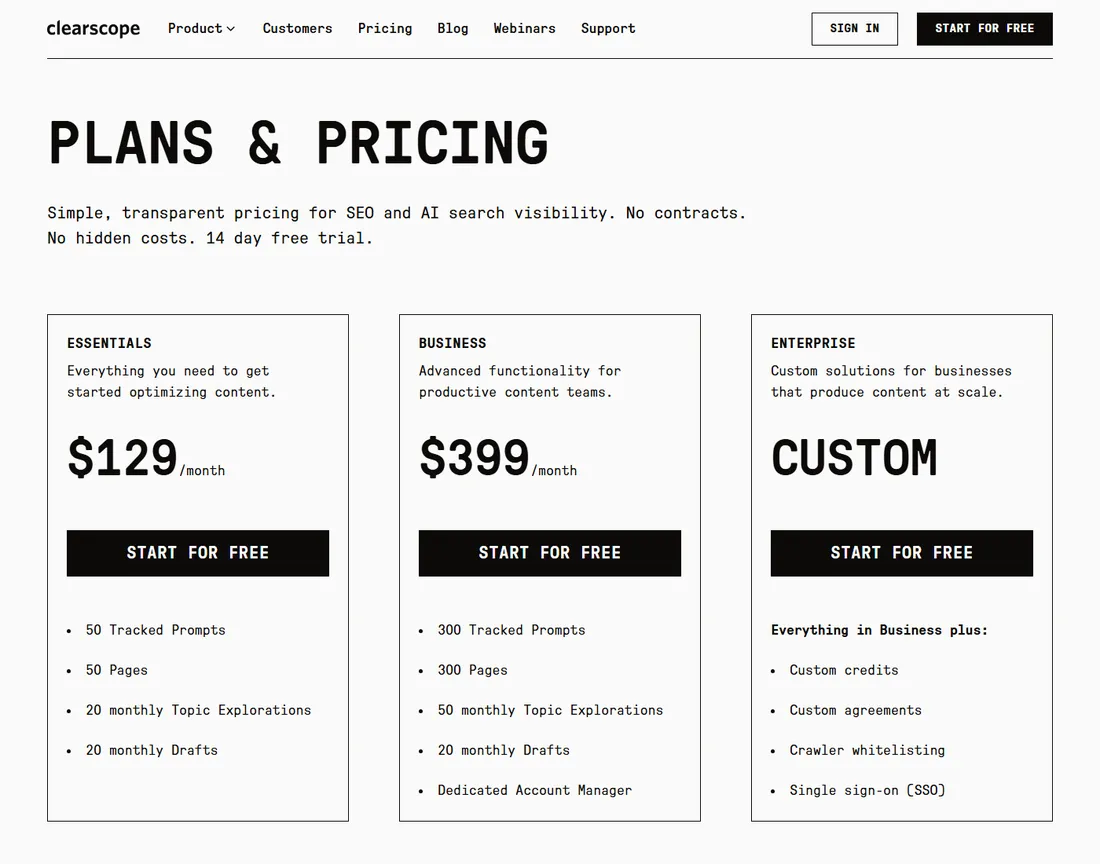
Pricing starts at $129/month (Essentials: 50 tracked prompts, 50 pages, 20 topic explorations, 20 drafts), rising to Business ($399, dedicated account manager) and custom Enterprise. Users and projects are unlimited on every plan, and there is a 14-day free trial.
Best for: editorial teams that want a clean, trustworthy term report and briefs informed by “query fan-out,” the set of searches an AI platform runs to build an answer. Limitation: the highest entry price of the mainstream editors, and a grade that rewards comprehensiveness can push drafts longer than the reader needs.
Frase (frase.io)
Frase pairs SERP research, an AI writer and a live optimisation score in one workflow, positioned openly as “the content operating system for AI search.” Its Topic Score measures term and topic coverage against the ranking results for a query.
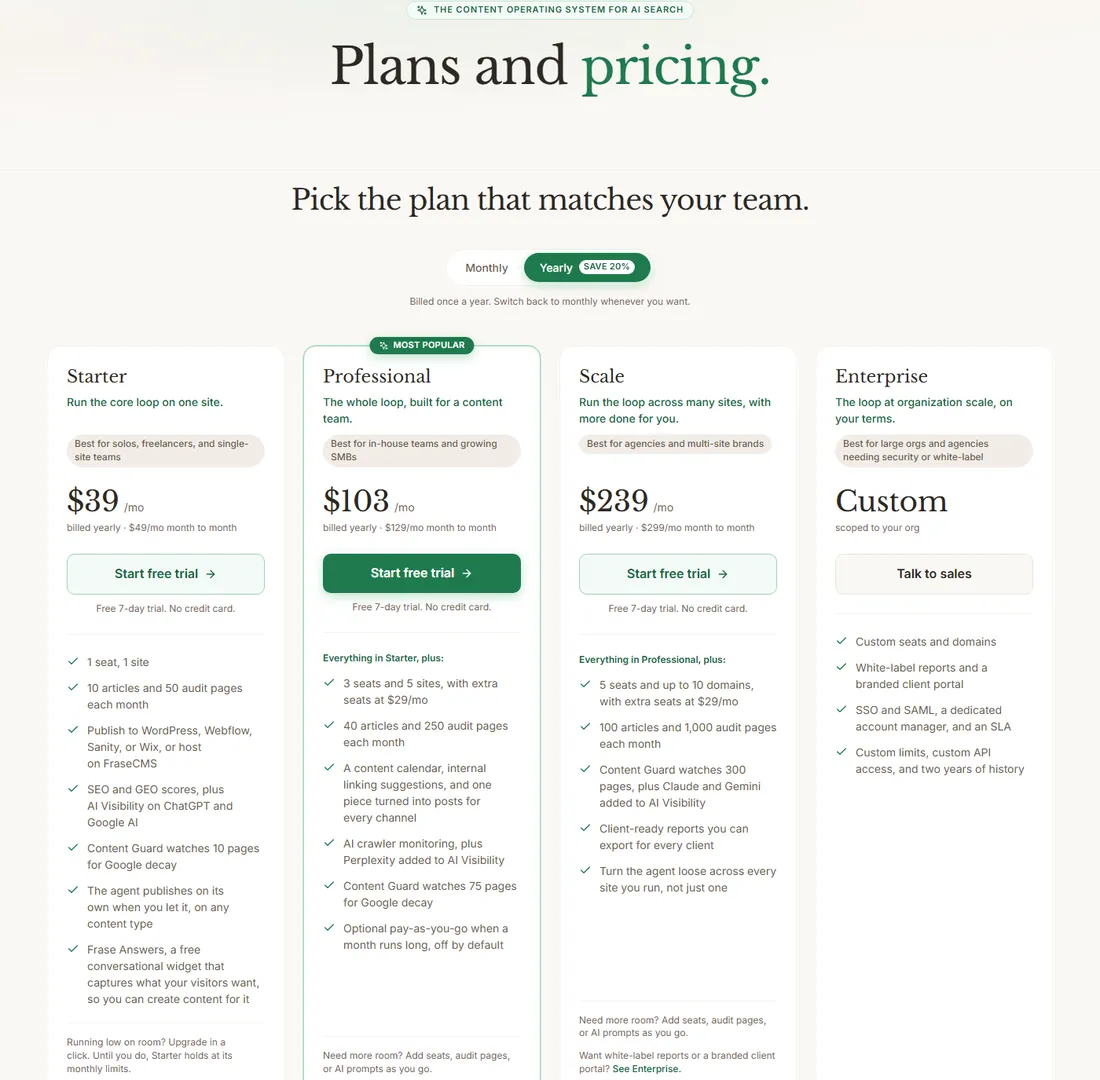
Pricing starts at $39/month (Starter, billed yearly; $49 month-to-month) for 1 seat and 10 articles a month, through Professional ($103/$129) and Scale ($239/$299) to custom Enterprise. A 7-day free trial needs no card.
Best for: solo writers and small teams who want research, drafting and scoring in one place at the lowest entry price here. Limitation: the term-coverage score is not obviously more advanced than Surfer’s or Clearscope’s, and Frase’s separately-named “GEO score” is a vendor metric with no detailed public methodology, so treat it as a proprietary number rather than a standard.
MarketMuse (marketmuse.com)
MarketMuse takes a different route. Instead of a flat term list from the top 10, it builds a model of a topic’s subtopics and how they relate, then scores a draft on how much of that model it covers. It adds Personalised Difficulty (a site-specific 1-to-100 ranking-difficulty estimate) and Topic Authority (how broadly your domain covers a topic).
Pricing is demo-gated: a Free tier (10 queries a month) is the only plan with a published number. Optimize, Research and Strategy are quote-only, differentiated by tracked topics (100, 1,000, 10,000), monthly briefs and seats.
Best for: teams planning topical coverage across a whole site, not just scoring one page. Limitation: no published pricing, a heavier analyst-oriented interface, and no AI-search positioning at all as of the check date.
NeuronWriter (neuronwriter.com)
NeuronWriter is the budget option that still does the real job. Its content score is a genuine competition-based model: it analyses the top-ranking pages for a query and scores a draft on semantic term and entity coverage plus target length.
Pricing starts at $23/month ($19 billed yearly) for the Bronze plan (2 projects, 25 content-writer analyses a month), up through Silver, Gold ($69, “most popular”, adds Content Designer, integrations and API), Platinum and Diamond ($117). Limited free access lets you try the editor.
Best for: freelancers and small sites that want real term and entity analysis without a $100-plus monthly commitment. Limitation: the cheap tiers cap monthly analyses tightly, and integrations plus AI features are gated to Gold and above.
PageOptimizer Pro (pageoptimizer.pro)
PageOptimizer Pro, usually shortened to POP, is the practitioner’s tool. Its recommendations do not come from a straight term-frequency comparison; they come from POP’s own recurring controlled tests on Google, run through a proprietary algorithm that compares your page against the actual pages ranking for the term across more than 100 on-page factors.
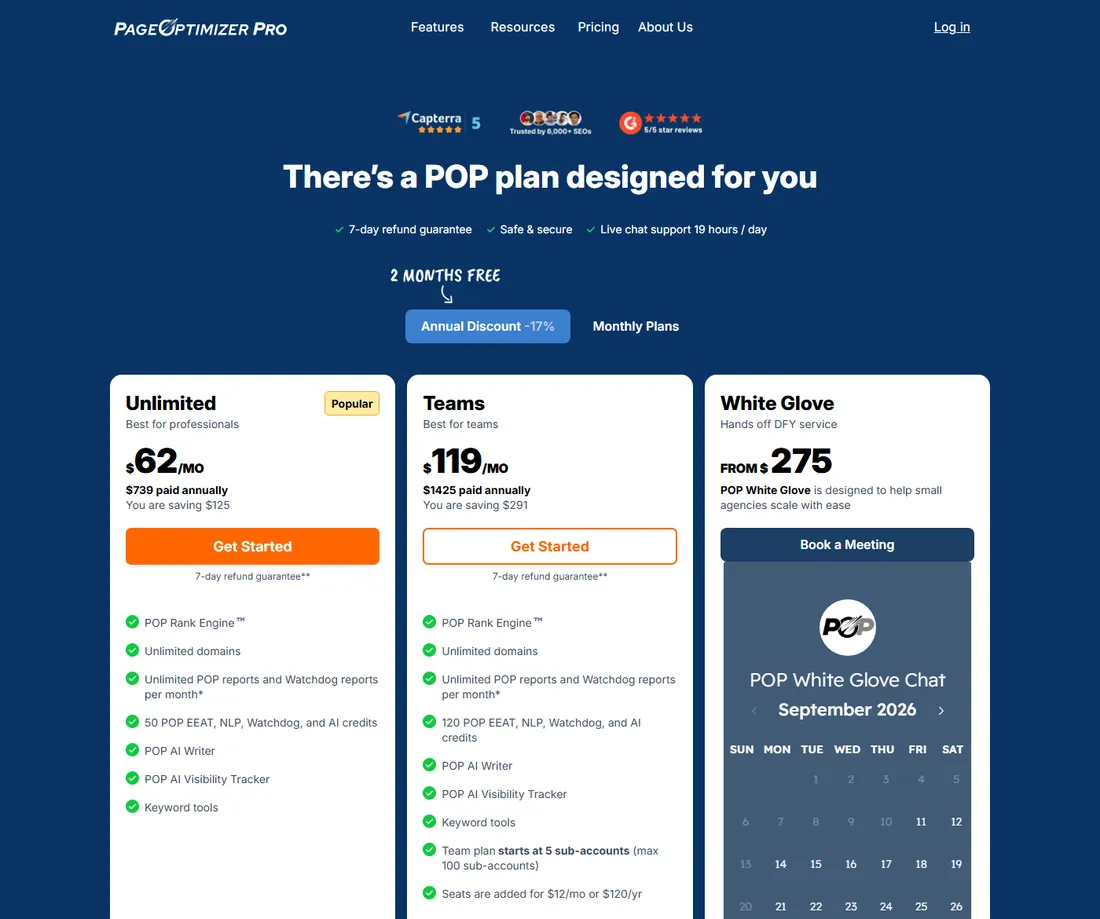
Pricing is $40/month (Basic, 20 report credits), $72/month (Unlimited, $62 billed annually), $143/month (Teams, $119 annually, 5 to 100 sub-accounts) and White Glove done-for-you from $275. There is no free trial, only a 7-day refund guarantee. Watchdog monitoring watches published pages for drift.
Best for: technical and agency SEOs who want recommendations grounded in split-test data and a defensible methodology. Limitation: dense output aimed at practitioners rather than casual bloggers, and no way to try it without paying first.
Scalenut (scalenut.com)
Scalenut leans hardest into automation. Its “Cruise Mode” walks a draft from brief to optimised article, with an NLP-driven SEO score in the editor based on top-ranking-page analysis for the target keyword.
Pricing shows a standing 60%-off promotion: Starter $24/month (list $59), Plus $36/month (list $89), Professional $80/month (list $199), plus a custom VIP service. A 7-day trial covers all paid plans.
Best for: high-volume producers who want the whole brief-to-draft process automated at the lowest promotional price here. Limitation: the promo obscures the real list price, and the heavy AI-writing focus means the optimisation score is one feature among many rather than the core of the product.
Rankability (rankability.com)
Rankability began as a content grader built by an SEO agency and has since repositioned around AI search. The content grader still exists, scoring term and topic coverage against the ranking set for a keyword, but it now sits inside a wider “AI Search Toolkit.”
Pricing starts at $99/month (Starter: 60 active prompts, 1 workspace), then Core ($199) and Team ($399), with unlimited seats on every plan and a 7-day free trial. Higher tiers add more AI platforms to the citation tracking.
Best for: teams that want the content grader alongside AI-citation tracking and technical AI-readiness audits in one subscription, with seats for everyone. Limitation: the standalone content editor is no longer the headline product, so the entry price is high if grading drafts is all you need.
Which of These Tools Have Actually Adapted for AI Search
Almost every vendor here now advertises something “AI,” and most competitor roundups repeat those claims at face value. It is worth separating three genuinely different things, because only one of them changes what you write.
1. Added a separate AI-visibility tracker, score unchanged. Surfer, Clearscope, NeuronWriter, PageOptimizer Pro, Scalenut and Rankability all now include a dashboard that tracks whether a brand is mentioned across ChatGPT, Perplexity, Google AI Overviews and similar. It is a useful monitoring layer bolted alongside the editor, but the optimisation score you draft against is still the same competition-based term-coverage model. When a vendor says it “optimises for AI search,” this is usually what it means.
2. Changed the score, or added a distinct one. Frase is the clearest case: it publishes a separate GEO score next to its classic SEO score. Surfer states its Content Score is “designed for” AI citations as well as rankings, though the documented inputs are unchanged. Clearscope’s “query fan-out awareness” acts at the brief stage, surfacing the searches an AI platform runs to assemble an answer so the brief can cover them. Treat these as vendor claims, not verified mechanisms: none publishes a methodology detailed enough to check, and none can see the platform side where citation is decided.
3. No AI-search adaptation at all. MarketMuse, as of the check date, has no AI-search positioning on its pricing page. Whether that is a gap or simply focus depends on what you need the tool for.
The honest summary: the underlying job of every tool here is still classic on-page work, matching a draft to the vocabulary and structure of the pages Google ranks now. The “AI” additions are mostly measurement, not a new way of scoring a draft. Structure, clear terminology and thorough topic coverage are reasonable inputs to answer-engine readiness, but no content optimiser can confirm an AI outcome, and buying one for its AI-visibility feature is buying a tracker you could also get standalone.
One category that sits outside this list entirely: a page-level readiness checker like AI Rank Inspector audits a finished page’s SEO, AEO and GEO signals and flags what needs review, rather than scoring a draft against competitors while you write. It is a different job, done at a different point, and it is not a content-optimisation editor, so it is not reviewed among the eight above.
Which Tool Fits: Solo Blogger, Content Team or Agency
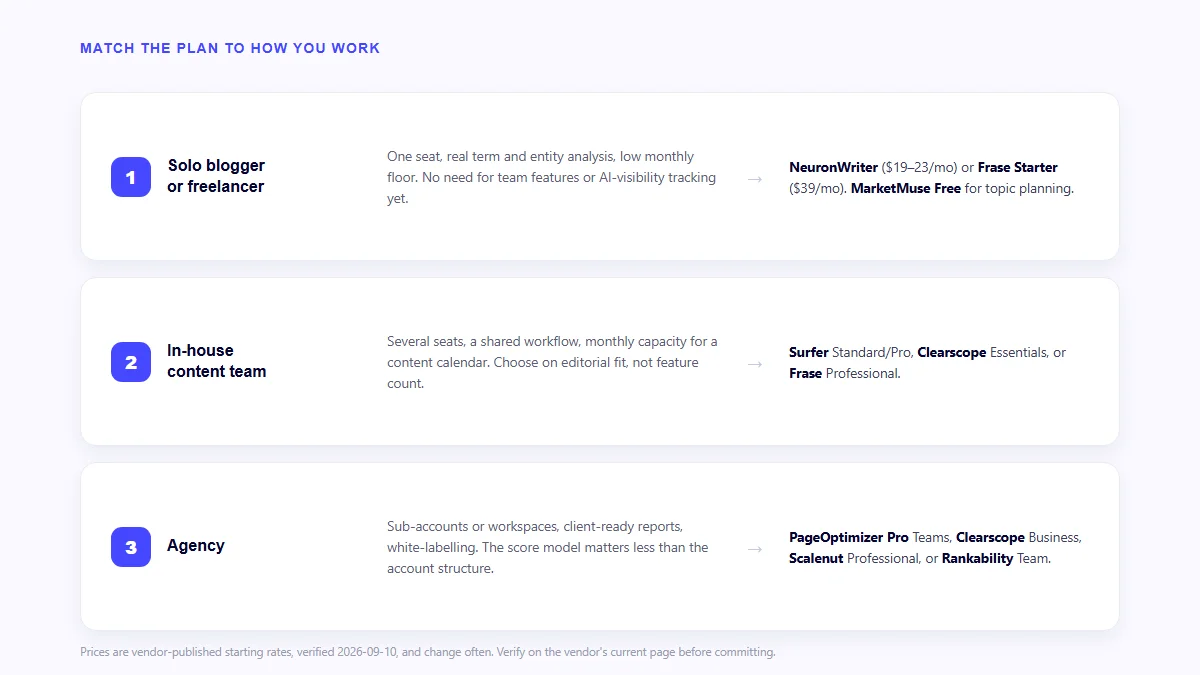
Match the plan to how you actually work, not to the longest feature list.
Solo blogger or freelancer. You need one seat, real term and entity analysis, and a low monthly floor. NeuronWriter ($19 to $23/month) or Frase Starter ($39/month) both give you a genuine competition-based score without a team-priced commitment. MarketMuse’s Free tier is worth a look for topic planning if 10 queries a month is enough. Skip anything sold mainly on AI-visibility tracking; at this scale you do not need it yet.
In-house content team. You need several seats, a shared workflow, and enough monthly capacity for a content calendar. Surfer Standard or Pro, Clearscope Essentials, and Frase Professional are the mainstream picks, all with team collaboration and higher document limits. Choose on editorial fit: Clearscope for the cleanest term report, Surfer for volume and integrations, Frase if you want research and drafting in the same tab.
Agency. You need sub-accounts or workspaces, client-ready reports, and often white-labelling. PageOptimizer Pro Teams (5 to 100 sub-accounts), Clearscope Business, Scalenut Professional (unlimited workspaces and members) and Rankability Team (unlimited seats, client portals) are built for this. If your clients ask specifically about AI-search visibility, Rankability or Frase fold that tracking into the same subscription.
Whichever tier you land on, the writing technique still matters more than the tool. Our guide to structuring content for direct answers and the AEO audit checklist cover what to do with a draft once a tool has flagged the gaps.
What None of This Software Can Promise
No tool in this article can guarantee a Google ranking, guarantee a featured snippet, or guarantee a citation in an AI Overview, ChatGPT or Perplexity answer. Every score described here is competition-derived: it measures how closely your draft resembles the pages that rank now, in terms and structure. That is a helpful signal and a reasonable quality floor. It is not a prediction.
The things that decide whether a well-optimised page actually ranks or gets cited, site authority, inbound links, competing pages, how well the content matches intent, first-hand expertise, and the search or AI platform’s own systems, are all outside what a content optimiser evaluates. A page can score 100 and not rank. A page can score 70 and rank first because the site behind it is trusted and the content is genuinely better. Use the score to catch real gaps in coverage and structure, then stop looking at it.
FAQs
Is SEO optimizer software the same as a rank tracker?
No. A rank tracker records where a URL sits in Google’s results over time; it measures an outcome after publication. On-page SEO optimizer software works on a draft before it is published, scoring it against the pages that currently rank for your target query. They are used at opposite ends of the process and do not replace each other.
Does a higher content score mean the page will rank?
No. A content score measures how closely your draft resembles the pages Google already ranks for a query, in vocabulary and structure. It is a page-level content signal. Whether the page ranks also depends on site authority, links, competition and intent match, none of which the score evaluates. A high score makes a page a stronger candidate; it does not make ranking a given.
Can these tools optimise content for AI Overviews and ChatGPT?
Partly, and it varies by vendor. Most have added a dashboard that tracks whether your brand is mentioned across AI platforms, which is monitoring, not optimisation. A few (Frase most explicitly) publish a separate GEO score or state their score targets AI citations. Treat those as vendor claims: none can see the platform side where AI citation is actually decided, and none can guarantee it.
What is the cheapest genuine content optimiser?
NeuronWriter has the lowest published entry price, $19 a month billed yearly or $23 monthly, for a real competition-based term and entity editor. Frase Starter is $39 a month billed yearly. Scalenut advertises $24 a month, though that is a promotional rate against a $59 list price. MarketMuse has a free tier limited to 10 queries a month.
Do I still need one if I already use an AI writing tool?
They solve different problems. An AI writer produces text; it does not tell you which terms, entities and subtopics the ranking pages for your query treat as essential. A content optimiser provides that competitive benchmark and scores the draft against it. Many teams run an AI writer for a first draft and a content optimiser to check its coverage.
Should I write to the tool’s recommended word count and term list?
Treat both as a reference, not a target. The word count is just the average length of the pages currently ranking, and Google states it has no preferred count. The term list is a coverage check, not a checklist to complete in full. Forcing in every term to lift a score from 90 to 100 risks tipping into keyword stuffing. Clear the floor, then write for the reader.
How to Choose On-Page Optimisation Software Without Overpaying
Start from the job. If you write a few pages a month on your own, a $19 to $39 plan with one seat covers it, and paying for team features or AI-visibility tracking is money spent on capacity you will not use. If you run a content calendar with several writers, the mainstream team editors (Surfer, Clearscope, Frase) are separated more by editorial feel than by capability, so trial two and pick the one your writers actually open. If you are an agency, the deciding features are sub-accounts, client reporting and white-labelling, not the score model.
Verify every price on the vendor’s own current page before committing, since the figures here are a snapshot and several are annual-billed or promotional. And whichever tool you choose, treat its score the way you would treat a spell-checker: a useful pass that catches real omissions, not a judge of whether the page is any good. That judgement still comes from knowing the topic and the reader better than the pages you are being scored against.