
An AEO score is a summary number from an audit that checks a webpage against Answer Engine Optimisation readiness signals: direct-answer clarity, question coverage and content structure, typically. It measures how well-prepared a page is to have an answer extracted from it, not whether any specific answer engine will actually select, cite or surface that page.
Scores like this are becoming a common way to summarise an AEO audit, but the number itself can be misleading if you don’t know what’s behind it. This article explains what these scores typically measure, how they’re usually built, and, most importantly, what a score can and can’t tell you, using one real example to make the pattern concrete.
It’s worth flagging one source of confusion early: “AEO score” sometimes gets used for a genuinely different kind of measurement, brand-level metrics like share of voice or citation frequency across multiple AI platforms, tracked over time rather than read from a single page. That’s a real and useful thing to measure, but it’s a different discipline built by querying platforms directly, not by auditing a page. This article is specifically about the page-level version: a score built from checking what’s actually present on one webpage.
What an AEO Score Typically Measures
An AEO score is built from checks against observable page-level elements: whether a direct answer exists and where it sits, whether headings reflect real questions, whether processes are presented as lists rather than dense paragraphs, and similar structural and content signals. The full AEO audit checklist covers what these checks usually look like in detail.
Everything a score like this measures is observable on the page itself. None of it measures what happens after: whether a specific answer engine actually reads, selects or cites the page for a specific query. That’s a separate, external outcome no page-level audit can observe directly.
This distinction is worth being precise about, because the two things get conflated easily. “Page-level readiness” is something you can check by looking at the page: does it have a direct answer, is the structure clear, are questions covered. “External AI visibility” is something that happens on a platform you don’t control: whether ChatGPT cited the page in a specific response, whether it appeared in an AI Overview for a specific query. A score measures the first category exclusively. Some tools also offer separate visibility tracking, testing prompts across AI platforms to see whether a brand or page gets mentioned, but that’s a different kind of measurement entirely, built by querying the platforms directly rather than reading the page.
How AEO Scores Are Usually Built
Most AEO scores follow a similar general pattern, though no platform or standards body publishes an official scoring methodology. Each tool that produces one has made its own choices about what to check and how to weight it.
The typical approach: group checks into categories (answer clarity, question coverage, structure, and so on), run each individual check against a page and assign a result, often a three-way Passed, Review or Failed outcome rather than a strict binary, since many checks have a genuine borderline case (an answer that’s technically present but buried several sentences in, for example). Category results then roll up into an overall score, sometimes with equal weighting across categories, sometimes weighted toward whichever checks the tool’s designers consider more consequential.
Because none of this is standardised, two tools can legitimately disagree about the same page, covered in more detail further down. Some tools also distinguish between checks that can be evaluated automatically with confidence (does a heading exist, is there a list present) and checks that genuinely need a judgement call (is this answer specific enough to count as clear). That distinction is often where the “Review” category comes from: not a technical limitation, but an honest acknowledgement that some checks have a real grey area a strict pass/fail result would paper over.
What a High Score Tells You, and What It Doesn’t
A high AEO score tells you that a page’s observable readiness signals are in good shape: it likely has a clear direct answer, sensible heading structure and well-organised supporting content. That’s a genuinely useful thing to know, and it’s something you can act on directly.
What it doesn’t tell you is whether any of that translates into external results. Google states directly that meeting stated requirements for AI Overviews and AI Mode “doesn’t mean that Google will crawl, index, or serve” a page’s content. The same logic applies to any score built on page-level readiness. A perfect score is not a guarantee of selection, citation or ranking by any specific platform, because those outcomes depend on factors the score can’t see: competing pages, exact query phrasing, and platform systems that change independently of anything on your page.
Example: How One Score Is Built
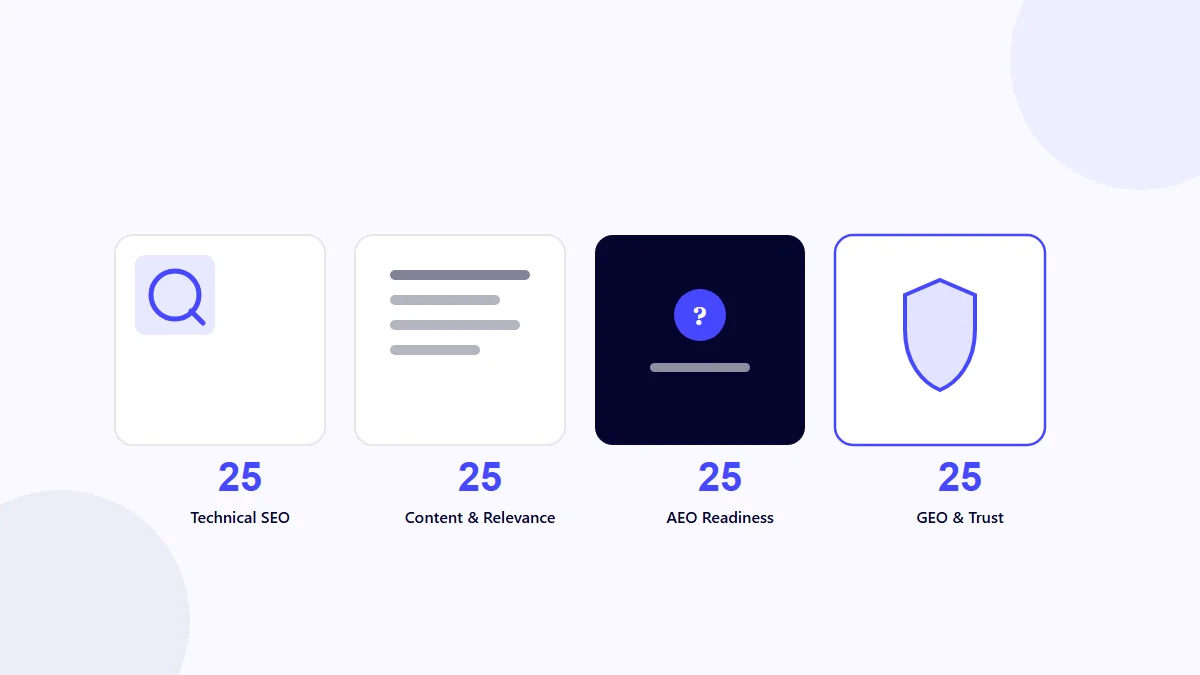
To make this concrete, here’s one real example of the pattern described above. AI Rank Inspector’s audit divides its score across four categories, each worth 25 points for a 100-point total: Technical SEO, Content and Relevance, AEO Readiness, and GEO and Trust. Within each category, individual checks return one of three results: a passed check receives full credit, a review item can receive partial credit where a human judgement call is genuinely needed, and a failed check receives no credit.
This is one example of the general pattern, not a universal standard. A different tool could reasonably choose different categories, different point values, or a different threshold for what counts as “review” versus “failed,” and neither approach would be more officially correct than the other, since no such official standard exists.
Why Two Tools Might Score the Same Page Differently
Given how much of this is left to each tool’s own design choices, disagreement between tools is expected rather than a sign that one of them is wrong. What an AEO checker actually measures covers this design-choice variation in more depth. A few reasons this happens:
-
Different check sets. One tool might check for a specific comparison-table format that another doesn’t look for at all.
-
Different weighting. A tool that weights direct-answer clarity heavily will penalise a buried answer more than one that treats all checks equally.
-
Different thresholds. What one tool calls “Review” (partial credit) another might call “Failed” (no credit), for the exact same borderline case.
-
Different scope. Some tools check AEO signals alone; others, like the example above, bundle AEO together with technical SEO and GEO signals into one combined score, which changes what a given number actually represents. What a GEO score measures covers that trust-and-sourcing side of scoring specifically.
-
Different page-type handling. A checklist item that makes sense on an informational article (question-based headings, for instance) may not apply well to a product listing. Tools vary in how much they adjust their checks by page type, and one that doesn’t adjust at all will score some page types more harshly than the pattern actually warrants.
None of this makes any individual score meaningless. It means a score is only really comparable to other scores from the same tool, tracked over time on the same page, rather than compared directly across different tools. Two audits of the same page from two different tools showing different numbers isn’t a contradiction to resolve; it’s an expected result of two different, independently designed measurements.
How to Use a Score Well
Treat a score as a prioritisation tool, not a pass/fail gate. Use the category breakdown to see where to focus first, rather than fixating on the overall number. Re-check after making changes, since the same tool applied consistently is what makes a score meaningful over time. And don’t chase a marginally higher score at the cost of accuracy. A page that overstates a claim to satisfy a “direct answer” check has made the page worse, not better, regardless of what happens to the number.
Check your own page’s category breakdown with AI Rank Inspector, read how the audit process works, or add AI Rank Inspector to Chrome to get started.
Tracking an AEO Score Over Time
A single score, taken once, tells you where a page stands today. Tracked consistently over time, with the same tool, it tells you something more useful: whether the page is actually improving, holding steady, or drifting backwards as content gets edited.
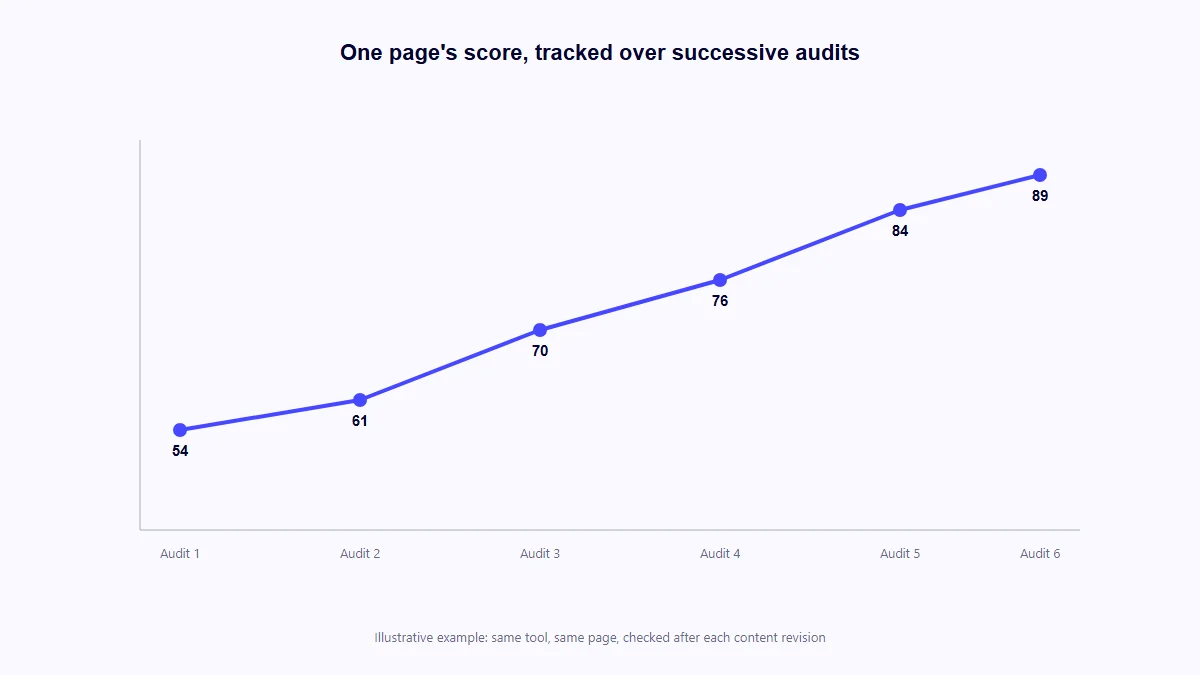
The practical version of this: re-run the same audit after any substantive content change, and periodically even without one, since a category score can drift down over time as a cited source goes stale or a competing page’s structure improves relative to this one. A score that was strong six months ago isn’t guaranteed to still be strong today, for reasons that have nothing to do with whether the page itself was edited.
A single low reading is also worth treating cautiously before reacting. If a score drops sharply between two audits without a corresponding content change, check whether the tool itself changed its checks or weighting before assuming the page got worse. Consistency in what’s being measured matters as much as consistency in when it’s measured.
Common Mistakes When Using an AEO Score
Treating the overall number as the goal. A page edited purely to push a score higher, without the underlying change genuinely helping a reader or a system, has optimised for the measurement rather than the thing the measurement was meant to represent.
Comparing scores from different tools directly. As covered above, two tools measuring the same page can legitimately disagree. A lower score on one tool than another isn’t necessarily bad news; it may just reflect a different check set or weighting.
Ignoring the category breakdown in favour of the headline number. Two pages can share the same overall score while failing in completely different categories, one on structure, one on sourcing, and need entirely different fixes despite looking identical at a glance.
Assuming a score improvement guarantees an external outcome. A rising page-level score is a real, positive signal about the page itself. It’s not evidence that any specific platform has changed how it treats that page, since that’s outside what any page-level score can observe.
Final Practical Takeaway
An AEO score is a useful summary of observable, page-level readiness, and nothing more than that. It’s built from a tool’s own choices about what to check and how to weight it, not from any universal standard, and it can’t see or predict what happens once a page leaves the audit. Used to prioritise fixes and tracked consistently over time, it’s a genuinely practical tool. Used as proof of future AI visibility, it isn’t one.
FAQs
Is there an official or industry-standard AEO score?
No. No platform or standards body publishes a scoring methodology. Every tool that produces an AEO score has made its own design choices.
Does a 100/100 AEO score mean my page will be cited by ChatGPT or appear in AI Overviews?
No. A score reflects observable page-level readiness only. It cannot predict or guarantee selection, citation or inclusion by any specific answer engine.
Should I compare my score across different tools?
Not directly. Different tools check different things and weight them differently, so scores from separate tools aren’t measuring quite the same thing. Track your score within one tool over time instead.
Can a low score still mean the page is fine?
Possibly, if the checks that failed don’t apply well to that specific page type. Review what actually failed rather than treating the number alone as a verdict.
Is an AEO score the same thing as a brand visibility or share-of-voice metric?
No. Those are separate, brand-level metrics built by querying AI platforms directly over time. An AEO score is a page-level reading built by auditing what’s actually present on one webpage.
How often should I re-check a page’s score?
After any substantive content edit, and periodically even without one, since scores can drift as cited sources age or competing pages change. There’s no fixed interval that suits every page.
Why did my score change between two audits when I didn’t edit the page?
Check whether the tool itself updated its checks or weighting first. A score can shift without any content change if the measurement behind it changed.
Is a higher score always better than a lower one?
Not if it was reached by distorting the content to satisfy a check, such as overstating a claim to force a “direct answer” pass. A score improvement only means something if the underlying page genuinely got clearer or more useful.