
Microsoft has documented that Copilot generates one short search query from a user’s prompt, sends it to the Bing search service, and uses the results to ground its answer. Bing’s own index is what powers that answer. What Microsoft has not published is the exact ranking logic that decides which pages get cited. Most “Copilot SEO” advice online fills that second gap with guesses.
Why “Optimising for Copilot” Means Something Narrower Than It Sounds
Search “Copilot SEO” and you’ll find long lists of ranking factors, scoring formulas and percentage claims, almost none of which trace back to anything Microsoft has actually published. Microsoft, though, has documented more about this specific mechanism than most AI platforms have, across Microsoft Learn, the Bing Webmaster Tools blog and the Bing Search blog. That gives this topic a genuine, sourceable answer, provided the documented parts stay separated from the parts nobody outside Microsoft can see.
This site distinguishes page-level readiness (what exists on your page), site-level authority (what exists across your site) and external AI visibility (what actually happens on Microsoft’s platform when someone asks). This article covers mostly the first, bounded by what Microsoft documents about the other two. None of it can tell you whether Copilot will cite a specific page for a specific query, since that decision happens inside a system Microsoft hasn’t fully disclosed.
How Copilot Actually Retrieves and Cites Pages
Microsoft’s clearest description of this mechanism sits in its own documentation on web search in Microsoft Copilot and Microsoft Copilot Chat, written primarily for IT admins managing the feature across an organisation. It’s still the most detailed account Microsoft has published of how the mechanism works, since the underlying grounding pipeline is the same one.
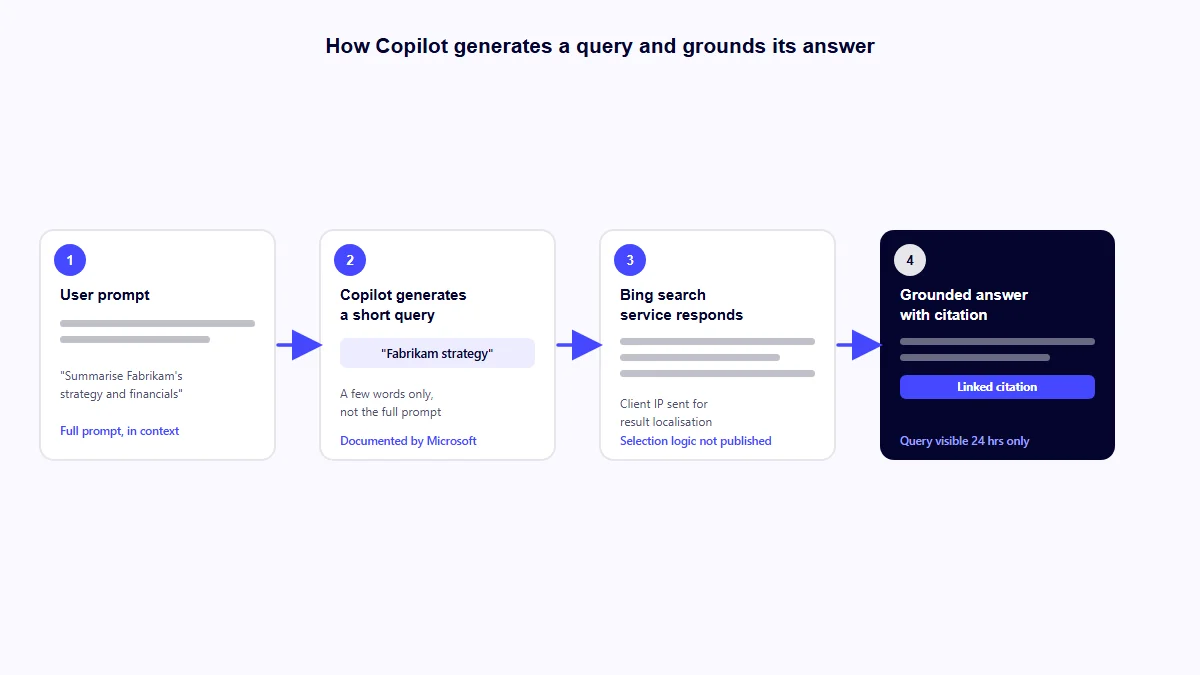
Step by step: when web search is enabled, Copilot parses the user’s prompt and identifies terms where web information would improve the response, then generates a short search query, typically just a few words, and sends that query, not the user’s full prompt, to the Bing search service. Microsoft specifies what stays out of that query: the user’s entire prompt (unless already short, like “local weather”), whole files or documents, full web pages or PDFs, and anything tied to the user’s Microsoft account identity. The user’s client IP address is sent along, used to localise results such as nearby weather or events.
Bing returns results, and Copilot uses them to compose its response, with any citation linking back to the page it drew on. A separate transparency feature, web search query citations, shows the exact generated query (not the original prompt) in a linked citation section. Microsoft documents a real constraint here: the feature exists only in Copilot Chat, not inside the Copilot pane in Word or PowerPoint, and the visible query history persists for only 24 hours in the chat thread.
Microsoft’s own worked examples make this concrete. One shows a user asking Copilot to summarise a company’s financials and strategy; the generated queries sent to Bing were two short phrases, “Fabrikam strategy” and “Fabrikam financials,” not a restatement of the longer original question. Another shows a prompt that produced no web query at all, because Copilot judged the answer already available from the user’s own files.
One documented point worth sitting with: nowhere in this description does Microsoft describe anything resembling Google’s publicly-stated “query fan-out,” where a single prompt can trigger several separate searches across subtopics. Copilot’s documented behaviour is one generated query per prompt (or none, if no web information is needed). That’s a genuine, citable mechanical difference between the two platforms, not a guess about which one is “better,” and it’s worth knowing if you’re used to reading about AI Overviews and assuming the same mechanics apply here.
What the documentation does not cover, at any point, is how Bing ranks or selects which retrieved pages actually become the cited source versus which are used only as background context. That step happens inside Bing’s systems, and Microsoft has not published its logic.
Does Bing Indexing Still Matter for Copilot?
Yes, and this is one of the few places Microsoft has stated the connection directly rather than leaving it to be assumed. In its own Microsoft Advertising blog post on optimising content for AI search answers, Microsoft’s Bing team states plainly that “Bing’s index powers experiences like Microsoft Copilot.” Copilot’s grounded answers draw on the same underlying web index Bing Search uses, not a separate “AI-only” index.
That means the usual precondition for Bing visibility applies: your page has to be crawled by Bingbot and indexed before it can be a candidate for anything else, including a Copilot citation. The same post describes assistants like Copilot as parsing pages into smaller pieces, which are then evaluated for authority and relevance before being assembled into an answer, and treats basic crawlability, metadata, internal linking and backlinks as the baseline every other recommendation sits on top of.
A genuine limitation in this research: Microsoft’s own crawler-verification page (reached via the official aka.ms/bingbot shortlink) is a JavaScript-rendered application that didn’t return readable article text to an automated fetch, even after multiple attempts. The detail that follows is therefore sourced from independent technical reporting that consistently corroborates the same facts, not a direct quote of Microsoft’s own page text, flagged as secondary rather than presented as a primary quote it isn’t. Bingbot’s standard desktop user agent is commonly documented as Mozilla/5.0 (compatible; bingbot/2.0; +http://www.bing.com/bingbot.htm), Microsoft publishes a verification tool at bing.com/toolbox/verify-bingbot and a Bingbot IP list at bing.com/toolbox/bingbot.json, and a matching user-agent string alone doesn’t prove a request is genuinely Bingbot, since user agents can be spoofed.
Bing’s own AI Performance launch post (covered in detail below) does confirm one thing directly: “Bing respects all content owner preferences expressed through robots.txt and other supported control mechanisms.” A page blocked from Bingbot in robots.txt is not a candidate for Copilot citation, because it was never a candidate for the index Copilot draws from.
What IndexNow Does (and Doesn’t Do)
IndexNow is a real protocol with a real, narrow job: notifying participating search engines the moment a URL on your site is added, changed or removed, so they can consider recrawling it sooner. Its own documentation describes submission in two forms, a single-URL request or a bulk JSON submission of up to 10,000 URLs, verified through a key file hosted on your site.
What that documentation does not say, anywhere, is that submission affects ranking, citation odds, or guarantees indexing. Its wording is explicit: “the HTTP 200 response code only indicates that the search engine has received your URL.” Nothing more.
Bing Webmaster Tools separates IndexNow from two related but distinct mechanisms worth keeping straight: the URL Submission API (notifies Bing of changes for crawling, indexing and discovery) and the Content Submission API, which can send content directly to Bing without a Bingbot crawl. Microsoft’s AI Performance launch post recommends IndexNow specifically “for keeping content current,” alongside accurate, structured, regularly-updated content, as “important for inclusion and citation in AI-generated answers.” That’s a real recommendation; it is not, and Microsoft does not frame it as, a guarantee that submitting a URL will get it cited.
What Bing Webmaster Tools’ AI Performance Report Actually Shows
In February 2026, Microsoft’s Bing team launched a public preview of an AI Performance report inside Bing Webmaster Tools, covering citations in Microsoft Copilot, AI-generated summaries in Bing, and what the launch post calls “select partner integrations.” It’s a genuinely useful, free data source for real, if limited, visibility into whether Copilot is citing your pages.
The report shows three main things: Total Citations (how many times your content appeared as a source over a chosen period), Average Cited Pages (the daily average of unique pages from your site used as sources), and Grounding Queries (the key phrases the AI used when retrieving the content it cited).
What makes this report worth a dedicated section is what Microsoft itself says these numbers don’t mean, stated directly and repeatedly rather than left for readers to assume. Total Citations “does not show placement or presentation within a specific answer.” Average Cited Pages “does not indicate ranking, authority, or the role of any page within an individual answer.” Page-level citation counts reflect “how often pages are cited, not page importance, ranking, or placement.” Grounding Queries data is explicitly “a sample of overall citation activity,” not a complete log.
Put plainly: this report tells you citations are happening and roughly how often, not why a page was chosen over another or how prominently it featured. Treating a citation count as a ranking signal, or as proof one page is “better optimised” than another with a lower count, goes further than Microsoft’s own documentation supports.
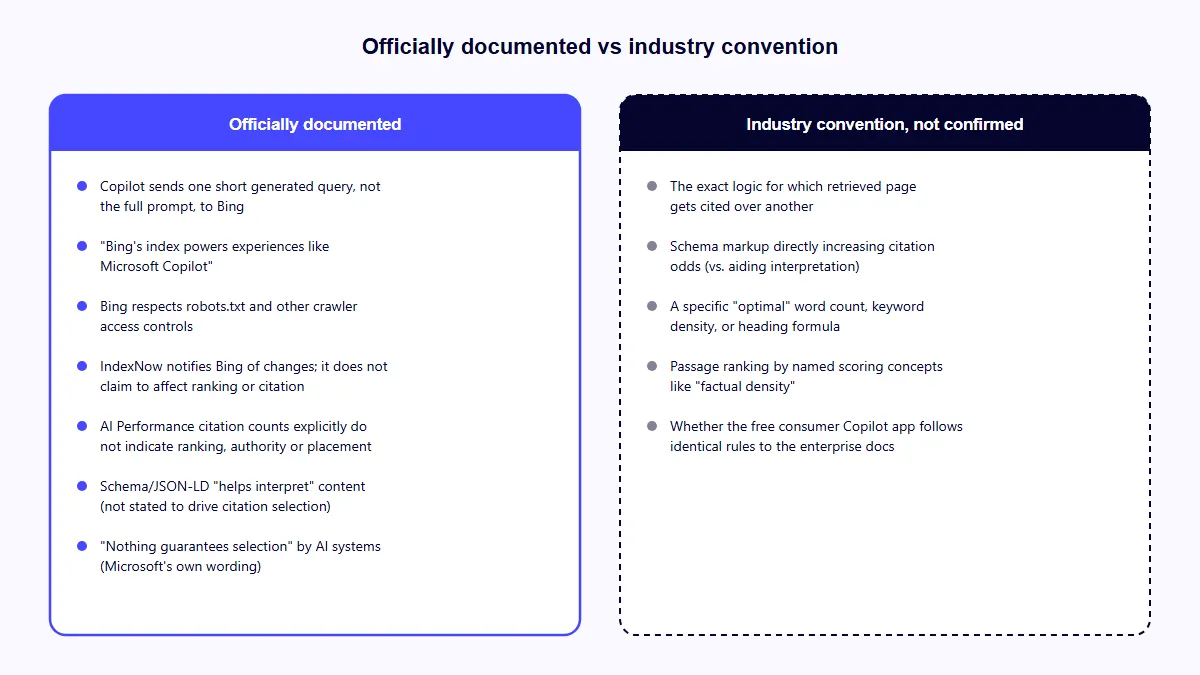
What’s Officially Documented vs What’s Industry Convention
This is the honest-accounting section most “Copilot SEO” content skips. Every row below is drawn from the primary Microsoft sources named throughout this article; nothing here is inferred beyond what’s written.
| Claim | Status | Source |
|---|---|---|
| Copilot generates one short search query from the user’s prompt and sends it to Bing | Officially documented | Microsoft Learn, web search in Copilot |
| The generated query, not the full prompt, is what’s sent to Bing (with named exceptions) | Officially documented | Microsoft Learn, web search in Copilot |
| Bing’s web index powers Copilot’s grounded answers | Officially documented | Microsoft Advertising blog, Oct 2025 |
| Bing respects robots.txt and other crawler-access controls | Officially documented | Bing Webmaster Tools AI Performance launch post |
| IndexNow speeds up discovery/recrawl notification | Officially documented | indexnow.org documentation |
| IndexNow submission guarantees indexing, ranking or citation | Not claimed anywhere by Microsoft; actively contradicted by IndexNow’s own wording | indexnow.org documentation |
| AI Performance citation counts indicate ranking or authority | Explicitly denied by Microsoft itself | Bing Webmaster Tools AI Performance launch post |
| The exact ranking/selection logic for which retrieved page gets cited | Not published | No primary source found |
| Schema/structured data drives citation selection in Copilot | Not claimed by Microsoft; its own wording supports interpretation help, not selection | Microsoft Advertising blog, Oct 2025 |
| A specific word count, keyword density, or “optimal” heading structure for Copilot | Industry convention, not confirmed by any Microsoft source found | None |
| Passage ranking by “factual density” or similar named scoring mechanisms | Industry claim found during research, unverifiable against any Microsoft source | Not used in this article |
Does Structured Data Help Get Cited by Copilot?
Microsoft’s position here is narrower than most SEO content implies. Its Advertising blog recommends schema markup, specifically JSON-LD pointing to schema.org vocabulary, as something that “helps search engines and AI systems interpret content.” That’s a real recommendation, and notably different framing from Google’s public statement for AI Overviews, which says no special schema.org markup is needed at all; the two companies simply say different things.
What Microsoft doesn’t say, here or anywhere else found during this research, is that schema increases citation odds, or factors into citation selection specifically rather than general interpretation. “Helps interpret” and “drives selection” are different claims, and only the first has a Microsoft source behind it.
This site’s own research on whether structured data actually helps AI citations found no measured citation uplift from schema across Google AI Overviews, AI Mode and ChatGPT. That study didn’t test Copilot specifically, so it’s cited here only as a reason for caution, not as direct evidence about Copilot’s behaviour.
A Practical, Documented Checklist
Everything on this list traces to a Microsoft source named above. Nothing here is presented as a guarantee.
- Confirm the page isn’t blocked from Bingbot in robots.txt; Bing has stated it respects those preferences.
- Verify the site in Bing Webmaster Tools and submit a sitemap, so Bing has a reliable way to discover and recrawl your pages.
- Use IndexNow (directly, through a plugin, or through Bing Webmaster Tools’ key generation) when you publish or materially update a page, to speed up discovery, not as a ranking lever.
- Keep content fresh, structured and semantically clear: specific claims over vague ones, clear heading boundaries, concise Q&A-style answers and lists/tables where they genuinely apply, per Microsoft’s own Advertising-blog guidance.
- Add JSON-LD schema where it’s genuinely applicable, as an aid to machine interpretation, not as a citation-ranking tactic.
- Check the AI Performance report in Bing Webmaster Tools periodically for Total Citations, Average Cited Pages and Grounding Queries, reading those numbers as activity signals, not as ranking or authority scores.
- Treat every item above as a readiness precondition, not a promise. Microsoft’s own wording on this is direct: “there is no secret strategy for being selected by AI systems,” and “nothing guarantees selection.”
What This Means in Practice
Page-level readiness, being crawlable, indexed, clearly structured and genuinely sourced, is a precondition Copilot’s documented pipeline needs before a page can be retrieved at all. None of it can confirm or predict whether Copilot will generate a query that surfaces your specific page, or whether Bing’s unpublished selection logic will choose it over another retrieved result. That’s the same page-level-readiness-versus-external-visibility distinction this site applies everywhere else, and Copilot is no exception.
A page checker, including AI Rank Inspector, can confirm the readiness signals Microsoft’s documentation plausibly requires: crawlable, indexable, clearly structured, sourced claims. What it can’t do, honestly, is predict whether Bing’s grounding pipeline will select that exact page for a given query on a given day, since that decision happens inside a system Microsoft hasn’t published the internals of.
FAQs
Does submitting a URL through IndexNow get it cited by Copilot faster?
No. IndexNow speeds up discovery and potential recrawling; its own documentation states a successful submission “only indicates that the search engine has received your URL,” nothing about ranking, timing, or citation.
Does Bing’s AI Performance report tell me why a competitor’s page gets cited more than mine?
No. Microsoft states directly in its own launch post that citation counts don’t indicate “ranking, authority, or the role of any page within an individual answer.” The report shows that citation activity happened, not why.
Is Microsoft Copilot the same as Microsoft 365 Copilot for optimisation purposes?
The underlying grounding pipeline is the same, but Microsoft’s most detailed published mechanism description sits in Microsoft 365 Copilot’s enterprise admin documentation (Entra ID, tenant policy, eDiscovery). It hasn’t published an equally detailed mechanism page specifically for the free consumer app.
Does adding schema markup help get my page cited by Copilot?
Microsoft’s guidance says schema “helps search engines and AI systems interpret content,” a real but limited claim. Nothing published ties schema to citation selection specifically, and this site’s own prior research found no measured citation uplift from schema on other AI platforms tested (not including Copilot).
Why doesn’t Copilot do the same “multi-query fan-out” Google’s AI Overviews reportedly does?
Based on what’s documented, it doesn’t. Copilot’s mechanism is one generated query per prompt, or none, not multiple sub-queries across subtopics, a genuine documented difference rather than a claim about which performs better.
Can AI Rank Inspector or any tool guarantee my page gets cited by Copilot?
No. A checker can confirm documented readiness signals, crawlability, indexability, clear structure, sourced claims, but citation selection happens inside Bing’s grounding pipeline, and Microsoft hasn’t published that logic.
Should You Treat Copilot as a Separate Optimisation Target?
Treat it as a platform with its own documented mechanics layered on the same fundamentals every AI answer surface needs: crawlable, indexed, clearly structured, genuinely sourced. The Copilot-specific layer is real but narrower than most “Copilot SEO” content suggests: one generated query per prompt rather than a multi-query approach, a direct documented link between Bing’s index and Copilot’s answers, a citation-activity report that explicitly isn’t a ranking signal, and a notification protocol that speeds up discovery without promising more. Build on the documented layer and stay honest about where it ends. For the broader mechanics this article deliberately didn’t re-cover, see generative engine optimisation and answer engine optimisation; for the schema question specifically, see this site’s structured-data citation research; and for tracking that citation activity over time, see our comparison of SERP rank trackers that also cover AI answers.