
LLMO (LLM optimization) is an emerging, inconsistently defined term for making content visible and citable inside large language models. Sources disagree on its scope: some nest it inside AEO, others call it broader than GEO, and a few scope it by surface, standalone AI apps rather than AI-powered search engines. No consensus exists yet.
What “LLMO” Is Supposed to Mean
Taken at face value, LLMO stands for large language model optimization: the practice of shaping content so that tools like ChatGPT, Claude, Gemini and Perplexity are more likely to surface, mention or cite it when generating an answer. That much is broadly consistent across the sources that use the term.
What isn’t consistent is everything past that first sentence. Different glossaries and vendors place LLMO in different positions relative to AEO and GEO, the two terms this site already covers in depth in Answer Engine Optimisation: How AEO Works and Generative Engine Optimisation: How GEO Works, and in the full three-way breakdown in AEO vs GEO vs SEO: Complete Comparison. This article doesn’t repeat those definitions. It picks up where that comparison left off and asks a narrower question: where does LLMO sit, and is it a separate fourth discipline?
No major AI platform’s own documentation defines or uses “LLMO” as an internal term, the same gap already noted for AEO and GEO in the three-way comparison above. Every definition examined for this article comes from a marketing vendor, an SEO agency or an industry glossary, not from OpenAI, Google, Anthropic or Perplexity themselves.
How Different Sources Scope LLMO
Rather than pick one definition and present it as correct, here’s what a direct read of several current sources says. These disagreements come straight from the source material, not a simplification for effect.
| Source | How it scopes LLMO relative to AEO/GEO |
|---|---|
| HubSpot | LLMO sits inside AEO, as one part of the broader answer-engine discipline |
| BrightEdge | LLMO is broader than GEO, covering any LLM setting, not just AI search surfaces |
| Conductor | LLMO is “essentially synonymous” with GEO, same work, different emphasis |
| Semrush | Doesn’t address AEO at all; treats LLMO as brand visibility inside AI-generated answers generally |
| inblog.ai | Gives each term a different target: LLMO = the standalone LLM apps themselves (ChatGPT, Claude, Gemini); GEO = AI-powered search results specifically; AEO = any direct-answer engine, including older featured snippets |
| SEOsherpa | Treats GEO, AEO and “LLM SEO” as three parallel surfaces that overlap heavily but aren’t identical |
| Contently | All three are “the same AI search work” with different historical labels, overlapping tactics, recommends just using GEO |
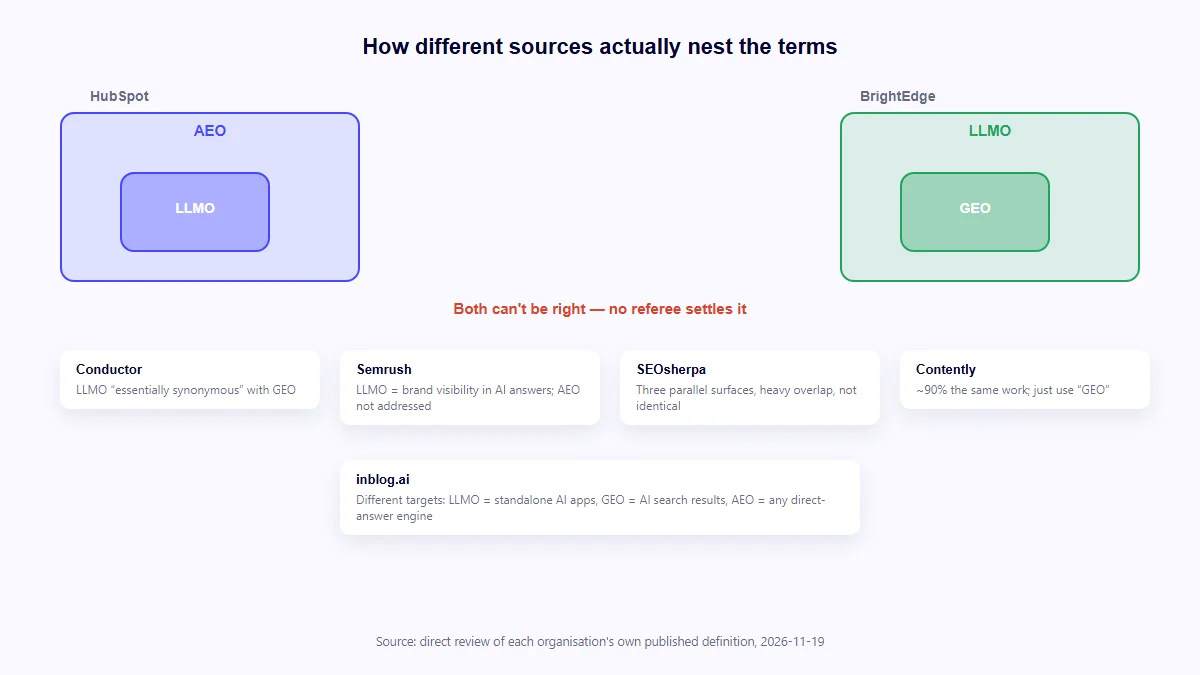
Two of these flatly contradict each other. HubSpot nests LLMO inside AEO. BrightEdge nests GEO inside LLMO. Both can’t be right, and no neutral referee exists to settle it, because none of these organisations is a standards body; they’re vendors describing a moving target from their own product’s vantage point.
The One Distinction Worth Taking Seriously
Most of the disagreement above is semantic noise. One distinction, though, is structurally real rather than a repackaging of the same idea in different words: which surface the content needs to reach.
Under this framing, found most explicitly in inblog.ai’s comparison but consistent with how several other sources use the terms in practice:
- AEO targets any engine that extracts and displays a direct answer, which includes long-standing surfaces like featured snippets and voice assistant responses, not just newer AI tools.
- GEO targets AI-powered search results specifically, where a generative system synthesises an answer from multiple sources inside a search experience, such as Google’s AI Overviews or Perplexity’s search mode.
- LLMO, under this reading, targets the standalone conversational AI applications themselves, ChatGPT, Claude or Gemini used directly rather than through a search box, where the model’s own training data and retrieval behaviour decide what gets mentioned or cited.
This way of thinking about it is useful if you need one, because it maps to something concrete: a user typing a question directly into ChatGPT is a different situation from the same user typing that question into Google and seeing an AI Overview. Content that reaches one doesn’t automatically reach the other, since the retrieval mechanics differ.
It’s worth being honest about the limits of this framing too. It isn’t the dominant view across the sources checked for this article; it’s one coherent reading among several, and most vendors don’t maintain this distinction consistently even when they state it. Treat it as a useful mental model, not as the settled industry definition, because that definition doesn’t exist yet.
Is LLMO a Fourth Discipline, or Just Another Name?
Based on what the research for this article found rather than what would make a tidier headline: mostly another name, with one partial exception.
The tactics involved in “doing LLMO” (clear entity naming, source attribution, consistent factual claims, content structured for extraction) are the same tactics already covered in this site’s GEO and AEO guides. There is no separate, documented technique that exists under “LLMO” and nowhere else. Contently’s position, that these are three labels for overlapping work with different historical baggage, matches what a direct read of the other sources shows, even though several of those same sources also contradict each other about the specific nesting.
The partial exception is the surface distinction above: if you specifically care about standalone LLM-app visibility as separate from AI-search-result visibility, treating that as a distinct checking lens has some value. But that’s a scoping choice, not evidence of a fourth, independently developed discipline with its own body of technique.
Is LLMO Gaining Traction?
Beyond how vendors define the term, it’s worth asking a separate, checkable question: do practitioners use it at all?
Two independent Fractl-run marketer surveys give a dated, checkable answer. A survey of 343 U.S. marketing decision-makers, reported in July 2026, asked how they describe this work internally:
| Term | Share who use it internally (343 marketers, July 2026) |
|---|---|
| SEO | 81% |
| AI search optimization | 48% |
| GEO | 19% |
| LLM optimization (LLMO) | 15% |
| AEO | 10% |
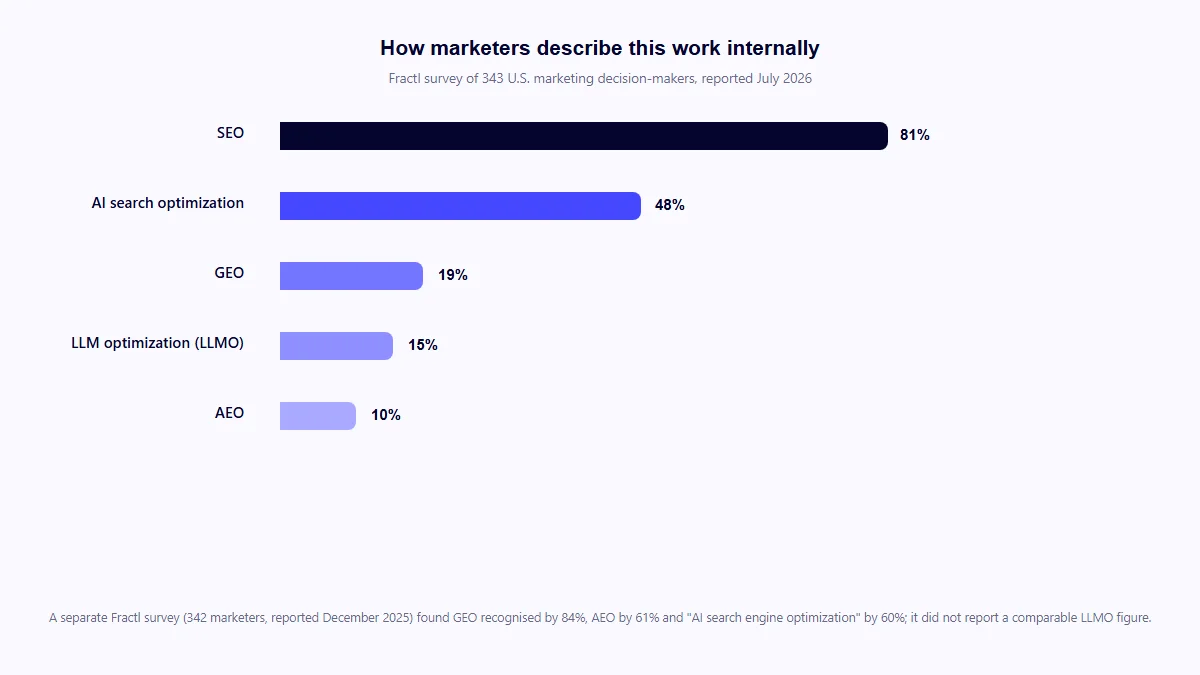
A separate, earlier survey of 342 marketers, reported in December 2025, measured term recognition rather than usage, and found GEO recognised by 84% of respondents, AEO by 61%, and “AI search engine optimization” by 60%; that write-up didn’t report a comparable LLMO figure, so none is given here.
Read together, these numbers point the same way: LLMO is a term in active use, but it isn’t the term most practitioners reach for. Most still say SEO, and among the newer labels, GEO has pulled ahead of both AEO and LLMO in day-to-day use. That’s a fact about adoption, not a verdict on whether the underlying concept is useful.
Does It Matter Which Term You Use?
Practically, not much, for one specific reason: none of these labels change what a page needs to do well. A page that states its claims clearly, attributes them to a credible source, names entities consistently and structures its answer so it can be extracted will perform reasonably under an AEO reading, a GEO reading, and whatever a reader decides “LLMO” means that week.
Where it does matter is communication inside a team or with a client. If a brief says “we need LLMO work” and the person reading it assumes that means something narrower or broader than what the writer meant, by HubSpot’s nesting, by BrightEdge’s nesting, or by the surface distinction above, the mismatch wastes time before any content work starts. The practical fix isn’t to adopt one “correct” term; it’s to state in the brief itself what surface or outcome is meant, rather than relying on the acronym to carry that meaning.
What to Do, Regardless of the Label
Since the underlying work overlaps heavily across all three labels, the useful next step for most people isn’t to pick a winning acronym. It’s to work from whichever of this site’s two dedicated guides matches the surface in question:
- For direct-answer clarity on any engine, including older featured snippets and the standalone-app scenario described above, start with how AEO works and its AEO audit checklist.
- For trustworthiness and sourcing strength aimed at AI-powered search surfaces and generative synthesis, start with how GEO works and its GEO audit checklist.
- For the full comparison of how SEO, AEO and GEO relate, including a worked example and a decision framework for which to prioritise first, see AEO vs GEO vs SEO.
AI Rank Inspector audits observable page-level SEO, AEO and GEO signals, but it doesn’t claim to measure “LLMO” as a separate category, because no platform publishes a stable, checkable signal set under that name to audit against. Add it to Chrome for the three disciplines that do have something concrete to check, without any guarantee of rankings, traffic or citation by any specific AI platform.
FAQs
Is LLMO a real, official term?
It’s real in the sense that it’s in active use across vendor content, glossaries and some job listings. It isn’t official in the sense of being defined by any major AI platform or standards body, and as shown above, the organisations that do use it don’t agree on what it covers.
Should I stop using “AEO” or “GEO” and switch to “LLMO”?
Nothing in the research for this article supports switching. GEO is the most recognised and most used of the newer AI-search terms in the survey data above, and the underlying work is the same regardless of which acronym a brief uses.
Is LLMO the same as “AI SEO”?
Not quite, though they overlap. “AI SEO” or “AI search optimization” tends to be used as a looser umbrella covering AEO, GEO and LLMO together, and the survey data above shows it’s used more often than any of the three narrower terms.
Who coined the term LLMO?
No reliable primary source found in this research names a specific origin or date. It appears to have entered wider use alongside AEO and GEO as AI-powered search and standalone AI chat tools both grew, but that’s a reasonable inference from the available material, not a documented fact.
Does optimising for LLMO guarantee my content gets cited by ChatGPT or similar tools?
No. Nothing in SEO, AEO, GEO or LLMO guarantees citation by any specific AI tool. These are page-level readiness practices; whether a particular system selects a page is an outcome decided externally, by that system’s own retrieval and ranking behaviour.
If a job posting or a vendor pitch uses “LLMO,” what should you ask them?
Ask what specific surface they mean: a standalone AI chat app, an AI-powered search result, or classic answer engines like featured snippets. Given how inconsistently the term is used across the sources checked for this article, that one clarifying question avoids most of the confusion before any work begins.