
Independent research on AI Overview citations finds that organic rank, content recency, where the answer sits on the page, and the presence of a comparison table correlate with being cited, while word count, backlink counts and FAQ schema don’t separate cited pages from skipped ones. This article shows how to check those same signals on a real SERP yourself, using two published studies and three real pages as worked examples.
What “Getting Cited” Actually Means
An AI Overview citation is a link Google’s AI Overview shows next to (or underneath) a piece of generated text, pointing to a specific page it drew that text from. That’s distinct from three things it’s often confused with: ranking in the organic results below the AI Overview, appearing in People Also Ask, and being the page an AI Overview’s wording clearly resembles without linking to it at all. The last case has a name in recent research: an “absorbed” passage, one the system appears to have used without crediting a source. A page can rank first, resemble the generated answer almost exactly, and still receive no citation and no link.
This matters for how you read everything that follows. Structure, schema and answer placement are things that exist on a page you control, checkable today, on demand. Citation is a decision made on Google’s side, for a specific query, at a specific moment, that nobody outside Google can fully observe. How generative engine optimisation works covers that page-level-versus-external-outcome split in more depth; this article assumes it and goes straight to the practical question underneath it: given that split, what can you actually learn by comparing real cited pages against real skipped ones?
What Independent Research Has Actually Tested
Two pieces of published research sit behind this article, chosen because both disclose their methodology, their sample size and their own limitations, rather than asserting a conclusion with no way to check it.
TripleDart’s study ran 1,000 B2B SaaS search queries through Google, scraped 11,002 of the resulting pages for more than 50 attributes each, and traced 5,227 individual citations back to the specific passages they came from. That’s a large enough sample to run a real statistical comparison between pages that got cited and pages that didn’t, for the same queries.
Bart Magera’s study, published via Advanced Web Ranking, took a narrower but more forensic approach: 40 real prompts across five SEO-related topics, with full-page screenshots of every AI Overview and Bing Copilot answer captured, plus a public coding sheet so the classifications can be independently re-checked. It’s a much smaller sample, and the author says so directly, but it’s unusually transparent about exactly which real pages were cited, absorbed or skipped for which real queries.
Both studies are explicit that they’re describing statistical association, not Google’s internal logic. TripleDart’s own summary states plainly: “We can’t see inside Google’s selection.” That caveat applies to every number in the rest of this article.
The Signals That Correlate With Citation (and the Ones That Don’t)
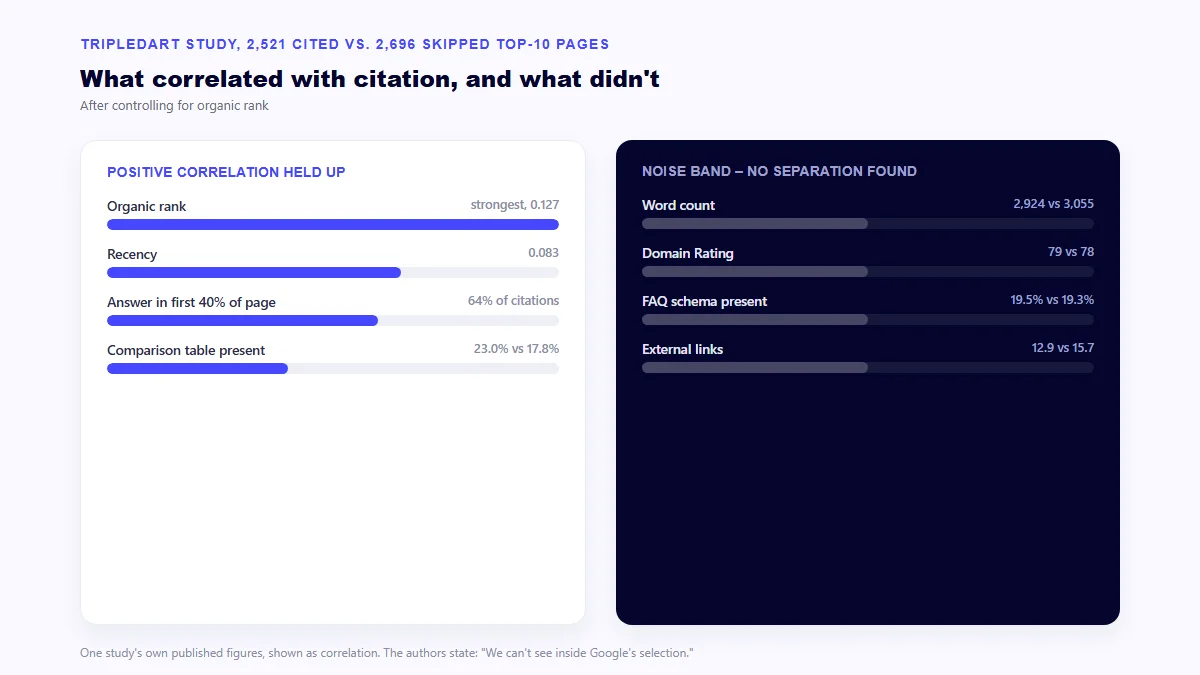
TripleDart compared 2,521 cited top-10 pages against 2,696 skipped top-10 pages on the same metrics. After controlling for organic rank, four things kept a measurable, positive association with citation:
- Organic rank itself, the strongest signal by far. Position 1 was cited in the study 55% of the time; position 9, 34%.
- Recency. Citation rates rose from roughly 26% on pages dated 2018 to 50-54% on pages dated 2023 or later.
- Answer placement. 64% of traced citations came from the first 40% of the page, and 35% came from the first 15%.
- A comparison table. Present on 23.0% of cited pages versus 17.8% of skipped pages, which the study’s own words describe as “the only on-page feature that stayed positive once we controlled for rank.”
A longer list of attributes showed no meaningful separation between the two groups at all, which the study calls a “noise band”:
| Attribute | Cited pages | Skipped pages |
|---|---|---|
| Word count | 2,924 | 3,055 |
| External links | 12.9 | 15.7 |
| Domain Rating | 79 | 78 |
| FAQ schema present | 19.5% | 19.3% |
| Any schema present | 81% | 78% |
Two things are worth sitting with here. First, word count and external link count actually ran slightly higher on the skipped pages, the opposite of what a lot of SEO advice assumes. Second, and more striking given how often schema markup gets recommended specifically for AI citation: FAQ schema and general schema presence showed almost no difference between the groups in this dataset. That doesn’t mean schema has no value at all (it has a separate, real role in entity recognition and rich-result eligibility, covered in our analysis of whether structured data helps AI citations); it means this specific study found it didn’t separate cited pages from skipped ones once rank was accounted for.
None of this is causal. TripleDart’s own full model, built from every available signal including authority metrics, reached only 59% prediction accuracy against a 52% base rate. That’s a small improvement over guessing, not a formula. Treat every row above as “associated with,” never “caused by.”
A Worked Comparison: Three Real Pages Cited for the Same Query
Aggregate statistics are useful, but they can hide what a real cited page actually looks like. Bart Magera’s study documented something concrete here: for the query “what is topical authority in SEO,” captured on 29 July 2026, a Google AI Overview named three specific web pages as citations, alongside several unnamed Reddit threads: Semrush, Ahrefs and Neil Patel. A fourth real page, Responsify, appeared in Google’s People Also Ask box for a related term but wasn’t cited by the AI Overview itself.
To see what those three citations actually had in common, I read all three pages directly on 2026-10-28, three months after that capture. That gap matters: pages change, and I’m not claiming to have watched the citation happen myself. What follows is what I personally found on each page, checked against the specific signals covered above.
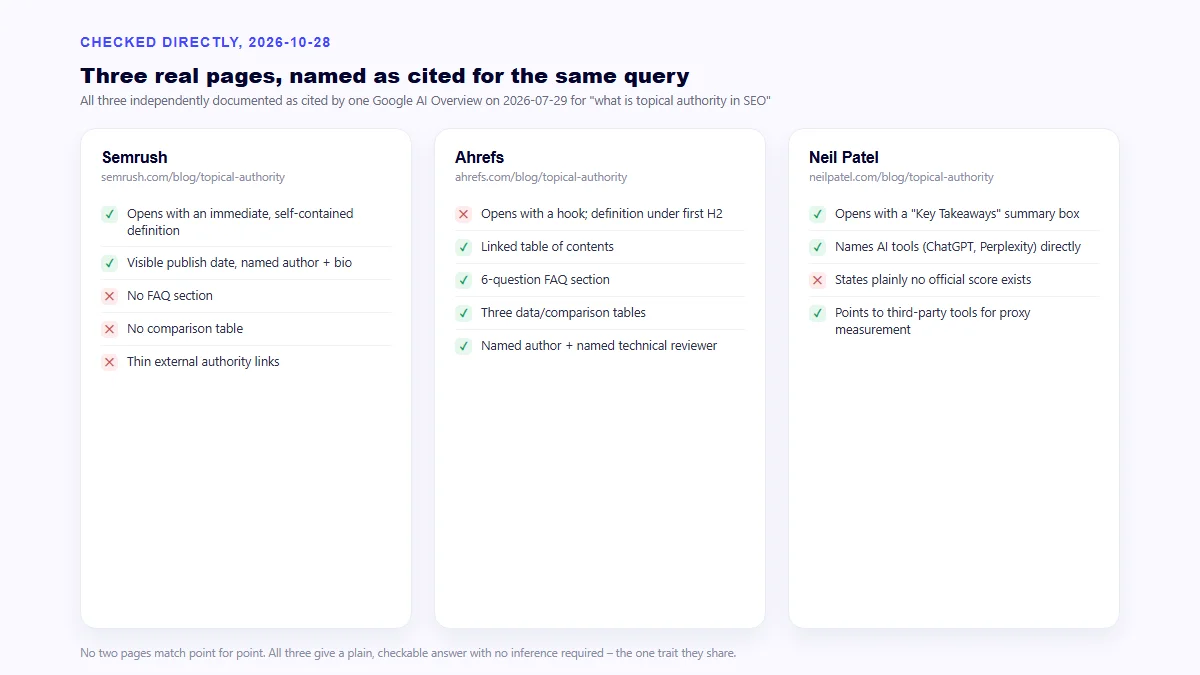
Semrush’s topical authority page opens with an immediate, self-contained definition: “Topical authority refers to a website’s expertise and credibility on a particular subject.” It carries a visible publish date (June 2024, no separate “last updated” date), a named author with a bio, and a clear heading ladder, but no FAQ section and no comparison table. Its outbound authority links are thin: one 2011 Google announcement and one Google Developers post, with most other links pointing back to Semrush’s own tools.
Ahrefs’ topical authority page does the opposite in its opening: a two-sentence hook before the definition arrives under the first H2, “Topical authority is when search engines recognize your site as the expert source on a specific subject.” But it’s the most heavily structured of the three: a linked table of contents, six FAQ questions, three separate tables (including a Google-update timeline and a factors-and-actions table), a named author plus a named technical reviewer, and outbound links to Google’s own help documentation and an independent third-party analysis.
Neil Patel’s topical authority page leads with a “Key Takeaways” summary box that frames topical authority explicitly as a signal relevant to both Google and AI tools, built through a network of related content rather than a single article, and points to third-party tools (Ahrefs, Semrush, Ubersuggest) as the only available ways to approximate a score, since no official one exists.
None of the three matches the others point for point. What they share is less about any single tactic and more about category: each gives a reader a plain, checkable answer to “what is this” without making them infer it from surrounding marketing copy, and each sits on a domain with an established publishing history in this topic area. That’s consistent with TripleDart’s rank-and-recency findings above, not a contradiction of them: these are established pages on established sites, refreshed reasonably often, which is a different thing from “contains every recommended on-page tactic.”
The Reverse-Engineering Process, Step by Step
The method both studies above used at scale is one you can run by hand on a single query you actually care about. It won’t give you certainty, but it will tell you more than guessing.
- Run the real query and save what you see. Note the AI Overview’s citations, the organic top 10, and anything in People Also Ask. Keep the date, since these results drift over time, and a comparison from three months ago is a different dataset, not the current state.
- Pull the cited pages and the top-ranking-but-uncited pages side by side. You’re building two groups for comparison, the same structure TripleDart used at a much larger scale.
- Check rank first, every time. If every citation also ranks in the top 3, you likely haven’t learned anything about structure yet, only that the citations are following rank. The more interesting comparisons come from citations that rank lower, or uncited pages that rank high.
- Check the four correlated signals from the section above: answer placement in the first fraction of the page, a visible recent date, presence of a comparison table, and general content freshness. Note, don’t assume, what’s actually there.
- Write down what’s different, not what you expected to find. The useful output of this process is a short, specific list of structural differences between the groups for this query, not a confirmation of a theory you started with.
Run this on a handful of real queries in your own niche and you’ll start to see which signals actually move for your SERPs specifically, since citation behaviour isn’t identical across every topic or platform.
What This Kind of Analysis Cannot Tell You
It cannot tell you that fixing any one signal will get a specific page cited. Both studies behind this article are explicit that they’re reporting correlation, and the full model’s weak predictive accuracy, noted above, is a weak basis for a one-time, single-query decision, even though the directional patterns hold up across a thousand queries.
It cannot tell you why Google’s AI Overview chose one page over another on any single occasion. Neither study had access to Google’s internal selection process; both are reverse-engineering from the outside, the same position you’ll be in if you run this process yourself.
It cannot promise the comparison stays true tomorrow. Magera’s study captured one snapshot on one day; a result from a repeated query a month later could look different, since AI Overviews, People Also Ask contents and even which queries trigger an AI Overview at all can change without any public changelog.
And it cannot separate causation from the fact that well-structured, well-maintained pages also tend to sit on domains with longer publishing histories in a topic. A page might get cited partly because of its comparison table, partly because of the trust built by the site publishing dozens of related pages before it, and there’s no clean way to split those two contributions apart from the outside.
Common Mistakes When Reverse-Engineering Citations
Treating one cited page as proof of a tactic. A single comparison table on a single cited page tells you almost nothing on its own; it’s the pattern across many cited-versus-skipped pairs that TripleDart’s study actually measured, and that’s the level this kind of claim needs to be tested at.
Ignoring the “absorbed” category. A page can rank first, supply the exact wording an AI Overview uses, and still get no link and no citation credit. If you only study linked citations, you’ll miss this category of outcome entirely, and conclude a well-matched page “failed” when it actually just wasn’t credited.
Assuming every AI system behaves the same way. Magera’s study found real differences even between Google’s AI Overviews and Bing’s Copilot Search on the same prompts: Copilot cited fewer, lower-authority sources and leaned more on extractive wording. A pattern documented for one AI system’s output isn’t automatically true of another’s.
Re-running the comparison once and calling it settled. Both source studies behind this article are single-snapshot captures with their own authors flagging that result as directional, not definitive. Treat your own single-query check the same way: a data point, not a conclusion.
Checking Your Own Pages Against These Signals
Most of what correlates with citation in the research above is something you can check directly on your own pages without waiting for a citation to happen: whether the answer sits in the first fraction of the page, whether the content carries a genuine, current date, and whether a relevant comparison exists where the query calls for one. That’s a page-level readiness check, the kind AI Rank Inspector’s automated audit reviews. It can tell you whether those structural conditions are present; it can’t tell you, and no tool honestly can, whether a specific AI system will cite a specific page for a specific query. See the full feature set if that page-level check would help, without treating it as a citation guarantee. How to structure content for direct answers and the GEO audit checklist both go deeper on the practical “how” behind these same signals.
FAQs
Is there a confirmed list of ranking factors for AI Overview citations?
No. Google has not published a ranking-factor list for AI Overview citation, and no independent study, including the two referenced in this article, claims to have reverse-engineered one completely. What exists is statistical correlation from observational research, explicitly described by its own authors as association rather than proof of mechanism.
If I add a comparison table, will my page get cited?
Not necessarily. A comparison table was the one on-page feature that stayed positively associated with citation after controlling for rank in the TripleDart study, but the same study’s full model only reached 59% predictive accuracy overall. A comparison table is a reasonable thing to add if it genuinely helps the reader, not a guaranteed lever for citation.
Does adding FAQ schema help get a page cited in AI Overviews?
The evidence available doesn’t support that specifically. TripleDart’s study found almost no difference in FAQ schema presence between cited pages (19.5%) and skipped pages (19.3%). Schema still has an established, separate role in entity recognition and rich-result eligibility; does structured data actually help AI citations? covers that broader question in full, just not shown here as a citation lever specifically.
Can I run this exact process myself without any paid tools?
Yes. The process in this article uses only a real search query, the AI Overview and organic results it returns, and a direct read of the pages involved. Paid tools can speed up tracking citations at scale across many queries, but the manual, single-query version costs nothing but time.
Why doesn’t this article include a real screenshot of an AI Overview?
Because an attempt to capture one directly for this article, via an automated browser, was blocked by Google’s own bot-detection challenge page. Rather than use a fabricated mockup, this article relies on two independently published, methodology-disclosed studies that did capture and document real AI Overview results, cited and dated accordingly.