

Making content easier for AI systems to cite means writing claims that are specific, attributed to a source, and self-contained enough to be lifted without needing the rest of the page for context. It’s a distinct skill from writing an extractable direct answer, and the two are often confused.
Direct-answer clarity, covered in how to structure content for direct answers, is about whether a page states its answer plainly for Answer Engine Optimisation (AEO). Citeability is about whether a generative system has reason to treat that statement as reliable enough to use, the citation-focused side of Generative Engine Optimisation (GEO), covered in full in how GEO works. A page can do one well and the other poorly. This article covers the writing technique specifically for citeability.
What “Citeable” Means
A citeable claim has three properties: it’s specific (a checkable fact, not a vague impression), it’s attributed (tied to a named, identifiable source rather than stated as a bare assertion), and it’s self-contained (understandable if lifted out on its own, without needing the surrounding paragraph for context).
This is a different bar from extractability. “Shipping takes 3 to 5 business days” is extractable (specific, positioned well, easy to lift) but not really a citation candidate, since there’s nothing to attribute; it’s simply the business’s own stated policy. “According to a 2024 benchmark study, citing sources was associated with a meaningfully higher rate of generative-engine citation” is both extractable and citeable, since it’s a specific claim tied to a named, checkable source.
Attribution is this article’s focus, but it’s one of several trust signals, alongside visible authorship and publication dates, covered together in how GEO works. A page can get attribution right and still read as less trustworthy overall if it never says who wrote it or when.
Attribute Claims at the Point They’re Made
The GEO pillar already establishes that attributing a claim at the point it’s made, rather than in a general “sources” list at the end, makes it easier for a system to associate the claim with its source. This article extends that point with the actual mechanics of doing it well.
Attribution works best when it’s specific enough to verify without extra effort: naming the source, and where reasonable, the date or study, rather than a vague “studies show” or “research indicates.” “Research indicates this approach works well” gives a reader, or a system, nothing to check. “A 2024 benchmark study by Aggarwal et al. found this technique associated with a measurable visibility increase” gives them something concrete.
Position matters as much as the naming itself. A page that states five claims in one section and then lists five sources in a “References” list at the very bottom forces a system to guess which source supports which claim. The same five claims, each followed immediately by its own attribution (“…according to [Source]”), remove that guesswork entirely. The content doesn’t need to change, only where the attribution sits relative to the claim it supports.
Write With Verifiable Specificity, Not Persuasive Tone
Google’s own guidance on creating helpful content states plainly that trust is the most important of the four E-E-A-T qualities its systems assess, and that content’s primary purpose should be serving an actual audience, not attracting search visibility for its own sake. That distinction matters directly here.
Content written primarily to persuade, dense with confident claims about quality or superiority and thin on checkable specifics, gives a generative system little to verify and less reason to treat it as a reliable source over a more neutral, specific competitor. This doesn’t mean content has to read as dry or clinical. It means the specific, checkable claims need to actually be there, not replaced entirely by confident-sounding generalities.
Persuasive and vague: “We’re recognised as one of the best providers in the industry, trusted by businesses everywhere.”
Specific and verifiable: “We’ve completed installations for over 200 commercial clients since 2018, with case studies available for retail, healthcare and logistics projects.”
The second version isn’t less confident. It’s more useful to check, which is precisely what makes it more citeable.
Use Formats That Are Easy to Lift Cleanly
A claim buried mid-paragraph, surrounded by unrelated context, is harder to lift cleanly than the same claim presented as a self-contained unit. Short paragraphs that pair one claim with its attribution, comparison tables that present sourced figures against consistent categories, and numbered lists that separate distinct sourced points all make individual claims easier to extract without dragging unrelated text along with them.
This overlaps with, but isn’t identical to, general AEO structuring. An AEO-friendly direct answer needs to be specific and positioned early. A citeable claim needs those same properties plus attribution. A table row stating “Standard plan: £29/month” is extractable. A table row stating “Standard plan: £29/month, per the current published pricing page (last verified January 2026)” is both extractable and more clearly verifiable.
The same principle applies to lists. A numbered list of five product benefits, each stated as a general claim (“saves time,” “improves accuracy”), is extractable as a list but not individually citeable, since none of the five items points to anything checkable. The same five items, each rewritten to name a specific mechanism or figure (“processes requests in under two seconds, based on internal testing across 500 sample runs”), turns a generic bullet list into five separately citeable claims rather than one vague block of marketing copy formatted as a list.
Patterns That Undermine vs Support Citeability
| Pattern | Undermines citeability | Supports citeability |
|---|---|---|
| Sourcing | “Research shows,” unnamed | Named source, with a date where relevant |
| Specificity | “Significant improvement” | A specific figure or comparison |
| Confidence | Superlatives (“the best,” “leading”) | A stated, checkable basis for the claim |
| Placement | Attribution buried in a separate sources list | Attribution next to the claim it supports |
| Tone | Uniformly persuasive throughout | Genuine claims and acknowledged limitations both present |
A Worked Example: Turning an Assertion Into a Citeable Claim
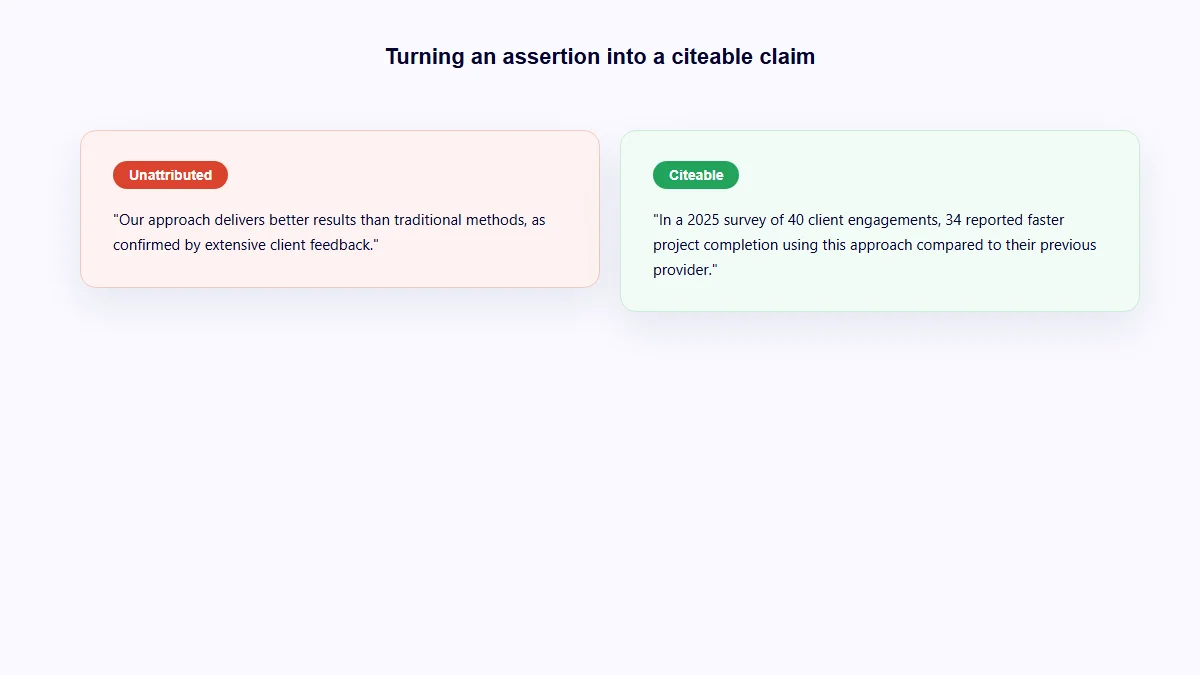
Take a sentence a page might genuinely contain: “Our approach delivers better results than traditional methods, as confirmed by extensive client feedback.” This is persuasive, vague, and unattributed. There’s no way to check “extensive client feedback,” no named source, and no specific outcome stated.
A rewritten version: “In a 2025 survey of 40 client engagements, 34 reported faster project completion using this approach compared to their previous provider.” This states a specific method (a survey), a specific scope (40 engagements, a stated year), and a specific, checkable outcome (34 of 40). It’s not a bigger claim than the original, just a genuinely verifiable one instead of a vague one.
Where to Start on an Existing Page
Rewriting every claim on a long-established page at once is rarely realistic. Two questions help order the work: which claims are most central to what the page is actually trying to establish, and which are currently the vaguest.
A page’s core claim, the thing the whole page exists to support, is worth fixing first even if it’s not the easiest edit, since it does the most work toward citeability. A page’s minor, supporting claims are worth batching together afterwards, since fixing ten small vague phrases in one pass is usually faster than treating each as its own project. Claims that are already specific but simply unattributed are typically the fastest wins of all, since the hard part (deciding what to say) is already done.
Common Mistakes That Undermine Citeability
Naming a source but not what it actually found. “According to a Google study…” followed by a claim the source doesn’t specifically state is attribution in form only. The named source needs to actually support the specific point it’s attached to, not just lend general credibility.
Stretching one citation across several unrelated claims. Citing a single source once, then attaching its authority to several other nearby claims it never actually addressed, reuses credibility the source didn’t extend that far.
Letting cited sources go stale. A statistic accurate when the page launched, from a source that’s since been updated, corrected or taken down, is worse than no statistic once it’s no longer accurate.
Over-attributing trivial claims while leaving substantial ones bare. Sourcing a minor detail carefully while leaving the page’s central, more consequential claim unattributed sends a strange signal about what actually needed verification.
How to Check Your Own Page
A quick manual test: pick any five factual claims on the page at random and ask whether each one is specific enough and attributed clearly enough that a sceptical reader could check it. If most can’t be verified without contacting the business directly, the page likely has a citeability gap regardless of how well-written it otherwise reads.
AI Rank Inspector’s GEO and Trust category checks source attribution as part of a combined audit, covering the full feature set; the full GEO audit checklist covers the broader trust picture beyond attribution alone. If it would help spot which claims on a page need attribution, AI Rank Inspector’s GEO checker runs this kind of check automatically, or add AI Rank Inspector to Chrome to try it.
Final Practical Takeaway
The gap between a persuasive page and a citeable one usually comes down to specificity and attribution, not length or polish. A claim that’s specific enough to check and attributed clearly enough to verify gives a generative system a genuine reason to treat it as reliable. A confident but vague claim, however well written, gives it nothing to work with.
FAQs
Does every claim on a page need a citation?
No. Claims about the business’s own stated policies (pricing, delivery times) don’t need external attribution, since the business itself is the source. Claims about broader facts, statistics or comparisons benefit from attribution.
Is a customer testimonial a citeable source?
It can support trust, but it’s a different kind of evidence than an attributed statistic or study. Presenting a testimonial as if it were independent research overstates what it actually demonstrates.
Does it matter how many claims on a page have zero citations, versus having a few weak ones?
A page with no citations at all reads as consistently unverified, which is at least predictable. A page with a handful of citations scattered unevenly, some claims sourced and others not, can read as more selectively persuasive rather than more trustworthy, since a sceptical reader notices what wasn’t attributed as much as what was.
Can a page be citeable but not extractable?
Yes. A well-attributed, specific claim buried in the fourth paragraph of dense prose is citeable in principle (it’s checkable and sourced) but poorly positioned for extraction. The two properties usually improve together in practice, since fixing position tends to happen alongside fixing specificity, but they’re independently checkable.
Can content be too neutral to be interesting?
Being specific and verifiable doesn’t require being dry. The rewritten examples above are still engaging; they’re just backed by something checkable instead of a vague superlative.
Should opinions and recommendations be removed entirely?
No, but they should be clearly distinguishable from factual claims. Labelling something as a recommendation or a judgement, rather than presenting it with the same confidence as a sourced fact, keeps the distinction honest.
Does this apply to product pages, or only articles?
Any page making a claim a reader might want to verify benefits from this, including product pages stating certifications, specifications or performance figures.