
Auditing a page for Answer Engine Optimisation means checking, systematically, whether it states a clear answer, covers the right questions and structures that information so a system can extract it. This checklist walks through what to check, in order, on any page: article, service page or product listing.
This assumes the page is already indexable. It’s an AEO-only checklist, not a technical SEO one; AEO vs SEO covers that distinction if you need it first. The underlying mechanics of how answer engines discover and select content are covered in how AEO works.
Before You Start
Every item below is a readiness signal, not a guarantee. A page can pass every check and still not be the specific source an answer engine selects for a specific query, for reasons outside the page itself. What this checklist confirms is that a page is a strong, well-prepared candidate. It applies to any page type; adjust which categories matter most depending on whether you’re auditing an article, a service page or a product listing.
This also assumes a starting point: the page is already crawlable and indexed. If you’re not sure that’s true, check that first. A page with no indexing problems but a buried answer is a smaller, faster fix than one that isn’t being found at all. Running this checklist on a page that isn’t indexed yet will still surface real issues, but fixing them won’t matter until the indexing problem is resolved separately.
The Checklist
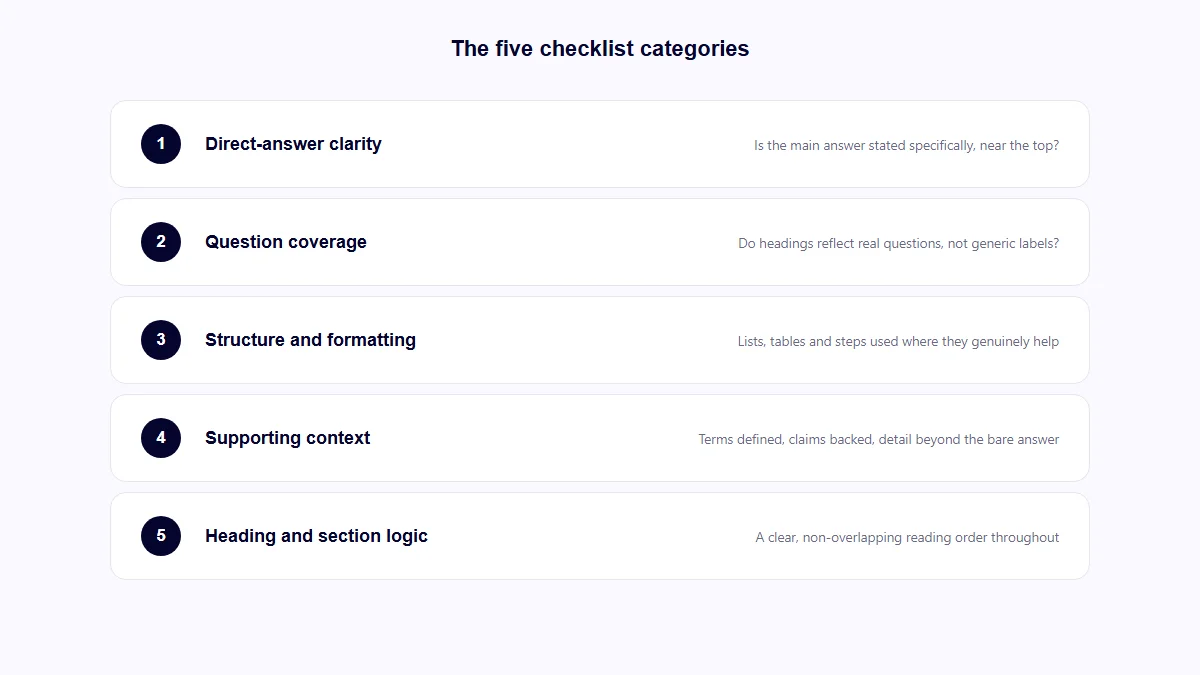
Direct-answer clarity
This is usually the single biggest factor in whether a page gets extracted at all. A system needs a specific statement to lift out, not a general sense that the topic is covered somewhere on the page. How to structure content for direct answers covers the actual writing technique in depth.
-
Does the page’s main question have a specific answer stated within the first few sentences of the relevant section, not buried mid-paragraph?
-
Is that answer self-contained: could it be read on its own and still make sense?
-
Is it stated as a specific claim (“shipping takes 3–5 days”) rather than a vague generalisation (“shipping times vary”)?
-
Does the surrounding paragraph support the answer with detail, rather than delaying it?
Question coverage
This is about whether the page addresses the actual questions someone in this situation would have, rather than whatever topics were easiest to write about.
-
Do the page’s headings reflect real questions a reader is likely to ask, not generic labels like “Overview” or “More Information”?
-
Are the most important questions addressed before minor ones?
-
Does the page avoid repeating the same question under two different headings?
Structure and formatting
Structure doesn’t create an answer that isn’t there, but the right format makes an existing answer far easier for a system, and a reader, to isolate.
-
Are processes or sequences presented as numbered steps rather than a single paragraph?
-
Are comparisons presented in a table where there’s a genuine comparison to make?
-
Are FAQs, if present, answering questions not already covered in the main content?
-
Is there a mix of formats (lists, short paragraphs, tables) rather than one long block of prose?
Supporting context
A technically correct answer that lacks any surrounding context can still read as thin or unreliable, both to a human reader and to a system trying to judge whether the page is a trustworthy source.
-
Are unfamiliar terms defined before they’re used repeatedly?
-
Does the page include enough context (examples, specifics) that the answer isn’t just technically present but actually useful?
-
Are claims that need it supported by a source or clear reasoning, rather than stated as bare assertions?
Heading and section logic
Heading structure is what lets a system (or a reader skimming the page) work out which part of the page is relevant to their specific question without reading the whole thing.
-
Does the heading hierarchy show a clear reading order (H2s for main sections, H3s genuinely nested under them)?
-
Does each section stay on-topic for its heading, without drifting into the next section’s subject?
-
Could a reader (or a system) tell where one section ends and the next begins, just from the structure?
FAQ and schema readiness
FAQs and structured data support the categories above rather than standing apart from them, but they’re worth checking on their own terms since they’re easy to add badly.
- If the page has an FAQ section, does each question genuinely differ from what the main content already covers, rather than restating it?
- Are FAQ questions phrased the way a reader would actually ask them, not as marketing headlines?
- If FAQPage or similar structured data is present, does it match the FAQs actually visible on the page, word for word?
- Is any schema present genuinely descriptive of the page’s content, rather than added because “more schema” was assumed to help?
How to Score Each Check
A simple three-way result works for most of these: Passed (the page clearly meets the check), Review (present but borderline: for example, an answer that’s technically there but three sentences in rather than one), or Failed (the element is missing entirely). This isn’t a formal standard, just a practical way to triage results: fix every Failed item first, then work through Review items, since Passed items don’t need attention.
How to Prioritise What You Find
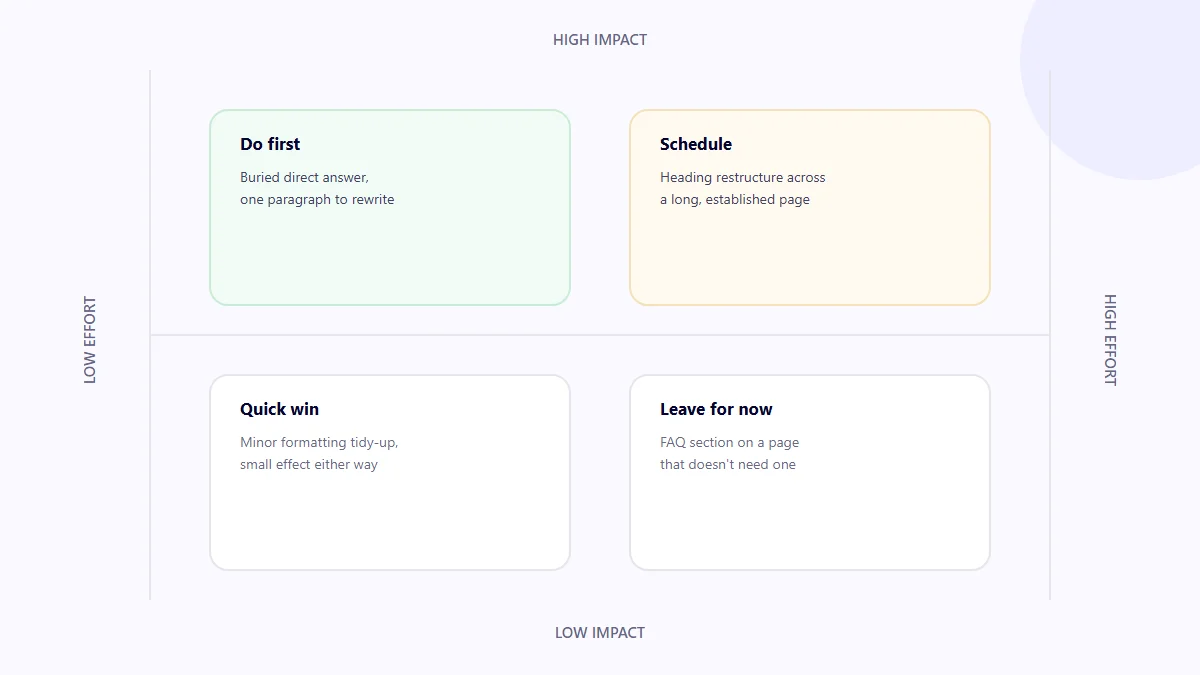
On a page with several Failed items, not all of them are worth fixing in the same order. Two questions help decide what to do first: how much does this item matter for this specific page, and how much effort does fixing it actually take?
A failed direct-answer-clarity check on a page’s main question is usually both high-impact and low-effort (often a single rewritten sentence), which makes it the obvious first fix. A failed heading-and-section-logic check on a long, established page might be genuinely high-impact but also high-effort, since it could mean restructuring several sections rather than editing one paragraph; that’s worth scheduling deliberately rather than doing reactively. A failed FAQ-related check on a page that doesn’t really need an FAQ section at all is low-impact regardless of effort, and reasonably left alone.
This isn’t a formula, since “impact” depends on how central the failed element is to that specific page’s main question, which only a human reviewing the page can judge. But weighing effort against impact, rather than working through failed items in the order the checklist happens to list them, tends to produce a more useful fix sequence.
Common Mistakes When Running This Checklist
Treating every Review item as urgent as a Failed one. A Review result means present but borderline, not absent. Working through every Failed item first, across the whole page, before returning to Review items is usually a better use of limited time.
Checking format without checking whether the underlying claim is true. A specific, clearly stated, well-formatted answer that’s factually wrong has passed every structural check on this list while still being a worse page than before. This checklist audits extractability, not accuracy; both matter, but they’re separate checks.
Running the checklist once and treating the result as permanent. A page that passes today can drift as content gets edited, a heading gets reworded, or a new paragraph gets inserted above the original answer. Re-running the checklist after any substantive edit catches regressions the original review wouldn’t.
Applying all five categories with equal weight to every page type. A short product listing rarely needs the same depth of question-coverage scrutiny as a long-form guide. Adjust which categories get the most attention based on what the page is actually for, as noted at the start of this checklist.
Worked Example
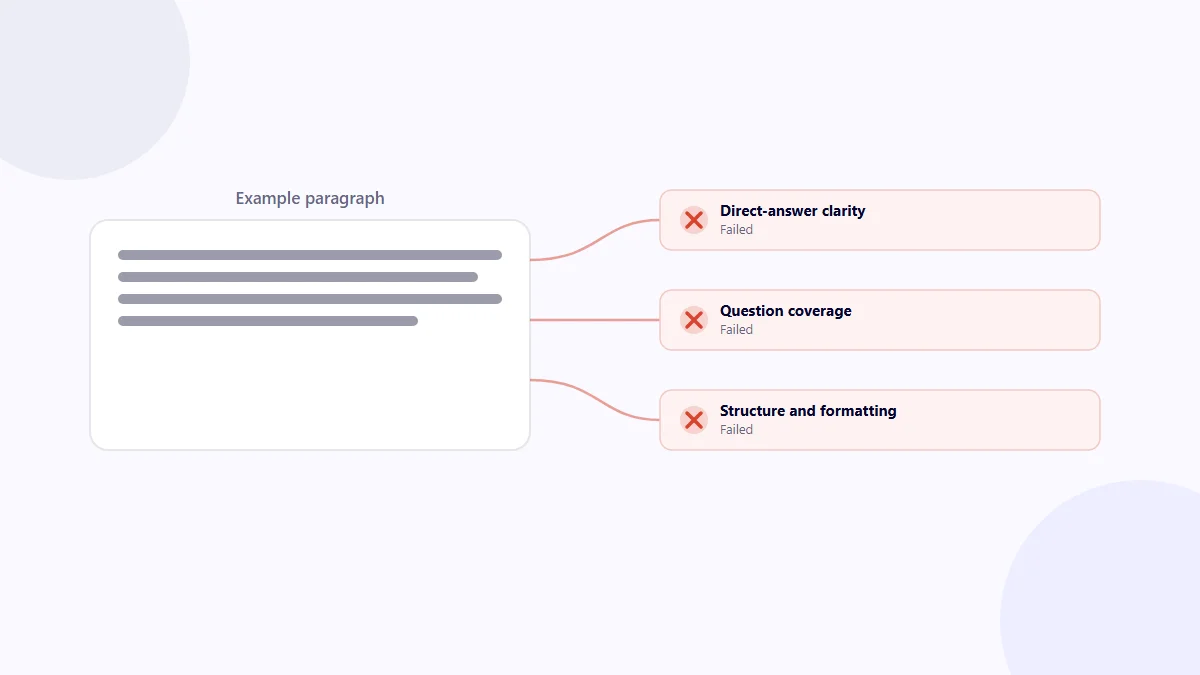
Take this paragraph: “There are many things to consider when choosing a shipping option, including cost, speed and reliability, and we try to offer choices that work for most customers in most situations.”
Run it against a few checklist items:
-
Direct-answer clarity: Failed. No specific answer is stated anywhere in the sentence. It describes the topic without answering “what are the shipping options” or “how fast is shipping.”
-
Question coverage: Failed. The heading this sits under (say, “Shipping”) doesn’t reflect a specific question, and neither does the content.
-
Structure and formatting: Failed. Multiple options are described in prose rather than as a list, making them hard to scan or extract individually.
A rewritten version, “Standard shipping takes 3–5 business days and costs £4.99. Express shipping takes 1–2 business days and costs £9.99,” passes all three: specific answers, a real question addressed, and a structure (even without literal bullets) that separates two distinct options clearly.
A second example shows a different failure pattern. Take a page that states, under the heading “Our Process”: “We assess your requirements, prepare a plan, and deliver the work according to an agreed schedule, keeping you informed throughout.” Run this against Heading and section logic and Structure and formatting: the heading itself is fine (“Our Process” is a reasonable label), but the three steps described are compressed into one sentence rather than separated. This page would score Review rather than Failed on direct-answer clarity (a process is described, just not usably), but Failed on structure and formatting, since a numbered three-step list would make the same information considerably easier to extract and to scan. This distinction matters: not every weak section fails for the same reason, and the fix is different depending on which check actually flags it.
Common Failures
Answers buried under scene-setting. A page states its answer eventually, but only after several sentences of context the reader has to read through first.
Headings that don’t match real questions. Sections labelled “Details” or “More Info” instead of the actual question being answered.
Lists that aren’t really lists. A process described as one dense paragraph, with steps implied by commas rather than separated.
FAQs that repeat the main content. A “Frequently Asked Questions” section that restates what the body already said, rather than covering genuinely separate questions.
One answer trying to cover several distinct questions. A single paragraph that half-answers three related questions at once, rather than giving each its own heading and a specific answer underneath.
How Long Should This Take?
For a single page, working through all five categories by hand typically takes fifteen to thirty minutes, depending on the page’s length and how many issues turn up. Most of that time goes into the Direct-Answer Clarity and Question Coverage categories, since Structure and Heading Logic issues are usually easier to spot quickly. Auditing a small site of ten or twenty pages by hand this way is realistic as a one-off exercise, but becomes impractical as a recurring process. That’s the gap the automated option below is meant to close.
Doing This at Scale
AI Rank Inspector runs the same kind of check automatically, auditing observable AEO signals across a page and organising results by what’s worth fixing first, covering the full feature set. It doesn’t guarantee that fixing every item will result in selection or citation by a specific answer engine. It checks what’s observable on the page, consistent with the readiness-versus-visibility distinction this checklist is built on.
Run this checklist automatically with AI Rank Inspector’s AEO checker, or add AI Rank Inspector to Chrome to get started.
Final Practical Takeaway
Most AEO problems come down to one of two things: the answer isn’t stated clearly, or it’s stated in a form nothing can extract cleanly. Working through this checklist in order (answer clarity first, then question coverage, then structure) catches both, on any page, without needing to guess at what a specific platform might reward.
FAQs
Does passing every item on this checklist guarantee my page gets cited by an AI system?
No. Every item is a readiness signal. Selection by a specific answer engine depends on factors outside any one page, including competing pages and exact query phrasing.
Do I need to check every item for every page?
Focus on the categories most relevant to the page type. A product listing may need less “question coverage” work than an informational article, for example.
How is this different from a general content-quality checklist?
This checklist specifically targets extractability (whether a system could isolate a clean answer) rather than general writing quality, though the two overlap.
Can I use this checklist on a page that isn’t ranking yet?
Yes, but check indexability first. A page that isn’t indexed has no AEO to speak of, regardless of how well it scores here.
Should I fix Failed items before or after Review items?
Failed items first, across the whole page, before circling back to Review items. A missing element is a bigger gap than a borderline one, regardless of which category it’s in.
Does adding more FAQs always improve a page’s score?
No. FAQs that repeat the main content or answer questions nobody would actually ask can fail the question-coverage check just as easily as having no FAQs at all. Quality and genuine distinctness matter more than count.
How do I know if a page needs the full checklist or just a quick check?
If the page is short, transactional, or has a narrow purpose (a simple pricing page, for instance), a quick check of direct-answer clarity alone often catches the highest-impact issue. The full five-category pass is more useful on longer, informational content where more can genuinely go wrong.